Hon Hai Precision Industry, the world's largest contract electronics manufacturer and the company most people know as Foxconn, reported April revenue growth of approximately 30 percent year over year as its AI server business continues to scale, making this the clearest current signal that hyperscaler and cloud data center capital expenditure is translating into durable manufacturing volume rather than the one-quarter procurement surge followed by digestion that skeptics have been predicting since the AI infrastructure buildout began accelerating in 2023.
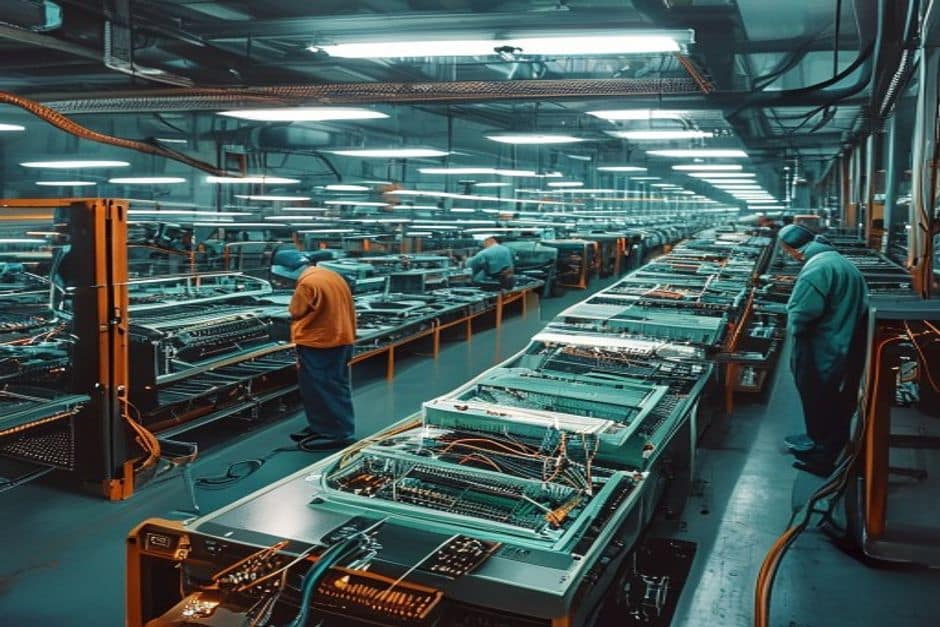
The shift in Hon Hai's revenue composition is the detail that makes this more than a topline growth story. The company that built its reputation and scale assembling iPhones for Apple is now generating a growing share of its revenue from AI server systems: complete rack-scale computing infrastructure built around Nvidia's GB200 NVL72 and NVL36 configurations, liquid cooling systems, networking hardware, and the mechanical and power distribution components that turn GPUs into deployable data center capacity. The AI server category carries higher average selling prices than consumer electronics assembly because the components are more expensive, the integration work is more technically demanding, and the customers, primarily hyperscalers, model labs, and cloud providers, are less price-sensitive per unit than consumer device buyers because the compute infrastructure directly determines their revenue-generating capacity. Hon Hai's gross margin on AI server work is reported to be higher than on consumer electronics assembly, which means the revenue mix shift toward AI infrastructure is improving profitability per dollar of revenue even before the volume benefits compound.
The 30 percent growth rate lands in a context where several of Hon Hai's largest customers have published capital expenditure guidance that makes the manufacturing demand visible. Microsoft committed $80 billion in data center investment for fiscal 2026. Amazon Web Services is spending at a rate that its CFO has described as the highest capex period in the company's history. Google's Alphabet committed $75 billion in infrastructure capex for 2026. Meta's capital expenditure guidance is $64 to $72 billion. Those four companies alone represent over $290 billion in planned 2026 infrastructure spending, a meaningful fraction of which flows through contract manufacturers like Hon Hai for server assembly, rack integration, and systems testing before the hardware ships to data center facilities. Hon Hai is not capturing all of that spending, but it is capturing enough to move 30 percent revenue growth at a company whose scale makes 30 percent growth an operationally significant achievement rather than a percentage game on a small base. The company's server and cloud computing segment, which includes AI server systems, has become large enough that its growth rate is materially influencing the consolidated revenue number.
The digestion risk that skeptics raise is real and worth engaging with honestly rather than dismissing. The history of enterprise technology hardware cycles includes periods of demand surge followed by inventory digestion where procurement slows as customers absorb the hardware they have already ordered. The telecom equipment cycle of the late 1990s and the server refresh cycle following the post-pandemic cloud spend acceleration in 2021 through 2022 both exhibited this pattern: accelerating procurement drove supplier revenue growth, then demand stalled as the installed base caught up with deployment capacity and customers paused to integrate what they had bought. The AI infrastructure cycle could follow a similar pattern if hyperscalers' capacity additions outpace their ability to generate revenue from that capacity through AI services, creating a period where further hardware procurement slows while utilisation catches up. The counter-argument, which the current procurement data supports more strongly than the digestion case, is that AI model capability is improving fast enough that each new hardware generation enables revenue-generating applications that the prior generation could not support, which creates continuous pull for next-generation hardware without a digestion pause because the new hardware is not simply more of the same compute but qualitatively different infrastructure enabling new product categories.
Hon Hai's positioning as a supplier with increasing leverage in the AI infrastructure supply chain is the competitive dynamic worth examining for its implications beyond the company's own P&L. Contract manufacturers in commodity electronics assembly have historically operated at thin margins with limited pricing power because their customers, device brands, can switch assemblers relatively easily and use competitive bidding to keep margins compressed. AI server assembly is structurally different in two ways that give Hon Hai more leverage. The first is technical complexity: assembling an NVL72 rack that requires liquid cooling manifolds, high-bandwidth networking with precise cable management, power distribution at 100 kilowatts or more per rack, and system-level testing that validates the entire compute fabric is operating correctly is qualitatively more difficult than assembling a consumer device, and the pool of manufacturers that can do it reliably at scale is smaller. The second is supply chain integration: Hon Hai has built relationships with the component suppliers, cooling system vendors, and networking hardware manufacturers that go into AI servers, and those relationships create procurement advantages and lead time visibility that customers value when their own infrastructure roadmaps depend on reliable delivery schedules. A hyperscaler that misses a data center opening because its rack supplier could not deliver on time faces revenue delay in its AI services business, which makes delivery reliability worth paying for rather than optimising purely on unit price.
The manufacturing economy of AI infrastructure showing up in Hon Hai's revenue before the software economics fully materialise is the temporal observation that is most useful for founders and investors trying to understand where the AI value chain currently sits. Physical infrastructure procurement, assembly, and deployment have multi-quarter lead times: a hyperscaler that announces capex in January will be placing component orders in February, receiving assembled systems in April through June, deploying hardware over the following six months, and generating incremental AI service revenue from that hardware in the back half of the year and into the following year. Hon Hai's 30 percent growth in April 2026 is reflecting procurement decisions made in the fourth quarter of 2025 and the first quarter of 2026, which in turn reflect hyperscaler demand forecasts for AI services in 2027 and beyond. The manufacturing revenue is a leading indicator of the compute capacity that will support AI service revenue in future periods, not a coincident indicator of current AI application economics. Founders building AI applications and services should read Hon Hai's growth as evidence that the infrastructure investment underpinning their market is real, durable, and being executed on schedule, rather than as confirmation that AI service economics are already generating the returns that justify the infrastructure spend.
Also read: Alphabet Just Returned to European Debt Markets With Another AI Megabond and the Cost of Capital Gap It Is Creating Matters More Than the Headline Size • A Single RTX 5000 PRO Is Running Qwen3 27B at 200k Context and 80 Tokens Per Second and That Number Should Change How Founders Think About Local Inference Economics • Apple Is Exploring Intel and Samsung as US Chip Foundries for Its Main Processors and the Edge-AI Implications Go Far Beyond Reshoring Politics