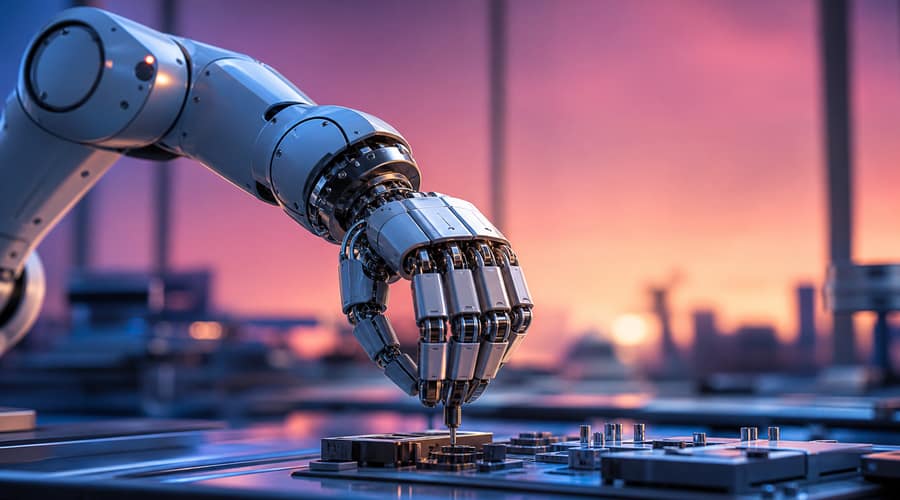
Genesis AI's reported $500 million funding talks show where robotics money is moving now: toward the software that might make machines useful, not only the machines themselves.
Genesis AI is no longer just another robotics startup with a clever demo and a large seed round. If its reported talks for roughly $500 million close anywhere near that figure, the company will have moved from a $105 million launch in July 2025 to one of the most closely watched physical AI bets in the market. That's fast. You should read it as a signal about venture capital's current obsession: the robot brain.
The timing is not subtle. The Financial Times reported this week that Travis Kalanick's Atoms secured $1.7 billion in debt and equity financing from backers including Andreessen Horowitz, Uber, Goldman Sachs and JPMorgan. TechCrunch reported in March that Physical Intelligence was in talks to raise about $1 billion at a valuation above $11 billion. According to data cited from Dealroom, robotics and physical AI startups raised about $55.8 billion by mid-2026, already past prior full-year records under that broad definition.
That kind of money changes the argument. A few years ago, robotics was still treated as the hard, slow, expensive cousin of software. Now investors are paying AI-style prices for companies that promise to make machines learn across factories, labs, warehouses and homes. Frankly, some of that optimism is running ahead of the proof. But the direction of the money is clear enough.
What Genesis is building matters here. TechCrunch reported that Genesis was founded by Zhou Xian, a Carnegie Mellon robotics PhD, and Théophile Gervet, a former Mistral research scientist. The company came out of stealth in July 2025 with a $105 million seed round co-led by Eclipse and Khosla Ventures, with Bpifrance, HSG, Eric Schmidt, Xavier Niel, Daniela Rus and Vladlen Koltun also among the backers. Bloomberg's report on that seed round called the US and China-linked syndicate unusual for a sector already split by geopolitics.
Genesis doesn't want to be known only for building a robot body. Its bigger claim is that it can build a foundation model for robots, the software layer that lets different machines handle physical work without being hand-programmed for every task. In May 2026, the company unveiled GENE-26.5, a model shown controlling dexterous robotic hands through tasks including cooking, Rubik's cube solving, lab work, wire harnessing and piano playing, according to Genesis's own technical blog and press materials.
There is a reason investors like that story. Data is the bottleneck. Text models could feed on the internet. Robots need information about contact, force, grip, slippage, timing and the mess of real rooms. Genesis says its answer is a proprietary simulation engine, plus human-like robotic hands and data collection tools that help it generate training examples without relying only on slow real-world teleoperation.
That is the real bet.
Genesis has decided software alone is not enough
In June, Genesis showed Eno, its first general-purpose robot. Reuters reported that the French startup unveiled a machine with a wheeled base rather than legs, a foldable tower and hands that the company says match the form of a human hand. Genesis says targeted customer deployments are planned by the end of 2026, starting with manufacturing, logistics companies and laboratories, followed by hotels and hospitals.
Eno is not a side project. It tells you Genesis has learned the same lesson as many serious robotics teams: a clean software story becomes much harder once a machine has to work around boxes, benches, vials, tools and people. The body affects the data. The data affects the model. The model affects whether customers trust the robot with a real workflow rather than a staged video.
So Genesis has gone full stack. It is still selling the idea of a general robot brain, but it is also building the hardware that can prove the model works. That makes the company less pure as a software bet, but more credible as a deployment bet. You can't debug dexterity from a pitch deck.
The China question will follow the money
The investor list brings another issue into view. HSG, formerly known as Sequoia China, participated in Genesis's seed round alongside US and European backers. That was already noteworthy in 2025. It is more sensitive now, as Washington keeps tightening scrutiny around advanced AI, robotics and China-linked capital.
A prospective $500 million raise would pull Genesis into a different category of attention. The company has headquarters and operations across France and California, according to its public materials and earlier reporting, and it is working on technology that sits close to industrial automation and robotic manipulation - the exact territory regulators are watching. You don't need to overstate the risk to see the obvious diligence question: who owns what, who gets access to what, and where the technology can legally go.
That probably won't stop investors if they believe Genesis can become a default intelligence layer for robots. It may affect the cap table, or the way partnerships are structured. The boring documents will matter.
For now, the company has done enough to make the funding talks believable. Genesis has a large seed round behind it, named technical founders, working demos, a first robot and a market suddenly willing to fund physical AI like infrastructure. What it doesn't yet have is proof that GENE can generalize across partner hardware at commercial scale. Until that happens, the Android-of-robotics comparison is only a hope with a very expensive term sheet attached.
Also read: Alphabet's century bond just lost 10% of its face value and bond markets are pricing in the AI debt reckoning • Bots now generate more web traffic than humans and startups are about to feel it • SAP's cloud backlog hits €22.9 billion as the ECC migration countdown enters its final stretch