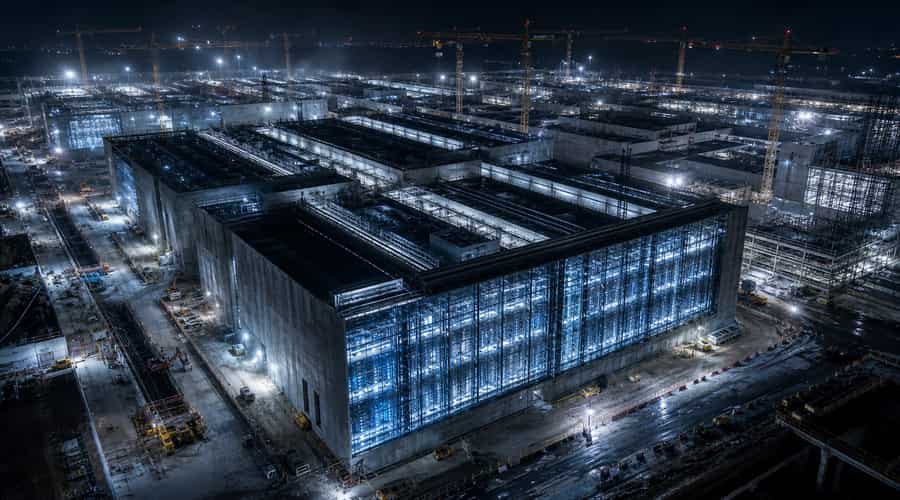
New York's one-year pause on new hyperscale data centers is current, real, and more important than a local permitting fight. It gives other states a tested way to make AI infrastructure pay for the strain it puts on power, water, and communities.
New York did not merely slow a project queue. It gave every governor watching rising power bills a policy model they can copy.
Governor Kathy Hochul signed Executive Order 62 on July 14, 2026, creating what her office called the nation's first statewide moratorium on new hyperscale data centers. The order applies to new or expanded facilities with at least 50 megawatts of electricity demand, and it tells the state Department of Environmental Conservation to hold back discretionary permits that were pending or incomplete when the order landed. Existing completed permits are not swept in. That detail matters.
You can see why she moved now. NYSERDA's residential electricity data shows New York's statewide average price hit 29.5 cents per kilowatt-hour in April 2026, up from 17.5 cents in April 2019. That is a 68.6 percent jump. The timing is obvious. When your monthly utility bill is already painful, a new class of power-hungry buildings becomes an easy political target.
The grid concern is not invented, but the numbers need to be stated honestly. NYISO's 2025 Power Trends report said demand could rise by an additional 1,600 megawatts to nearly 4,000 megawatts by 2030, driven by new large loads and building electrification. It did not say New York would be short 1,600 megawatts because of AI data centers alone. That distinction is the difference between a serious argument and a scare line.
Hochul's order is narrower than the word ban suggests. It directs the Department of Public Service, working through New York's environmental review process, to prepare a Generic Environmental Impact Statement on data center construction and operations, including energy demand, water use, water quality, and air quality. Empire State Development has 60 days to issue a Community Investment Framework, meant to guide host communities as they negotiate benefits from developers. The governor's announcement named local infrastructure, child care investments, workforce standards, and direct community support as examples.
This is not a small lever.
The order also tells regulators to look at grid cost allocation, including a possible New York Grid Acceleration Fund. In plain English, New York wants data center operators to pay upfront for the grid work they force into being. If you are a resident paying 29.5 cents per kilowatt-hour, that is not an abstract regulatory fight. It is the whole point.
The backlash is already national
Don't treat this as a New York oddity. MultiState reported in February that more than 300 state data center bills had been filed across more than 30 states in just the first six weeks of 2026. The National Conference of State Legislatures said in its July 1 update that lawmakers in 15 states were considering bans or moratoriums. Columbia's Climate Law Blog, citing Data Center Tracker, noted that at least 100 local data center moratoria had been adopted across the country.
The politics travel fast.
Maine lawmakers attempted a moratorium this spring before Governor Janet Mills vetoed it, as Commercial Observer reported. In Texas, Hill County approved a one-year pause in May, then rescinded it on June 4 after a developer sued for $100 million, according to the Texas Tribune. New York's move is stronger because it came from the governor's office and sits inside a statewide environmental review process.
There is federal pressure too. Senator Bernie Sanders and Representative Alexandria Ocasio-Cortez announced the AI Data Center Moratorium Act on March 25, and Ocasio-Cortez introduced the House version on June 24. Their bill targets AI data centers above 20 megawatts and would pause construction until Congress passes broader safeguards. You do not have to agree with that approach to see the direction of travel. The fight has moved from zoning boards to statehouses and Congress.
Investors should watch permitting, not press releases
The market noticed too little. Microsoft fell 1.55 percent on July 14, Amazon was nearly flat, and Alphabet gained. A one-day stock move tells you almost nothing here. A pause changes the math.
Commercial Observer reported on July 23 that engineering and supply chain intelligence platform Accuris projects the top five hyperscalers, Amazon, Microsoft, Google, Meta and Oracle, will spend more than $600 billion on infrastructure in 2026, up 36 percent from 2025. That money needs power, permits, interconnection studies, and local political tolerance. New York has just made one of those inputs harder.
Here's the thing: a one-year moratorium is not really one year if the review produces new standards, new community payments, and new grid charges. Developers who underwrote a New York site using the old permitting assumptions are now looking at different economics. Lenders will notice. Equity funds will notice. Local officials in other states will notice too, especially if their constituents are complaining about noise, water withdrawals, and power bills.
Commercial Observer also cited Cleanview data showing New York had nine operating data centers totaling 205 megawatts, with 25 more planned for 9,797 megawatts. Virginia and Texas are much larger markets. But New York's planned pipeline is not trivial. If projects move elsewhere, the lost capital goes with them - Albany's review schedule is not their concern.
That is the real trade. New York is risking some AI infrastructure investment to get control over who pays for the grid, who gets local benefits, and which communities host the buildings. Frankly, that is a defensible position if the state follows through with clear rules instead of turning a pause into open-ended uncertainty. Developers can price rules. They struggle to price confusion.
For startups and investors, the message is simple enough: AI infrastructure is no longer just a capex story. Power bills, water rights, local politics - the assumption of frictionless expansion through 2030 is gone.
Also read: Genesis AI is in talks to raise $500 million as VCs bet on robotics software over hardware • Progress Software pays $400 million for Domo's operating business as Josh James eyes his next act • Bots now generate more web traffic than humans and startups are about to feel it