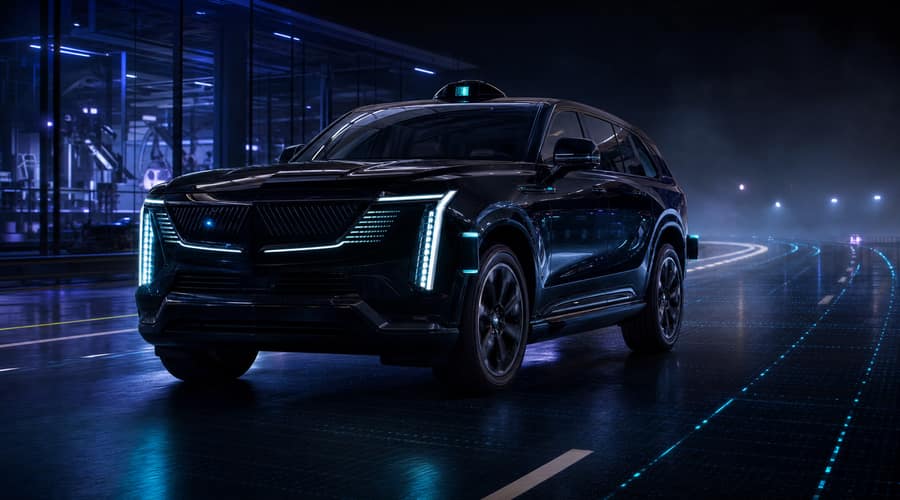
GM has stopped trying to win the robotaxi war on city streets. Its new autonomy bet is more ordinary, and possibly more useful: sell eyes-off driving to people who already buy Cadillacs.
General Motors is trying to turn the Cruise collapse into a product you can actually buy. According to Business Insider, GM's latest autonomous-vehicle push is now led by Rashed Haq, its vice president of autonomous vehicles, and the first target is eyes-off highway driving in the Cadillac Escalade IQ by 2028.
That is a very different story from the one GM was selling a few years ago. Cruise was supposed to build fleets of driverless cars, charge for rides, and give GM a mobility business beyond selling vehicles. Instead, GM stopped funding Cruise's robotaxi work in December 2024 after years of losses, regulatory damage, and the ugly aftermath of a 2023 San Francisco crash. The Associated Press reported at the time that Cruise had piled up more than $10 billion in operating losses while producing less than $500 million in revenue, based on GM shareholder reports filed with the SEC.
You don't need to be sentimental about that pivot. The robotaxi dream consumed cash, patience, and political goodwill. GM's new plan is colder and more practical: take the engineers, software work, sensor knowledge, and hard lessons from Cruise, then attach them to high-margin consumer vehicles where the customer is already paying Escalade money.
Haq told Business Insider that GM is hiring engineers from Tesla, Waymo and Zoox, and that the company has nearly doubled last year's external hires for its autonomy team. The named hires matter. GM brought in Haq in 2025, added Ronalee Mann, a Cruise alum and former Aptiv executive, and hired Sterling Anderson, the former Tesla Autopilot leader, as chief product officer. Business Insider also named Sean Harris from Wayve, Jean-Yves Bouguet from Zoox, and ZJ Jia, who had worked at Uber, among recent additions.
That kind of hiring doesn't guarantee success. It does show GM knows this is no longer a slide-deck business. Autonomous driving is an engineering grind, and the companies with scars have more useful people than the companies with clean theories.
The first version of GM's eyes-off system is supposed to be limited to highways. That's the right place to start. Highways are mapped, more predictable, and more useful for the driver who spends an hour on I-75 or the 405 than another demo video of a car navigating a tricky left turn in San Francisco. If you're asking a customer to pay for autonomy in a private vehicle, commute time is where the value is easiest to understand.
GM also has one real asset Tesla doesn't have in the same form: Super Cruise data. Business Insider reported that GM says Super Cruise has now logged more than 1 billion hands-free miles. Axios reported in October 2025 that the figure was 700 million miles when GM outlined its eyes-off plan at its GM Forward event in New York. That growth is not a stale talking point. It is the base GM wants to build on.
Lidar is GM's bet against Tesla
The technical split is plain. Tesla has spent years pushing a camera-heavy approach and still requires driver supervision for Full Self-Driving. Waymo uses a richer sensor stack, including lidar, but operates robotaxis in defined service areas. GM is trying to occupy the space between them: more sensing than Tesla, more private-vehicle scale than Waymo.
Haq told Business Insider that lidar gives GM an advantage for eyes-off driving. Car and Driver reported after GM's October 2025 announcement that the next Super Cruise system will use cameras, radar and lidar, and that a prototype Escalade IQL showed a roof-mounted sensor module plus turquoise lighting to signal eyes-off operation. That roof hardware may offend people who want autonomy to look invisible. Frankly, that is the wrong priority. If the system is going to tell you that you can look away from the road, the burden is on GM to prove redundancy, not beauty.
The harder question is cost. Haq framed the unsolved problem to Business Insider as getting self-driving technology into millions of cars with roughly $10,000 worth of hardware. That number is the whole fight. Lidar can improve perception, but it also threatens the clean mass-market math that Tesla has chased for years. GM can hide more of that cost in an Escalade IQ than it can in a Chevrolet Equinox. Starting with Cadillac is not just branding. It's financial shelter.
Waymo remains the obvious counterexample. It has a commercial robotaxi business, not merely a promise attached to a future model year. But Waymo's strength is also its limit: a fleet business has to buy, maintain, clean, charge, insure, dispatch and regulate the cars. GM's path lets the customer buy the hardware and park it in the driveway. If the system works, GM gets to sell the vehicle, the trim, the software and possibly the subscription.
That is why Cruise's failure may still matter. The company didn't prove GM could run a robotaxi network. It may have proved that GM shouldn't try. AP reported GM expected the Cruise restructuring to reduce spending by more than $1 billion annually, and that sentence explains the new strategy better than any autonomy manifesto. Spend less on fleets. Put the technology into cars GM already knows how to build.
The 2028 deadline is still aggressive. Business Insider reported that GM ran its new autonomy stack in simulation in January, on a closed course in February, and on public roads in March. That is progress, but it is not a finished product. Haq himself pointed to the work still ahead: safety, edge cases, full testing, and a customer experience smooth enough that people trust it after the novelty wears off.
GM's advantage is not that it has cracked autonomy. It hasn't. The useful thing is that it has finally picked a battlefield that fits the company. Cruise tried to make GM into a robotaxi operator. The Escalade IQ plan asks GM to be what it already is: a manufacturer that can turn difficult hardware into expensive consumer vehicles. For your driveway, that is a much more believable bet.
Also read: AI SEO Is How Startups Get Found on Google and ChatGPT • The BIS says the AI boom has become a financial stability risk • How to Make Money With AI: Nine Models That Don't Need Code