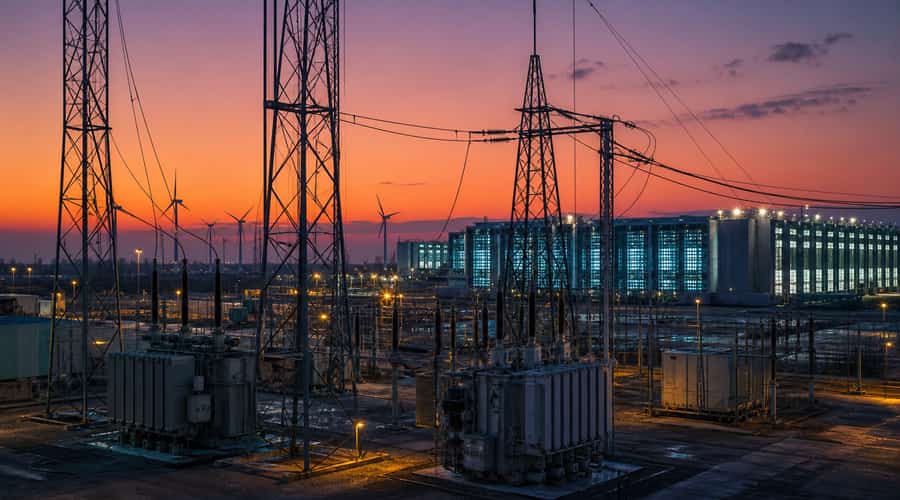
Goldman Sachs is telling investors that America's AI buildout is turning into a European industrial trade, and the money is showing up in grid equipment, factory automation and chipmaking tools.
The useful thing about Goldman's latest AI call is that it doesn't ask you to pretend Europe suddenly owns the software layer. It doesn't. The chips are still led by US designers, Taiwan remains central to manufacturing, and the biggest model labs are still American. Goldman's point is more practical: the AI boom has to be built somewhere, wired somewhere and powered somewhere, and European suppliers are sitting in parts of that chain.
Goldman's strategists have turned more bullish on European equities as hyperscaler spending keeps being revised higher. According to Business Insider's June reporting on a Goldman note, the bank now expects Amazon, Google, Meta, Microsoft and Oracle to spend about $757 billion on capital expenditure in 2026, up 84% from last year, with the figure rising to $920 billion in 2027. An earlier Goldman estimate cited by Business Insider put 2026 hyperscaler capex at $755 billion, an 83% increase. The direction is the story. Every time investors think the number has peaked, another earnings season pushes it up.
Investing.com's reporting on Goldman's European equity note said the bank raised its 12-month STOXX 600 target to 660, with three-month and six-month targets at 640 and 645. That implies only modest index upside from a recent level near 626, but the stock call underneath it is sharper than the index move. Goldman also lifted its 2026 earnings-per-share growth forecast for the STOXX 600 to 10% from 5% in January, helped by lower rates, stronger earnings and the industrial spillover from AI infrastructure spending.
Here's the trade in plain terms. If Microsoft or Amazon wants another AI campus, Nvidia chips are only one line in the bill. The site also needs turbines, transformers, switchgear, substations, cooling and automation before a single rack does useful work. That is where Siemens Energy, Schneider Electric and ABB enter the picture. You don't need to believe Europe will produce the next OpenAI to see why those companies matter.
Siemens Energy is the bluntest example. The German group sells gas turbines and grid equipment at a moment when power supply has become one of the hardest limits on data center growth. Goldman research on data center electricity demand previously projected a 165% increase in power use by 2030, and ITPro reported in December that Goldman later raised that forecast to 175% from 2023 levels. When the constraint moves from chips to electricity, a turbine maker stops looking like an old-economy footnote.
Schneider Electric, based near Paris, has a different place in the same buildout. Its medium and low-voltage equipment, power distribution systems and building controls sit inside the data center rather than at the edge of the grid. ABB, headquartered in Zurich, competes across electrification and automation. These are not the companies that dominate AI headlines. Frankly, that is why the call is interesting. The visible winner is Nvidia. The less obvious winners are the suppliers that make the building usable.
ASML is the name investors already know. The Dutch company does not sell transformers or data center cooling systems, but its extreme ultraviolet lithography machines remain essential for the most advanced chips. Business Insider reported last month that Goldman expects AI infrastructure spending to keep lifting earnings for companies tied to semiconductors, production equipment, hardware and electronic components. ASML fits that part of the argument, although it is not the undiscovered piece of the trade.
The split between chips and the rest is the number to keep in your head. Goldman has estimated that roughly a quarter of AI infrastructure spending goes to chips, while the rest goes into data centers, cooling, networking and power infrastructure around them. That is why an electrical equipment supplier can be tied to the same boom as a US chip designer without doing anything that looks like model training.
There is a real risk here, and you shouldn't wave it away because the capex charts look enormous. Goldman global equity research chief Jim Covello said on the bank's Exchanges podcast, according to Business Insider, that the AI industry's profit problem is getting bigger because companies are spending faster than they are proving returns. If cloud providers slow orders, the pain will show up quickly in equipment suppliers. A canceled transformer order arrives long before a cloud revenue line visibly cracks.
A separate Goldman report shared with Axios last week put the broader physical-economy buildout at about $7.6 trillion globally from 2026 through 2031, covering compute, data centers and energy capacity. That is the larger frame for the European call. Investors have spent two years staring at chips and chatbots. Goldman is saying the next set of numbers may come from factories, grids and suppliers with backlogs rather than demos.
Watch the capex revisions. As long as the 2026 and 2027 spending forecasts keep moving higher, Siemens Energy, Schneider Electric, ABB and ASML have a tailwind that doesn't require Europe to win the AI model race. It only requires the American AI race to keep demanding more concrete, copper and power.
Also read: Senate Republicans race to bring the Clarity Act to a July floor vote • Abu Dhabi's MGX Closes Nearly $50 Billion to Bankroll the AI Buildout • Lime prices its Nasdaq IPO at $25 per share as Uber bets the scooter category still has a future