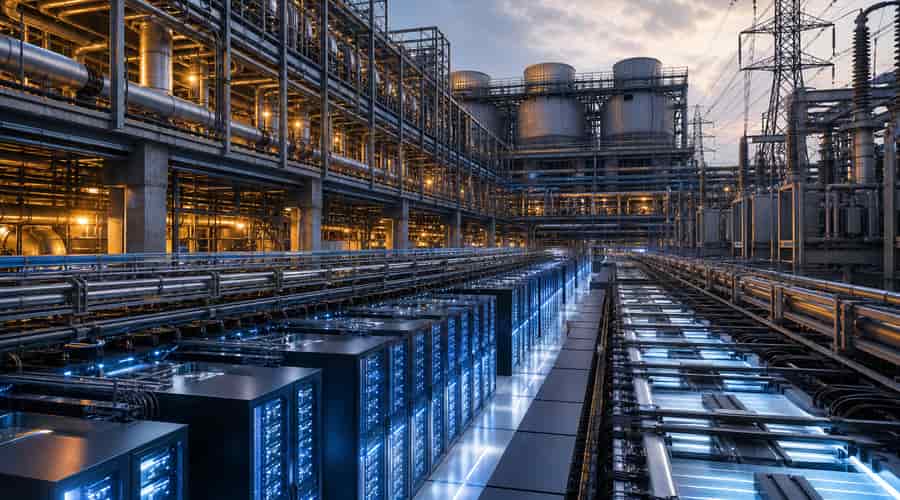
Goldman Sachs has put a larger number on the AI buildout, and the message is simple: this is no longer just a chip cycle. It is becoming a financing, power, cooling and real estate story.
The latest Goldman Sachs update gives the AI infrastructure boom a much bigger price tag. The firm now expects Meta, Microsoft, Amazon and Alphabet to spend a combined $5.3 trillion in capital expenditure from fiscal 2025 through fiscal 2030, up from its prior estimate of $4.5 trillion before first-quarter earnings.
That matters because the number is not just about Nvidia GPUs or model training runs. It covers the physical system required to keep AI moving: data centers, power connections, cooling systems, custom chips, networking equipment and the financing structures needed to build all of it quickly enough. For founders and investors, the useful question is no longer whether AI spending is high. It is where the next dollar of infrastructure pain will show up.
According to The Business Times, citing Goldman Sachs, private infrastructure and real estate capital are expected to play a larger role as the data center boom moves beyond what even the largest technology balance sheets can comfortably fund alone. That is the real shift. The companies still have enormous cash flows, but the scale of the buildout is starting to look more like airports, utilities and telecom networks than traditional software spending.
One important correction is worth making. The recent Goldman figure being circulated refers to the four largest hyperscalers, Meta, Microsoft, Amazon and Alphabet, not Apple. Apple is still investing heavily in AI across devices, services and cloud partnerships, but it is not currently part of the same hyperscale cloud capex group in Goldman's update.
Goldman's broader framework is even larger. Its baseline model points to about $7.6 trillion of aggregate AI capital expenditure between 2026 and 2031 across compute, data centers and power. The firm says that model is based on supply-side infrastructure assumptions, not a direct forecast of AI end-user demand. That distinction is important. It means the debate is less about one killer app and more about what must be built if current chip deployment expectations hold.
Morgan Stanley's work lands in the same neighborhood, though with a different frame. Its 2026 outlook estimates nearly $3 trillion of AI-related infrastructure investment through 2028, with global data center construction as the core spending channel. It also expects credit markets, private capital and asset-backed financing to become more important as the largest projects outgrow simple corporate capex budgets.
So is AI video back? In one sense, yes. Not because one consumer app suddenly changes the market, but because video is one of the clearest examples of why compute demand keeps expanding. Generating, editing, searching and personalizing video requires far more infrastructure than text-based AI. If video models become a daily enterprise and consumer workflow, the strain moves quickly from software teams to power substations and cooling loops.
The second-order winners may be less obvious
The first wave of AI infrastructure investing was easy to understand. Buy the accelerator maker, buy the memory suppliers, buy the companies closest to cloud demand. The next phase is messier and probably more interesting. AI data centers need high-density power distribution, liquid cooling, grid interconnection, backup generation, optical networking and land in places where utilities can actually deliver capacity.
Power may be the hardest bottleneck. Morgan Stanley has warned that AI is driving a surge in electricity demand, with data centers contributing a meaningful share of global demand growth through 2030. It also forecasts a large gap between U.S. data center demand and available power access by 2028. That is why hyperscalers are exploring on-site generation, renewables, nuclear deals, fuel cells, batteries and long-term power purchase agreements.
Cooling is another practical constraint that will not be solved by software optimism. Goldman notes that modern AI systems generate enormous heat and increasingly require industrial-scale liquid cooling. Traditional cloud data centers were not designed for the same rack density or thermal profile. That opens room for companies working on thermal management, pumps, chillers, coolant distribution units, heat reuse and site-level engineering.
Networking also deserves more attention. Large AI clusters are not just collections of chips. They are tightly connected systems where latency, bandwidth and reliability determine how efficiently expensive accelerators can be used. That makes optical interconnects, switches, cables and network software part of the compute story, not a side category.
The risk, of course, is that capital runs ahead of monetization. Investors are already asking whether AI revenue can justify the size of the buildout, especially when chip generations turn over quickly and data center designs can become outdated within a few years. But even that concern points back to the same conclusion: infrastructure discipline will matter as much as model ambition.
For venture investors, the takeaway is straightforward. The AI opportunity is spreading from model labs into the heavy machinery of the economy. The best founders in this phase may not be building another chatbot. They may be shortening grid interconnection timelines, making liquid cooling easier to deploy, improving cluster utilization or financing data center assets in a way banks and hyperscalers can trust.
Watch the capex guidance from Meta, Microsoft, Amazon and Alphabet over the next two quarters. If those budgets keep rising, the AI trade will keep moving outward into power, real estate, networking and industrial services. That is where the next durable companies may be built.
Also read: Reve 2.0 shows image generation is still open for startups • Lovable’s Google Cloud deal shows where AI app builders are heading • CrowdStrike shows why AI security stocks face a harder test