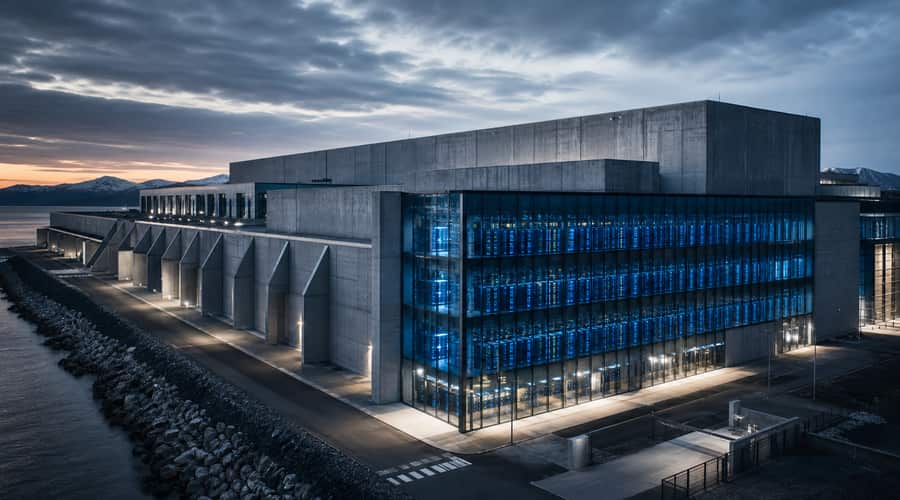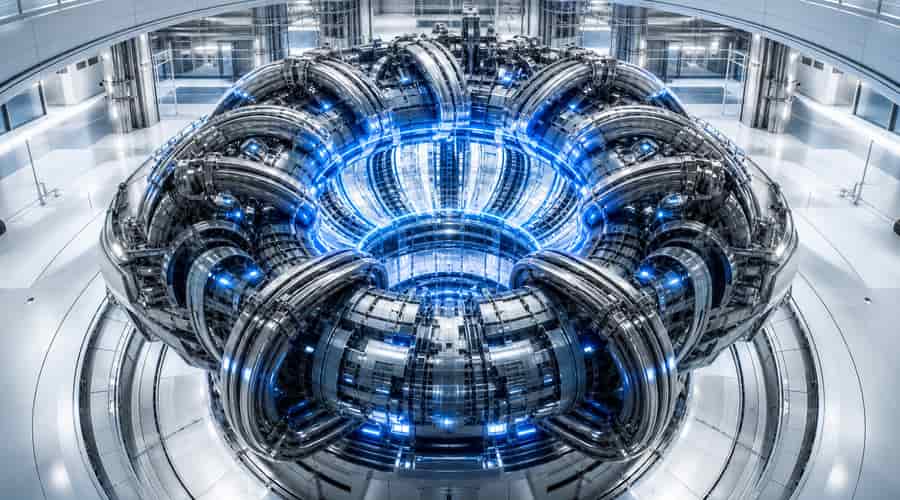
Google's stake in Proxima Fusion is not a routine climate bet. It is a signal that AI's power problem is now serious enough to pull Big Tech into Europe's hardest energy science.
The money is real and the physics is specific. Reuters reported on July 7 that Munich-based Proxima Fusion raised €411 million, about $470 million, in a round led by XTX Ventures and East X Ventures, with Alphabet's Google and German utility RWE joining as strategic investors. The deal valued Proxima at €2.4 billion, according to the company, and made it Europe's best-funded fusion startup. That's a big claim. It checks out against the public record of European fusion funding.
Proxima is not another software company borrowing the language of hard science. It is the first spinout from the Max Planck Institute for Plasma Physics, announced in May 2023, and its founding team came out of Max Planck IPP and MIT, with a Google X connection too. The company is building around the stellarator, a twisted magnetic-confinement design meant to hold plasma steadily rather than in pulses. If you want the blunt version, this is one of the harder routes into fusion, but it also has the clearer path to continuous power if the engineering works.
Google's part in the round is the detail you should pay attention to. In its 2026 environmental report, Google said its AI infrastructure buildout is accelerating faster than the grid is decarbonizing. That is not activist language. That is a hyperscaler admitting that the power system underneath AI is not moving fast enough. CreditSights said in February that capex among the top five hyperscalers could reach roughly $750 billion in 2026, up from its earlier estimate of about $620 billion. The servers are being bought now. The clean firm power is not arriving on the same schedule.
The Stellarator Bet
Proxima's technology rests on Wendelstein 7-X, the Max Planck stellarator in Greifswald that the institute describes as the world's most advanced machine of its kind. Proxima calls its approach a QI stellarator using high-temperature superconducting magnets, which is a technical mouthful but not an empty one. The point is to use modern stellarator optimization and stronger magnets to make a reactor compact enough to be commercial.
That is the promise. It is not proof.
The €411 million round will fund Alpha, Proxima's net-energy stellarator demonstrator near the Max Planck IPP site in Garching. Proxima's own roadmap targets Alpha for the early 2030s. In February, Proxima, RWE, Bavaria and Max Planck IPP signed a memorandum of understanding for Alpha in Garching and a later pilot power plant, Stellaris, at Gundremmingen in Bavaria. That location matters. Gundremmingen is a former RWE nuclear fission site, and RWE said on July 7 that it invested €25 million in Proxima's round after signing that cooperation agreement.
RWE is not doing this for goodwill. Germany shut down its last nuclear plants in 2023 and still has to square industrial demand with high power prices and decarbonisation targets. A utility with a former nuclear site, grid infrastructure and operating history has obvious reasons to keep a place in the next version of nuclear energy. It also knows permitting and grid connection can kill an energy project long before the machine itself fails.
Why Big Tech Is Here
Look at what the other hyperscalers are doing and Google's move looks less strange. Microsoft has backed the restart of power from the Three Mile Island site through its agreement with Constellation. Amazon has signed nuclear deals tied to small modular reactors. Google has already backed advanced geothermal and nuclear projects. Proxima adds fusion to the same shopping list, but with a European angle and a much longer technical runway.
Frankly, that is the honest read of this investment. Google is not buying electricity from Proxima next year. It is buying exposure to a possible source of firm, carbon-free power in the 2030s, at a moment when AI data centers are turning electricity from a facilities problem into a board-level constraint. If fusion misses, Google can absorb the loss. If it works, being early matters.
There is still a hard line between funding a demonstrator and running a commercial power plant. Alpha has to show net energy in steady state. Stellaris then has to turn that physics into a plant that can be built, serviced and licensed - and connected to the grid. Plenty can break between those points. Fusion companies have always been good at selling the future.
Proxima has one advantage many of them lack: it has attached the future to a named site, a specific utility partner and a world-class research institute. Gundremmingen is not a slide in an investor deck. Garching is not a vague European lab address. These are real places with infrastructure and politics and people who will have to live with the project.
That is why this round deserves attention. The €411 million figure is the headline, but the stronger signal is the combination of Google, RWE, Max Planck IPP and Bavaria around one stellarator roadmap. Fusion is still an engineering bet. Now it is also an AI infrastructure bet.
Also read: Congress wants to freeze state AI laws for three years and state lawmakers are refusing to go quietly, Etched raises $300M at $10.3B valuation as Sequoia backs the Harvard dropouts it once rejected, and Why your startup sales deck keeps losing enterprise deals