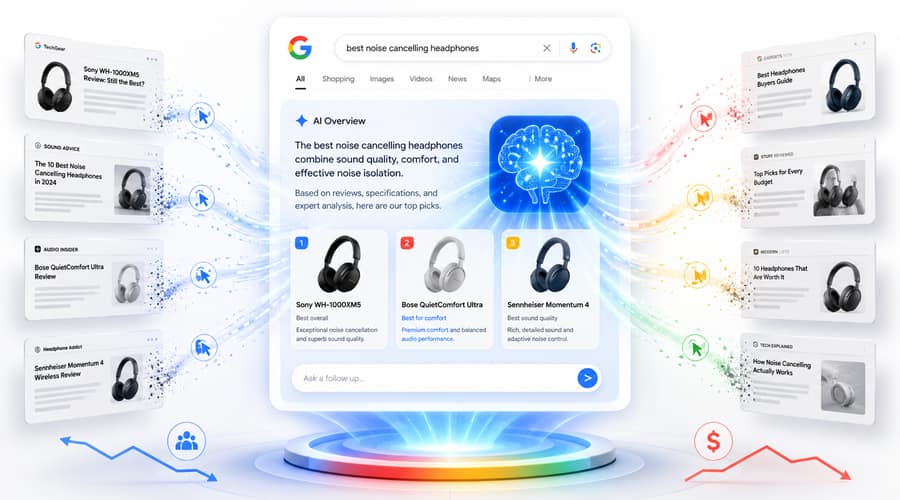
Google is making AI search feel too convenient to ignore, and that is exactly why publishers, creators, and the open web are worried.
Google used its I/O 2026 stage this week to push Search further into AI territory, putting AI Mode, agent-style tasks, multimodal queries, and a redesigned search box closer to the center of how people find information. That matters because Google is not just adding another feature. It is changing the behavior of the most important gateway on the internet.
The old bargain was simple. Google sent people to the web, and the web gave Google the material that made search useful. The new bargain is less generous. Google now wants to answer the question itself, summarize the best bits, and keep the user inside its own interface. That is efficient for users. It is also a direct threat to the publishers, artists, and independent thinkers whose work made the answer possible in the first place.
Google's own I/O update described the change as the next chapter of Search, with Gemini 3.5 Flash powering AI Mode globally and new agentic features designed to help users research, shop, plan, and generate custom information views from a single query. The company also said AI Mode has surpassed 1 billion monthly users, while AI Overviews now reach more than 2.5 billion monthly users. That is not a niche experiment anymore. It is the front door.
The practical appeal is obvious. A user asks a question and gets a polished answer immediately, often with enough context to stop there. No scrolling through ten blue links. No comparing sources. No opening a handful of pages to reconstruct the story for yourself. Google knows that convenience is sticky, and it is leaning into that reality with the confidence of a company that still controls search at scale.
But convenience has a cost. If the answer is already sitting at the top of the page, the incentive to click drops. If the click drops, traffic falls. And when traffic falls, the business model that supports much of the web starts to crack.
The publisher problem is getting louder
That is why this story is no longer just about product design. In February, the European Publishers Council filed a formal antitrust complaint with the European Commission over Google's AI Overviews and AI Mode, arguing that the features substitute publisher content and keep users inside Google's own results. The group also said publishers should have more meaningful control over how their material is used in AI search without having to disappear from regular Google Search.
The concern is not theoretical. The Reuters Institute for the Study of Journalism said in January that news executives expect search referrals to fall by 43% over the next three years. Chartbeat data cited in the same report showed organic Google search referrals to news sites down 33% globally from November 2024 to November 2025, and down 38% in the U.S. over the same period. Search is still large, but the direction is uncomfortable.
This is where the argument around AI search gets sharper. Google says AI features help people ask more complex questions and connect with more of the web. Publishers say the summary can absorb the value while the source takes the hit. Both things can be true at once. Users may discover more topics, but the sites that did the original work may never see the visit.
Why this feels different now
Google has always changed search. That was the point of its constant ranking updates, quality reviews, and experiments with snippets, maps, knowledge panels, shopping boxes, and direct answers. The difference now is that search is no longer just ranking pages. It is increasingly doing the reading for you.
That shifts the economics. Traditional search rewarded the publisher with a click if it produced the best answer. AI search rewards Google with user retention if it produces a good-enough answer. Those are not the same thing. One model strengthens the web by sending people outward. The other can weaken it by making the web optional.
It also raises a harder cultural question. The web is not just a pile of interchangeable content. It is a messy, human record of reporting, analysis, research, art, and expertise. If AI summaries become the default way people consume information, then the original voices behind that information become less visible, less visited, and less financially sustainable.
Google's executives understand the upside, which is why they keep moving in this direction. AI agents are now being threaded through Search, Workspace, shopping, coding tools, and consumer products. That tells you how broadly the company sees the shift. The machine should do more of the work, and Google wants to own the place where that work begins.
That is a powerful pitch. It is also a warning. The more AI makes search feel effortless, the harder it becomes for users to remember that the web is still built by people, and that those people need traffic, attribution, and revenue to keep making the thing everyone now takes for granted.
Also read: Data center opposition is becoming a founder risk • Meta is drafting 7,000 workers into its AI rebuild • X is making reposted video harder to monetize