
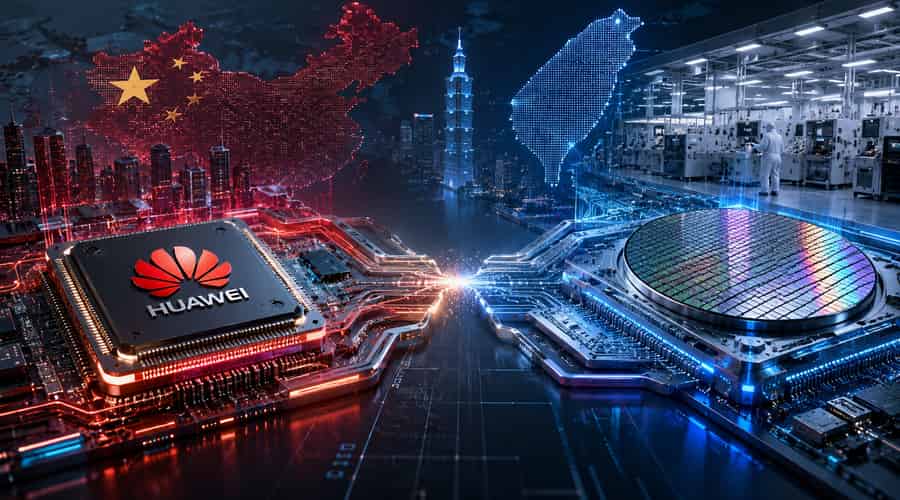
Huawei is not claiming it has beaten TSMC today. It is saying China may have a credible route to advanced chips without waiting for U.S. restrictions to loosen.
Huawei has put a date on China's semiconductor ambition, and that is what makes this moment worth watching. The company says it expects to design high-end chips by 2031 with transistor density equivalent to 1.4-nanometre manufacturing, a target that would place it near the frontier of advanced chipmaking by the end of the decade.
This is not the same as announcing a finished chip or a production line ready for mass output. It is more precise than that, and in some ways more important. Huawei is trying to show investors, customers and policymakers that sanctions have not frozen China's chip industry in place. They may have changed the route, but not necessarily the destination.
According to Reuters, He Tingbo, president of Huawei's semiconductor business and director of its Scientist Committee, introduced the approach at the 2026 IEEE International Symposium on Circuits and Systems in Shanghai on May 25. The company calls the concept LogicFolding, and it is designed to improve density and performance without relying on the same manufacturing advantages that have kept TSMC and Samsung ahead.
That matters because the chip race is no longer just about who has the smallest node on a slide. It is about who can supply enough usable AI compute, at a price and scale that local customers can trust. For China, Huawei is becoming the clearest answer to that problem.
TSMC remains the benchmark. The Taiwanese foundry says its A14 technology is on track for volume production in 2028, which means Huawei's 2031 target still leaves a meaningful time gap. There is also a deeper issue. Huawei did not provide independent performance data, and transistor density does not tell the full story of yield, power efficiency, packaging, software support or manufacturing economics.
Those details are where chip leadership is usually won. A technology can look impressive in principle and still struggle when customers need millions of reliable units. Advanced semiconductor manufacturing is brutally practical. If yields are poor, costs rise. If software is weak, developers hesitate. If packaging falls behind, AI systems lose the memory bandwidth they need.
Still, it would be a mistake to dismiss the announcement as only political messaging. Huawei has already shown that it can keep moving under pressure. Its Kirin smartphone chips, made with Chinese foundry partner SMIC, remain behind the best from TSMC, but they proved that export controls did not end Huawei's access to advanced domestic silicon. The new roadmap takes that argument into a more strategic category: AI infrastructure.
That is where the market implication becomes sharper. China does not need Huawei to beat Nvidia chip for chip in every global benchmark tomorrow. It needs Huawei to become good enough for domestic cloud providers, state-backed AI projects and large technology groups that want fewer surprises from Washington.
Nvidia's China problem gets harder
Nvidia is still the global leader in AI accelerators. Its hardware, software ecosystem and developer mindshare remain difficult to copy. But China has become a complicated market for the company, partly because U.S. export rules have repeatedly limited what Nvidia can sell there, and partly because every restriction gives Chinese buyers another reason to test local alternatives.
That is the uncomfortable lesson from Huawei's latest move. Export controls can slow access to leading chips, but they also create a guaranteed market for substitutes. When Chinese companies cannot plan around stable access to Nvidia products, they have to plan around Huawei, Cambricon and other domestic suppliers. Once that planning starts, it does not easily reverse.
For Nvidia, the medium-term risk is not simply lost sales in one quarter. It is the gradual training of China's AI ecosystem around non-Nvidia hardware. Developers adapt. Procurement teams adapt. Government funding adapts. A weaker chip with reliable availability can beat a stronger chip that may become unavailable after the next policy shift.
This also changes the calculation for foreign fabless chip designers. China remains too large to ignore, but the operating environment is becoming harder to read. Companies that depend on TSMC manufacturing, U.S.-linked design tools or American intellectual property have to ask whether their China exposure is a growth opportunity, a compliance burden or both at the same time.
Huawei's announcement does not make those decisions easier. It tells global chipmakers that China is building around restrictions with more urgency, not less. It tells investors that domestic AI infrastructure in China may deserve closer attention. And it tells policymakers that technology bans are more effective when they buy time for a broader strategy, not when they are treated as the strategy itself.
The next thing to watch is proof. Huawei needs to show whether LogicFolding can move from conference-stage roadmap to commercial chips with convincing performance, yields and customer adoption. Until then, TSMC keeps the lead and Nvidia keeps the crown. But the direction is clear enough: China's AI hardware stack is becoming more independent, and every step in that direction changes the assumptions global chip companies have been using for years.
Also read: Pope Leo brings Silicon Valley into the AI ethics fight • Proton is turning Canada's VPN fight into a startup risk test • Sakura Internet plans more AI data center spending in Japan