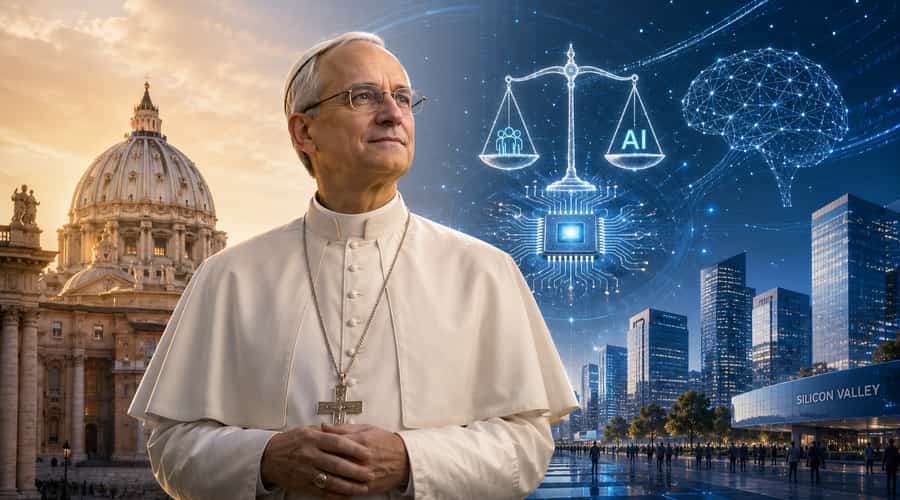
Pope Leo XIV is turning artificial intelligence into a defining moral issue for the Catholic Church, and Silicon Valley is paying attention because the Vatican now sits inside the governance conversation.
The AI industry has spent the past two years pitching regulators, investors and customers on speed. Now it is making a different kind of pitch in Rome, where Pope Leo XIV is preparing to release his first encyclical on artificial intelligence with Anthropic co-founder Christopher Olah among the speakers.
That matters because an encyclical is not a conference memo. It is one of the most important teaching documents a pope can issue, and Leo has chosen to use his first one to address what the Vatican calls the safeguarding of the human person in the time of artificial intelligence. For founders, investors and executives, the message is clear enough: AI governance is no longer only a Washington, Brussels or Beijing story.
The Vatican press office said the document, Magnifica Humanitas, will be presented on May 25, 2026, in the Synod Hall, in the presence of the pope. The speaker list includes Cardinal Victor Manuel Fernandez, Cardinal Michael Czerny, Durham University theologian Anna Rowlands, Santa Clara University professor Leocadie Lushombo and Olah, who is Anthropic's co-founder and head of research on AI interpretability. Cardinal Pietro Parolin will give closing remarks before Leo speaks and offers a blessing.
The symbolism is hard to miss. Leo signed the encyclical on May 15, the 135th anniversary of Pope Leo XIII's Rerum Novarum, the 1891 document that shaped modern Catholic social teaching around labor, capital and the social consequences of the Industrial Revolution. Pope Leo XIV is making the same comparison for AI. The question is no longer whether machines can work faster than people. It is what happens to dignity, truth, labor and trust when they do.
It would be easy to treat the Vatican as a strange venue for an AI debate. That would miss the point. The Catholic Church commands a global audience that reaches deep into Latin America, Southern Europe, Africa and parts of Asia, all markets where AI products, data centers, enterprise tools and education platforms are expanding quickly. A papal warning does not create law, but it can shape the climate in which laws are written.
That is why the industry's presence in Rome is so interesting. Anthropic is the most visible company in this moment because Olah is joining the encyclical launch, but the Vatican's technology conversations go back years. Under Pope Francis, Rome hosted and encouraged AI ethics work involving major technology companies, including Microsoft, IBM and Cisco through the Rome Call for AI Ethics. More recent Vatican-linked AI events have included representatives from Google, IBM, OpenAI, Cohere and Anthropic.
For technology companies, this is not charity work. The industry knows that trust is becoming a commercial asset. Customers worry about hallucinations, surveillance, deepfakes, copyright, job losses and military uses. Governments worry about national security and dependency on a handful of private labs. The Vatican offers something the industry cannot manufacture on its own: moral language with global reach.
But proximity cuts both ways. A company can gain credibility by showing up in serious ethical forums, yet it also invites scrutiny over whether its business model matches the values being discussed. Anthropic has built its public identity around safety and interpretability, which makes Olah a natural figure for a Vatican event focused on understanding and governing AI systems. Still, critics will ask whether any frontier AI company can credibly speak for restraint while competing in a race defined by scale, capital and speed.
The Soft Power Front
The timing also matters. Pope Leo met with participants in a Vatican AI conference on May 22 and argued that the challenge facing humanity is not merely technological, but anthropological. In plain business terms, that means the Church is not only asking how AI works. It is asking what kind of people and societies the technology produces.
That framing will resonate far beyond theology. Regulators in Europe have already moved toward risk-based AI rules. U.S. policy remains more contested, especially as companies push against rules they see as slowing innovation. In that environment, religious and civic institutions can become pressure points. They do not write the code or sign the term sheets, but they influence what societies will tolerate.
Founders should pay attention because soft power often arrives before hard rules. A pope's encyclical can influence bishops, universities, hospitals, charities, schools and political leaders across Catholic-majority regions. Those institutions buy software, set procurement standards, educate students and shape public expectations. If Leo's AI teaching emphasizes dignity, labor protection, transparency and limits on military use, companies selling into those networks will eventually have to explain how their products fit.
There is also a broader lesson here for the AI industry. The most powerful technology companies have become political actors whether they like the label or not. They shape labor markets, education, media, defense and personal relationships. Once a sector reaches that level, it cannot keep answering moral questions with product demos.
Leo's encyclical will not settle the AI debate. No document can. But it does mark a new stage in the conversation, one where the world's oldest global institution is telling the world's most ambitious technology companies that human dignity is not a feature to be added later. The next thing to watch is whether Silicon Valley treats Rome as a photo opportunity, or as a serious signal that the market for AI will be shaped by trust as much as capability.
Also read: Sakura Internet plans more AI data center spending in Japan • Japan's AI rally is changing how retail traders reach the market • Microsoft's Claude pullback shows AI coding still has a budget problem