A humanoid robot named Lightning has shattered the human half-marathon world record in Beijing, finishing in 50 minutes and 26 seconds, a feat that signals a dramatic leap in robotic endurance and autonomous locomotion.
Seven minutes. That is the margin by which a humanoid robot named Lightning just obliterated the official human half-marathon world record. At the second annual Beijing E-Town Humanoid Robot Half-Marathon on April 19, 2026, Lightning crossed the finish line in 50 minutes and 26 seconds. To put that in perspective, the human record, set just months earlier by Ugandan runner Jacob Kiplimo in January 2026, stands at 57 minutes and 31 seconds. We are no longer watching machines slowly catch up to human capability in controlled environments. They are actively surpassing our physiological limits in specific endurance and speed tasks, and doing so convincingly.
The scale of the event itself underscores how rapidly this sector is maturing. Over 100 teams fielding more than 300 competing units participated in this year's race, a stark contrast to the inaugural 2025 event where robots, to put it charitably, struggled to stay upright. The 2026 edition introduced separate categories for remote control and autonomous navigation, with the winning performance demonstrating sophisticated stability and battery efficiency that simply did not exist twelve months ago. As WSLS reported, the race featured frontrunners who significantly surpassed human athletic limits, validating a year of intensive engineering breakthroughs.
This was not an isolated stunt. The victory was underpinned by breakthroughs in high-energy-density battery technology that have solved one of the most stubborn problems in mobile robotics: sustained power output. Lightning maintained high-speed locomotion for over 50 minutes, a feat industry experts previously considered unfeasible due to power constraints. A frantic race among battery makers to develop cells capable of supporting what analysts are calling the "AI physical era" is yielding tangible results. Just one week before the marathon, Unitree Robotics demonstrated its H1 robot hitting a sprint speed of 10 meters per second, approximately 22.4 miles per hour. That velocity approaches the peak speeds of Usain Bolt, the fastest human sprinter in recorded history, whose top speed was roughly 10.44 meters per second. These machines are becoming fast, and more importantly, they are becoming fast for long stretches of time.
From Prototype to Industrial Strategy
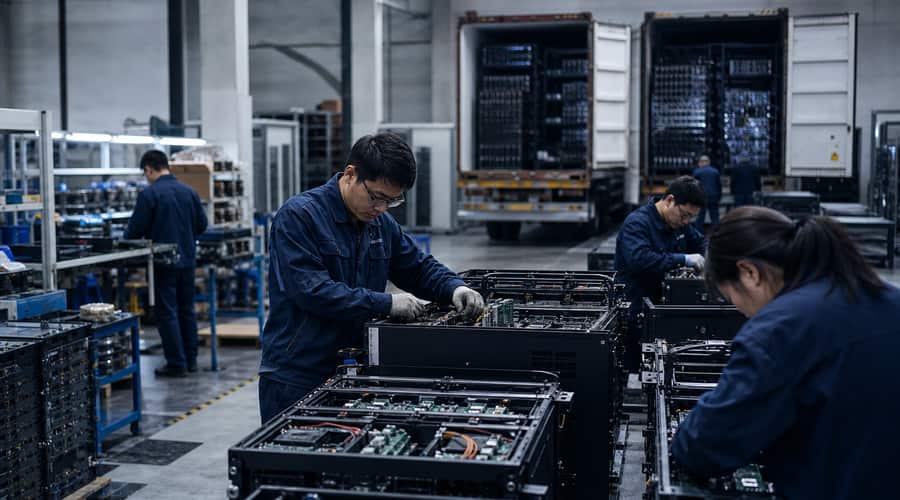
The spectacle in Beijing serves as the public debut for a generation of hardware backed by a massive, state-aligned industrial strategy. China has integrated robotics development directly with national defense and manufacturing goals, providing heavy government support for firms like Unitree, which recently completed a high-profile IPO on the STAR Market in early 2026. The capital flowing into this sector is drawing direct comparisons to the early stages of the electric vehicle boom, with analysts actively identifying breakout performers and tracking manufacturing readiness. Reports indicate that the focus has already shifted from proving prototype viability to driving down hardware costs for mass production. The goal is widespread commercial deployment in manufacturing and logistics, not simply winning footraces.
The competitive implications extend well beyond the commercial sector. Global investors and policy think-tanks, including the Jamestown Foundation, have highlighted the event as evidence of China's rapid advances in physical AI, raising urgent questions about technological parity for the United States and Europe. When a robot can outrun the fastest human distance runner by a seven-minute margin, the conversation fundamentally shifts from whether these machines are viable to how they will be deployed, and who will control the supply chains that produce them. Watch for battery efficiency and unit cost to be the two metrics that determine which companies graduate from impressive demonstrations to actual market dominance.