IBM's July warning was not just a bad mainframe quarter. It was a hard sign that AI infrastructure is taking money from the enterprise budgets that used to feed older software and hardware cycles.
If you wanted proof that AI spending isn't simply being added on top of corporate tech budgets, IBM gave it to you on July 14. Reuters reported that IBM shares fell 25% after the company warned that second-quarter revenue would come in at $17.2 billion, below Wall Street's $17.86 billion estimate, after customers shifted spending toward AI-related infrastructure in the final weeks of June.
The stock move was ugly. It was also specific. Reuters said the fall was steeper than IBM's one-day drop during Black Monday in 1987, and IBM's own July 22 results confirmed the weakness underneath it: infrastructure revenue fell 7%, IBM Z revenue fell 42%, and transaction processing software was down 8%.
That is the part you should pay attention to. IBM didn't miss because nobody wants technology. It missed because customers were choosing which technology got paid for first.
Arvind Krishna put the problem plainly in his July 14 investor letter. IBM had expected some disruption, but it did not expect the scale of the reprioritisation. In his words, clients shifted quarterly capex toward servers, storage and memory to secure supply-constrained infrastructure ahead of expected price increases. He also said numerous large deals failed to close on IBM's expected timelines.
That is not a vague AI story. It is a purchase-order story. The money moved.
Where the budget went
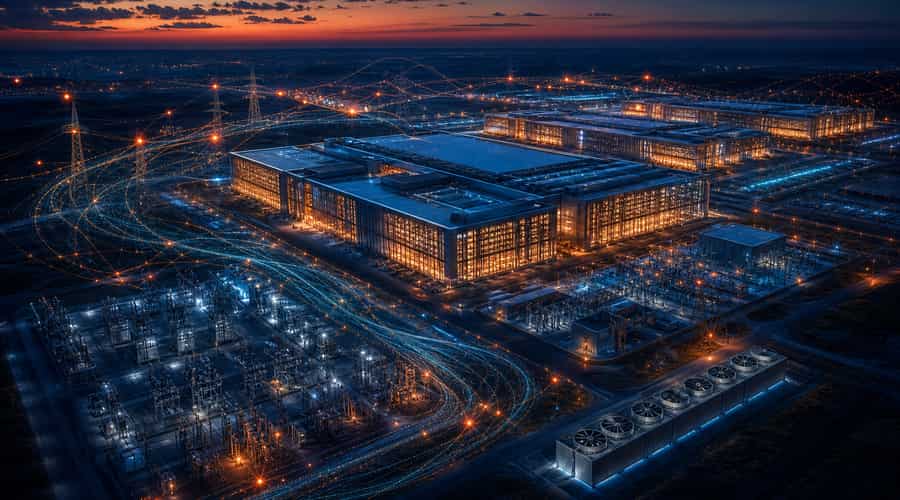
Businesses are racing to buy the physical pieces of AI: servers, chips, storage and networking gear. According to Business Insider, Google, Amazon, Microsoft and Meta are expected to spend more than $700 billion in 2026 on AI data-centre capacity. That number is so large that it changes the conversation for every vendor selling into the same CIO budget.
For IBM, the exposed line was the mainframe cycle. Z systems still matter deeply inside banks, airlines and other large organisations that process huge transaction volumes. Nobody sensible assumes those customers can rip that infrastructure out over a weekend. But deferring an upgrade is enough to hurt IBM when the old cycle is one of the cash engines still paying for the new strategy.
Here's the thing: a delay can still be structural if it keeps happening.
Reuters also reported that the warning hit other software names, with Microsoft, ServiceNow, Salesforce and Intuit falling between 1.5% and 5%. Investors understood the read-through immediately. If AI hardware has first claim on the budget, then software renewals and legacy upgrades will wait. Some consulting projects too. Some won't come back on the original terms.
That doesn't mean every enterprise software company is suddenly broken. Don't overread one quarter. But you should not underread it either. IBM's miss showed that AI demand can damage the companies trying to benefit from AI, especially when their growth story still depends on customers spending steadily across older product lines.
The risk for IBM
IBM has spent years trying to make this transition before investors forced the issue. Krishna has pushed the company toward hybrid cloud and AI, with Red Hat still central to the pitch and watsonx positioned as the enterprise AI platform. In its July 22 release, IBM said Red Hat revenue rose 11% and the watsonx portfolio remained part of the company's high-growth software focus.
There was good news in the same release. Software revenue rose 5%. Distributed Infrastructure jumped 37%. IBM said Power and Storage built a backlog of nearly $500 million, and the company kept its free-cash-flow outlook for the year, expecting an increase of about $1 billion year over year.
Still, the full-year guide moved down. IBM now expects constant-currency revenue growth of 4% to 5%, after previously guiding for more than 5%. That is a real cut, even if the company tried to surround it with stronger second-half language.
The uncomfortable part is that IBM's strategic direction looks right while its funding base looks more fragile. The company says it will invest more than $10 billion in quantum over five years and remains on track for a large-scale fault-tolerant quantum computer by 2029. It is also trying to build around AI and automation inside its own operations. Fine. But reinvention costs money, and the old infrastructure business just showed how quickly that money can wobble.
For startup founders selling into enterprise IT, this quarter is useful because it cuts through the lazy assumption that AI creates unlimited budget. It doesn't. If your product relies on customers funding AI experiments and legacy modernisation at the same time, you need to test that assumption now. The buyer may like both. The finance team may fund only one.
IBM can survive this transition. That is not the question. The question is whether it can move fast enough while customers are already moving their budgets somewhere else.
Also read: Google Cloud grew 82% in Q2 2026 and the $514 billion backlog tells you everything about who is winning the AI race • Galaxy Digital bets $5 million that Bitcoin can be made quantum-proof before Q-Day arrives • Claude Code can now tap through your iOS app in real time and fix what it finds