Treasury Secretary Scott Bessent gave gold believers the line they wanted on Fort Knox, then gave them the line they didn't: the metal is there, but it doesn't back your dollar.
You don't often get that clean a contradiction from a Treasury Secretary. In a Fox News appearance with Jesse Watters that aired in mid-July, Bessent said U.S. gold is "present and accounted for" and valued the country's holdings at more than $1 trillion at current market prices. He also made clear that he hasn't personally inspected Fort Knox. Treasurer Brandon Beach has been there, he said, and people on his staff have been there too.
That's enough to calm some people. It won't satisfy anyone who wanted a bar-by-bar public audit.
The vault question is still political
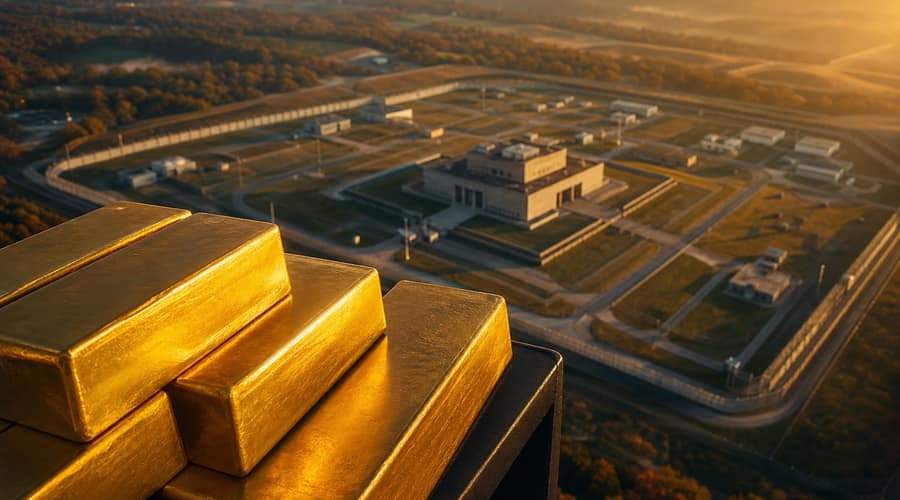
The official numbers are not vague. The U.S. Mint says Fort Knox holds 147,341,858.382 fine troy ounces of gold. Treasury data published through the St. Louis Fed puts total U.S. government gold reserves at about 261.5 million fine troy ounces as of June 2026, with the rest held at West Point, Denver, working stock locations, and Federal Reserve Bank vaults in New York. Fort Knox is the famous vault, but it's not the whole pile.
The trust problem sits somewhere else. Rep. Thomas Massie introduced the Gold Reserve Transparency Act of 2025 on June 6, 2025, and Congress.gov shows it was referred to the House Financial Services Committee that same day. Sen. Mike Lee introduced a Senate version on November 19, 2025, sending it to the Senate Banking Committee. Neither version has become law. The House bill would require the Comptroller General to contract with an independent third-party auditor for a full assay, inventory, and audit of U.S. gold reserves, including gold in deep storage.
So Bessent's statement matters, but don't confuse it with the thing Massie and Lee are asking for. A Treasury Secretary saying the gold is there is an official assurance. It is not an independent assay. Those are different things, and you shouldn't let the politics blur them.
The pressure to open Fort Knox had real momentum in early 2025. Fox Business reported at the time that President Donald Trump backed an Elon Musk-led DOGE push to confirm the reserves, while Musk posted that a livestream of Fort Knox would be "fire." Bessent's latest answer gives the administration a clean stopping point if it wants one. The gold is there, the secretary says. The bill can sit in committee.
The dollar is the harder part
What makes Bessent's remarks worth more than another Fort Knox reassurance is what came next. As Fortune reported on July 22, Bessent said the U.S. "used to be backed by silver, sometimes gold," before moving in the 1970s to fiat currency, where gold or silver no longer had to sit behind the dollar in the vault. That is the point gold reset talkers keep trying to glide past.
Nixon closed the gold window in August 1971. Since then, the dollar has rested on the credit of the U.S. government, tax authority, Treasury markets, military power, and global demand for dollar settlement. You can think that system is stronger than gold, weaker than gold, or overdue for trouble. Fine. But Bessent was not hinting at a new Bretton Woods arrangement. He was describing the old one as gone.
Here's the thing. The U.S. can hold the largest official gold reserve on earth and still run a fiat currency. Both facts are true at once. The Mint also says Fort Knox gold is carried on government books at $42.22 per fine troy ounce, a statutory price fixed since 1973. At market prices above $4,000, that accounting number looks almost comic. It's also still the law.
Gold traders are watching other signals
The market did not need Bessent to discover gold. Front-month gold futures settled at $4,146.90 on July 22, according to The Wall Street Journal, after a strong one-day rally. J.P. Morgan's latest public outlook says its analysts expect gold to average $6,000 an ounce in the fourth quarter of 2026, with $6,300 possible in 2027. That is not a Fort Knox trade. It's a central-bank demand, inflation, fiscal-risk, and geopolitics trade.
Central banks have been the real buyers to watch. J.P. Morgan's June research said the buying that powered gold's rise had cooled, but its broader argument still leaned on demand diversification into the metal. That is a more useful signal than another argument over whether a vault in Kentucky is full. Traders buy what moves. Auditors count what exists.
The crypto market has found its own way into the same story. CoinGecko's RWA Report 2026 said tokenized gold spot trading reached $90.70 billion in the first quarter of 2026, already ahead of the $84.64 billion traded in all of 2025. PAX Gold and Tether Gold dominated that activity, with CoinGecko putting XAUT at $2.52 billion and PAXG at $2.32 billion in market value at the end of the quarter. That's not replacing Fort Knox. It's a different wrapper around the same old instinct: when people distrust paper promises, they reach for metal.
Frankly, the least dramatic part of Bessent's answer is the part you should remember. America has the gold. Your dollar is not backed by it. The open question is not whether those two facts can coexist, because they already do. The question is how long investors stay comfortable with the distance between the gold sitting in federal vaults and the money moving through the system every day.
Also read: Abu Dhabi just gave tokenized gold the regulatory stamp it needed to go mainstream • China's Biggest Banks Order Retail Gold Traders to Exit by July 24 • Sibanye-Stillwater Bets $1.1 Billion on Platinum Mines That Won't Pay Off Until 2033