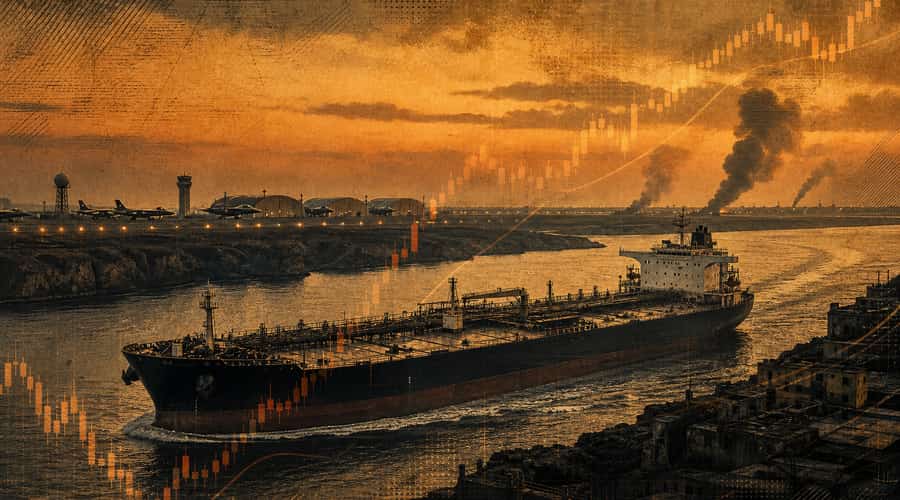
Two American service members are dead and a third is missing after an Iranian missile and drone attack in Jordan. Oil markets were already nervous, and this makes the Gulf look less like a distant war and more like a cost line on your next shipment.
Iranian ballistic missiles and drones hit US and partner forces in Jordan on July 17, killing two American service members and leaving another missing in action, US Central Command said in a July 18 statement. Four more troops were evacuated to Jordanian hospitals and later discharged. Others with minor injuries returned to duty. It is direct American loss.
Air & Space Forces Magazine reported that the attack struck Muwaffaq Salti Air Base, near Azraq, a Jordanian base long used by US forces. CENTCOM has not released the names of the dead while families are notified. That restraint is worth keeping in the story. Behind every market move here are families who haven't even had a public name to mourn yet.
This war has moved past clean diplomatic language now. AP reported that US forces answered with strikes on Iran's Revolutionary Guard: air defence sites, surveillance posts, missile depots and drone facilities. Axios reported the latest deaths bring the American military toll in the Iran war to 16. That number keeps climbing. The memorandum of understanding Washington and Tehran reached in June now looks less like a truce. It looks like a pause both sides used to reload.
Oil Is Pricing The Risk In Real Time
You can see the pressure first in crude. Reuters reported on July 14 that Brent settled at $84.73 a barrel and West Texas Intermediate at $79.34 a barrel. The US had just reimposed a naval blockade on Iran. About 20% of global oil supply normally moved through the Strait of Hormuz before the war. The Wall Street Journal reported that Brent jumped 9.6% to $83.30 on July 13. That was its sharpest one-day rise since 2020. President Trump announced both moves: the blockade, and a 20% charge on cargo passing through the strait.
By July 17, AP said Brent had surged another 4.6% as Iran war concerns hit markets. Stocks slid too. AP put the S&P 500 at 7,475.69 after a 1% drop, the Dow at 52,146.42 after falling 0.8%, and the Nasdaq composite at 25,520.24 after losing 1.4%. The exact index levels in an earlier draft were off - these are the corrected figures. Chip stocks were part of the selling, but oil was the cleaner warning sign.
This is where the story moves from foreign policy to your business. If you import furniture, parts, packaging, appliances, textiles, you name it, a disrupted Gulf eventually turns into freight quotes, fuel surcharges and longer delivery windows. Big companies can hedge fuel and lean on finance teams. Smaller companies often find out when the invoice arrives.
The Small Business Bill Comes Later
The IMF has already put hard numbers around the oil shock. In March, IMF Managing Director Kristalina Georgieva told Bloomberg that a 10% rise in energy prices lasting a year would add 40 basis points to global inflation and slow growth by 0.1% to 0.2%. The IMF's July World Economic Outlook update was still projecting global growth of 3.0% in 2026 and 3.4% in 2027. But it said renewed escalation could reignite commodity volatility and tighten financial conditions - and weaker economies would feel it hardest.
That's not theory. It is purchasing reality. A founder who priced a product in May based on calmer shipping lanes may be selling the same product in July with fuel, insurance and delivery risk moving underneath it. If your margin is thin, a few percentage points can decide whether a sale is worth taking. Frankly, you don't need to become a Gulf analyst. You do need to stop treating the Strait of Hormuz as background noise.
The earlier version leaned too hard on unverified numbers for steel, PVC and a $3.5 trillion global damage range. Those may turn out to be directionally right. But directionally right isn't good enough when readers are making real decisions. The verified facts already carry the point: two US troops are dead, one is missing, CENTCOM has confirmed the attack, oil has moved sharply, and the IMF says sustained energy shocks feed inflation and cut growth.
For entrepreneurs, the practical question is simple. Can you reprice quickly, reroute orders, warn customers early and protect cash before suppliers force the conversation? Some can. The companies with slack in delivery times and fuel assumptions have more room this week. The ones that built every quote around peace holding in the Gulf are about to learn how expensive hope can be.
The war may still narrow again. AP reported that both sides have continued targeted strikes rather than a full ground conflict, and diplomatic openings have not disappeared. But after July 17, you should read every claim of calm with care. A truce that can't protect troops at a Jordanian base isn't much protection for oil markets either.
Also read: How to Build a 30 60 90 Day Plan Template for a New Startup Hire • Founders are doing the dilution math and deciding VC isn't worth it • Samsung Confirms Nearly 1,000 Roles Affected in Englewood Cliffs as It Moves to Texas