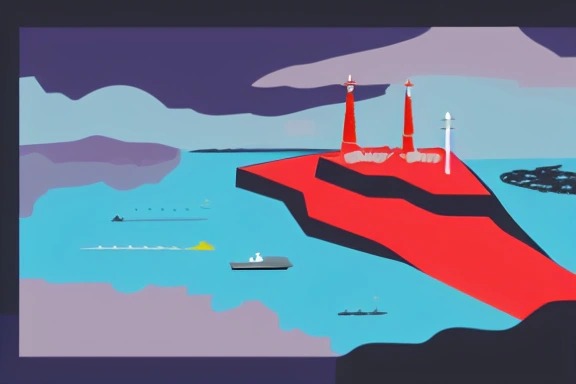
Iran's accelerating military buildup on strategic Persian Gulf islands is raising the stakes for regional conflict, with ripple effects that could hit cryptocurrency markets through energy prices and sanctions-driven demand.
Tensions in the Persian Gulf just ratcheted up another notch. Iran has been steadily fortifying several strategic islands near the Strait of Hormuz, deploying advanced missile systems, coastal defense infrastructure, and expanded military garrisons that significantly complicate any potential US military campaign in the region. The buildup, reported by Crypto Briefing, reduces already slim ceasefire prospects and makes some form of direct US-Iranian confrontation more plausible than it has been in months.
For cryptocurrency investors and entrepreneurs, this matters more than you might think. The Strait of Hormuz handles roughly 20% of global oil shipments daily. Any disruption there sends immediate shockwaves through energy markets, inflation expectations, and, by extension, risk assets across the board including digital assets.
The islands in question sit at or near the narrowest points of the strait, giving whoever controls them outsized influence over one of the world's most critical shipping lanes. Iran has occupied several of these territories for decades, but the recent escalation in fortification activity suggests Tehran is positioning itself to leverage that geography more aggressively if relations with Washington deteriorate further.
Geopolitical risk and cryptocurrency have a complicated but increasingly documented relationship. When conventional markets get spooked by military tensions, capital flows shift. Sometimes Bitcoin benefits as a perceived safe haven, similar to gold. Other times it gets sold off alongside risk assets as investors retreat to cash and short-term government bonds.
The pattern depends heavily on whether the crisis triggers inflation fears. A disruption to oil flows through the Strait of Hormuz would almost certainly drive crude prices higher, feeding into energy costs globally. Higher energy costs mean higher operating expenses for Bitcoin miners, tighter margins, and potential selling pressure from large mining operations that need to cover overhead. We saw a version of this dynamic play out when oil prices spiked following Russia's invasion of Ukraine in early 2022, with Bitcoin initially selling off before recovering as investors weighed inflation hedging narratives.
There is also the sanctions angle. Iran has a well-documented history of using cryptocurrency to circumvent international financial restrictions. As Bloomberg has reported, Iranian entities have leveraged Bitcoin mining and crypto-based payment channels to move value outside the traditional banking system. A military escalation would likely trigger tougher sanctions enforcement, potentially increasing demand for privacy-focused coins and cross-chain bridging tools that facilitate movement between networks. Traders watching on-chain metrics for unusual wallet activity tied to Iranian exchanges should stay alert.
What Comes Next
The US Navy maintains a significant presence in the Persian Gulf, and the Pentagon has repeatedly emphasized freedom of navigation as a core strategic interest. But fortified islands with anti-ship missile batteries and layered air defense systems change the tactical calculus considerably. What might have been a straightforward naval operation becomes a complex, multi-domain campaign with higher casualty risks and longer timelines.
That friction matters. The harder and more costly a potential military response becomes, the more likely Washington may pursue economic and diplomatic pressure instead. That could mean expanded sanctions regimes targeting Iranian crypto infrastructure, including exchanges and mining operations that have already operated in regulatory gray zones.
For founders building in the blockchain compliance and on-chain analytics space, this is a growth catalyst. Regulators worldwide are pushing for tighter oversight of how digital assets interact with sanctioned jurisdictions. Firms like Chainalysis and Elliptic have already built substantial businesses around this need, and escalating US-Iran tensions would only accelerate demand for compliance tools that can trace funds across complex transaction paths.
The bottom line for anyone holding or building in crypto: watch the Strait of Hormuz. Not because blockchain protocols care about geography, but because the markets that price risk absolutely do. If these fortifications lead to a meaningful escalation, you will see it in oil futures first, then in the S&P 500, and finally in whether Bitcoin trades like a safe haven or a risk asset on any given day. The signal matters more than the noise, and right now the signal is pointing toward higher volatility ahead.