JioStar is preparing to move AI video from experiment to programming strategy. If it works, the economics of Indian streaming could start to look very different.
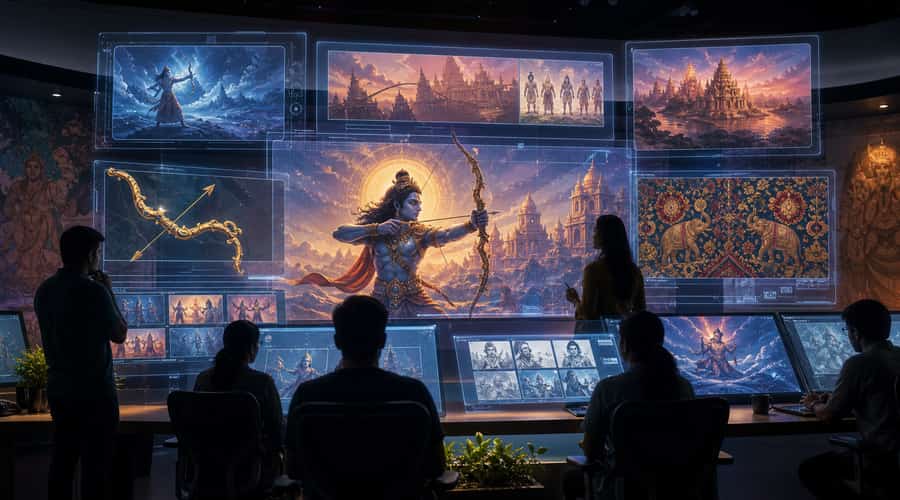
Mukesh Ambani’s media platform is no longer treating synthetic entertainment as a novelty. JioStar, the Reliance Industries and Walt Disney joint venture behind JioHotstar, is planning a slate of series written, animated, voiced and edited entirely with artificial intelligence, after an AI-powered Mahabharat series delivered the kind of early audience response that makes executives pay attention.
As Business Standard reported, citing Bloomberg, Mahabharat: Ek Dharmayudh drew 6.5 million views on its first day in October, more than double JioHotstar’s average reach for a series. Financial Express later reported that the 100-episode show had crossed 26.5 million video views since launch. That gives JioStar a practical reason to keep going. The first test did not just prove that AI could produce a long-running show. It showed that a mass-market Indian audience would at least sample one at scale.
The company is now developing several AI-powered entertainment projects, including the TV series Makaraj, a feature film Hanuman and micro-dramas, according to people familiar with the plans cited in the report. JioStar also plans to hire 80 AI specialists and engineers for the effort, and earlier this year brought in Stephan Bugaj, a veteran U.S. screenwriter and content producer, to lead its generative AI content strategy.
For a streamer, the attraction is not hard to understand. India is one of the world’s most competitive entertainment markets, but also one of the most price-sensitive. JioHotstar’s subscription plans start at Rs 79 per month, and that tells you something important about the business. Platforms need huge libraries, constant refreshes and local-language appeal, but they cannot assume U.S.-style subscription pricing will cover every production bet.
AI changes that calculation if it can reduce the cost and time needed to build animated worlds, mythological settings and short serialized dramas. Mahabharat was a useful test case because it required palaces, battlefields, costumes and large-scale visual sequences that would normally be expensive to stage or animate. AI production does not make those choices free, but it can compress parts of the workflow that usually require large teams and long schedules.
That matters beyond JioStar. If a mainstream platform can turn AI-native production into a repeatable pipeline, smaller studios may start building themselves as suppliers to streamers rather than as traditional production houses. The next wave of Indian content companies may look less like film studios and more like hybrid creative labs, with writers, prompt engineers, animators, voice designers and editors working inside the same production loop.
This is where the opportunity becomes uncomfortable. Hollywood’s resistance to AI has been led by writers, actors, directors and animators worried that synthetic production could weaken creative labor and reduce bargaining power. India faces the same question, but in a different market. The country has a vast base of television, animation and dubbing talent, and many workers operate without the same level of union protection or contract leverage seen in Los Angeles.
Audience tolerance has limits
JioStar’s first experiment also showed the downside. Some viewers criticised Mahabharat: Ek Dharmayudh as AI slop, pointing to visual glitches, distorted faces and characters with too many fingers. Those reactions matter because synthetic video does not only compete on cost. It still has to hold attention. A cheap show that feels emotionally flat can be sampled by millions and still fail as a habit-forming product.
The company appears to see those problems as technical issues that will improve as models get better. That may be true. Generative video tools are improving quickly, and a controlled production pipeline can catch more errors than a casual prompt-to-video workflow. But storytelling is not only a rendering problem. Mythological stories in India carry cultural weight, and audiences notice when a show looks grand but feels hollow.
There is also a regulatory question building in the background. India has been moving toward clearer rules around deepfakes, synthetic media and platform responsibility, while entertainment workers globally are pressing for consent and compensation when AI systems imitate voices, faces or styles. JioStar’s projects may avoid some of those issues if they use original synthetic characters and licensed workflows, but the broader market will not be so tidy.
The timing is important. JioHotstar has already been pushing AI into the viewing experience. In February, OpenAI and Reliance announced a partnership to bring ChatGPT-powered conversational search to the platform, letting users find movies, shows and live sports through text and voice prompts in multiple languages. That makes JioHotstar one of the more aggressive examples of AI moving across both sides of streaming: discovery and production.
If JioStar succeeds, competitors will not wait long. Netflix, Prime Video, Zee, Sony and regional platforms all face the same pressure to produce more content without letting costs run away. The first AI-made hits will not replace premium human-led shows, but they could create a new tier of programming, especially in animation, mythology, children’s content and mobile-first micro-dramas.
For now, the bet is simple. JioStar is testing whether viewers care more about story availability, language, familiarity and price than about how a show was made. The next thing to watch is not whether AI can generate another spectacle. It is whether a platform can turn synthetic production into repeat viewing, and whether creative workers can claim a fair place in that new machine.
Also read: Google must give UK publishers control over AI search use • Delta Electronics says AI data centers now need power as much as chips • Kioxia has become Japan's clearest AI memory trade.