
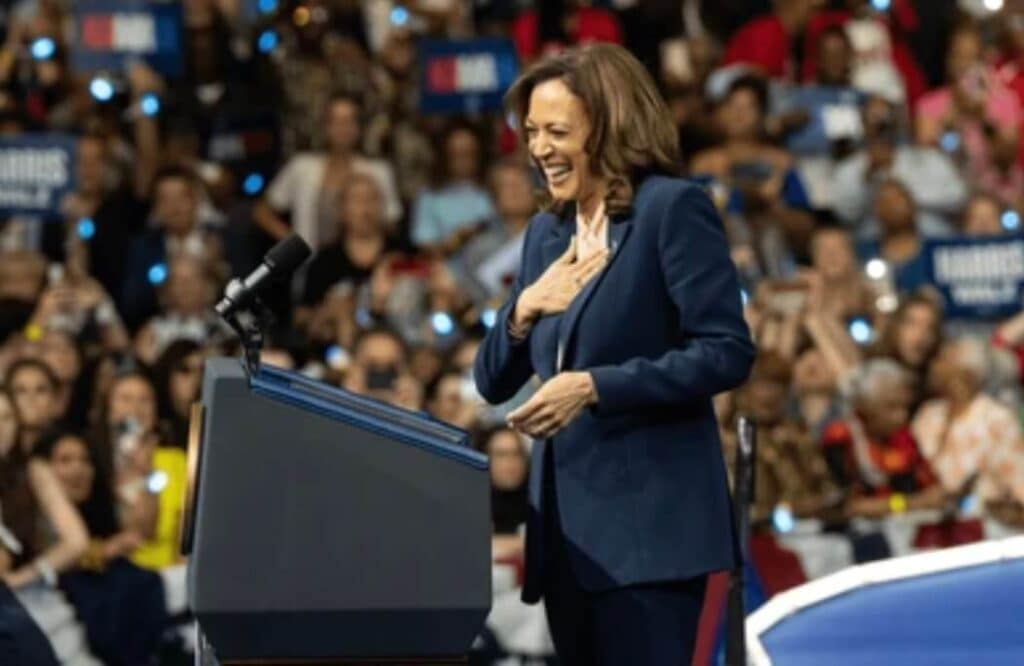
Nearly 6 million viewers tuned in to watch Kamala Harris and Tim Walz's first joint CNN interview, surpassing recent television audiences drawn by Donald Trump and signaling strong public interest in the Democratic ticket.
Vice President Kamala Harris and her running mate Tim Walz drew nearly 6 million live viewers for their first joint interview on CNN Thursday night, a figure that reveals just how much momentum the Democratic ticket has built in a short amount of time. The audience size did not just beat expectations. It doubled some of the competition's recent benchmarks and offered a concrete data point for a campaign that has been buoyed by enthusiasm since Harris replaced President Joe Biden at the top of the ticket.
The contrast with Donald Trump's recent television appearances is difficult to ignore. Trump's last town hall on CNN in May 2023 attracted 3.3 million viewers. His joint interview with running mate JD Vance on Fox News in July pulled in an estimated 4 million. Both of those events took place on highly rated networks with deeply loyal audiences, yet neither came close to the viewership that Harris and Walz commanded on a Thursday evening. These numbers tell a clear story about where public attention is focused right now.
For CNN, the interview represented a welcome ratings victory. The network has spent months struggling to compete with the consistently higher viewership of Fox News and MSNBC across many primetime slots. Landing an exclusive sit-down with the newly minted Democratic ticket gave CNN a moment of dominance in the cable news landscape, even if the audience fell short of the convention speech numbers that aired across multiple networks simultaneously.
That convention comparison is worth noting. The Democratic National Convention consistently outperformed the Republican National Convention when it came to audience size. On the third night of the DNC, 20.1 million people tuned in to watch Walz deliver his speech accepting the vice presidential nomination. JD Vance's speech at the RNC drew 17.9 million viewers by comparison. The final night of the DNC saw Harris accept the nomination in front of 28.9 million viewers across 15 networks, slightly edging out the 28.4 million who watched Trump's RNC address. These are small margins in some cases, but the direction is consistent.
What makes the viewing figures particularly notable is the trajectory they suggest for Trump. For someone who has long bragged about commanding the biggest television audiences in political history, the gradual shrinkage of his viewership tells a different story than the one he prefers to tell. Trump built his political brand on the idea that he alone could dominate the media landscape. The numbers from this election cycle suggest that dominance is no longer a given.
Harris, meanwhile, is exceeding benchmarks set by the Biden campaign in 2020. The energy surrounding her candidacy has been evident in crowd sizes, fundraising numbers, and now television ratings. Whether that energy translates into votes in November remains the central question of this election, but there is no denying that the Democratic ticket has captured something that was missing from the race just weeks ago. The public is paying attention, and they are tuning in at levels that warrant serious attention from both parties.
The Harris-Walz campaign's ability to draw these audiences is not accidental. It reflects a deliberate strategy to introduce Walz to a national audience and to present the ticket as a unified front with a clear message. As the campaign enters its next phase, with debates and more media appearances on the horizon, both sides will be watching closely to see whether these viewership trends hold or shift. One thing is already certain: the race for attention, at least for now, is not particularly close.
Tagged with: Harris Walz Interview, Kamala Harris Interview Rating, Kamala Harris Interview