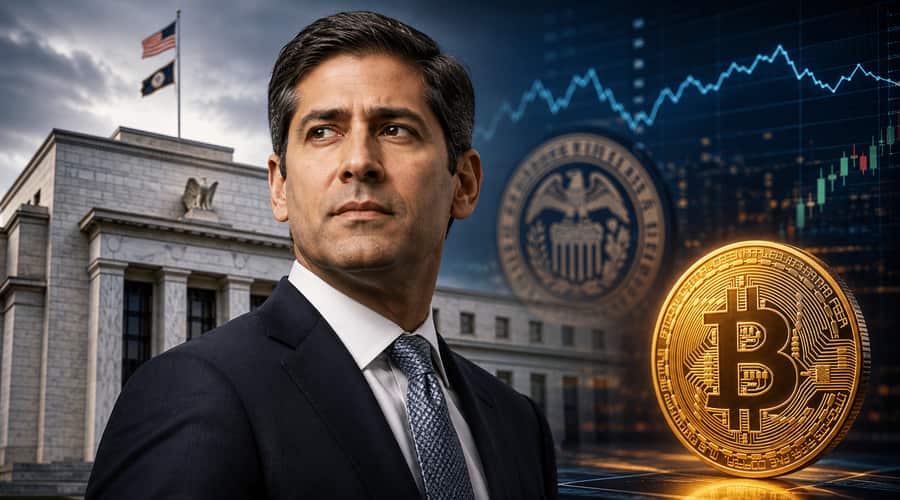
Kevin Warsh is now running the Federal Reserve, but crypto investors should not mistake a friendlier tone toward Bitcoin for an instant return to easy money.
Kevin Warsh was sworn in as Federal Reserve chair at the White House on May 22, 2026, giving President Trump the monetary policy change he has been pushing toward for months. For Bitcoin, venture capital and every risk asset that has been trading on the hope of cheaper money, the question is now simple: can Warsh actually cut rates, or has inflation already boxed him in?
According to AP, Trump used the ceremony to say he wanted Warsh to help stimulate the economy while also presenting the central bank as independent. That balancing act is now the whole story. A Fed chair can shape language, tone and priorities, but he still has to carry a committee, face the bond market and explain why lower rates make sense when inflation is still above target.
The handover itself was unusually tense. The Senate confirmed Warsh on May 13 in a 54-45 vote, after months of pressure on Jerome Powell and repeated demands from Trump for lower interest rates. Powell's term as chair ended before Warsh took the oath, and the Federal Reserve Board briefly named Powell chair pro tempore until the swearing-in could take place. That small procedural wrinkle matters because it shows how closely markets are watching every sign of institutional strain.
Warsh has been treated by parts of the crypto market as a Bitcoin-friendly figure, largely because he has spoken about Bitcoin as a useful market signal and has shown more comfort with digital assets than many traditional central bankers. That is not the same thing as being able to deliver liquidity on demand.
Bitcoin cares less about personal sympathy than about real rates, dollar liquidity and the path of the Fed balance sheet. When borrowing costs fall, investors tend to move further out on the risk curve. That can lift public equities, private tech valuations and crypto assets at the same time. When inflation forces the Fed to stay tight, the opposite happens. Capital becomes selective, and the weakest stories are exposed first.
This is why the Warsh moment is important for founders as well as traders. A credible path to lower rates would reduce funding costs, support later-stage valuations and make it easier for venture investors to underwrite longer duration bets in fintech, AI infrastructure and crypto networks. But if the Fed is forced to hold or even tighten, the private market recovery will stay uneven. The best companies can still raise. The marginal ones will keep waiting.
The bond market is already pushing back
The complication for Warsh is that the market mood has shifted in the wrong direction. Fed minutes released this week showed that a majority of officials saw possible rate hikes as appropriate if inflation stayed persistently above 2%. That is not the backdrop a new chair wants if he is expected to start with a dovish pivot.
Energy prices tied to the Iran conflict have added another layer of pressure. Higher fuel costs can be temporary, but they can also filter into freight, food, wages and inflation expectations if they last long enough. That is the danger for the Fed. It can look through a clean one-time shock. It has a much harder time looking through a chain of price increases that consumers and businesses start to expect.
Bond investors understand that risk. Long-term Treasury yields have already moved higher in recent weeks, a sign that markets are demanding more compensation for inflation and fiscal uncertainty. If Warsh cuts too quickly, he may get the opposite of what the White House wants: lower short-term rates paired with higher long-term yields. That would not help mortgages, startup financing or the broader cost of capital very much.
For crypto, the next signal is not the ceremony. It is Warsh's first policy meeting and the language that follows it. If he keeps Powell's cautious posture while opening the door to cuts later in 2026, Bitcoin may treat that as enough to preserve the rally. If he sounds eager to ease despite hot inflation, the bond market may become the real referee. And if he turns more hawkish than expected, the trade built around a pro-Bitcoin Fed chair could unwind quickly.
The practical takeaway is straightforward. Warsh changes the tone of the Fed, but he does not change the arithmetic. Inflation, yields and committee votes still decide how much liquidity reaches the market. Bitcoin may have a more sympathetic listener at the top of the central bank, but the next leg of the cycle depends on whether cheaper money is actually coming.
Also read: Pump.fun launches USDC pools, raises memecoin launch costs • Uniswap’s UNI token now trades natively on Solana • US bill seeks 1M Bitcoin reserve with 20-year hold