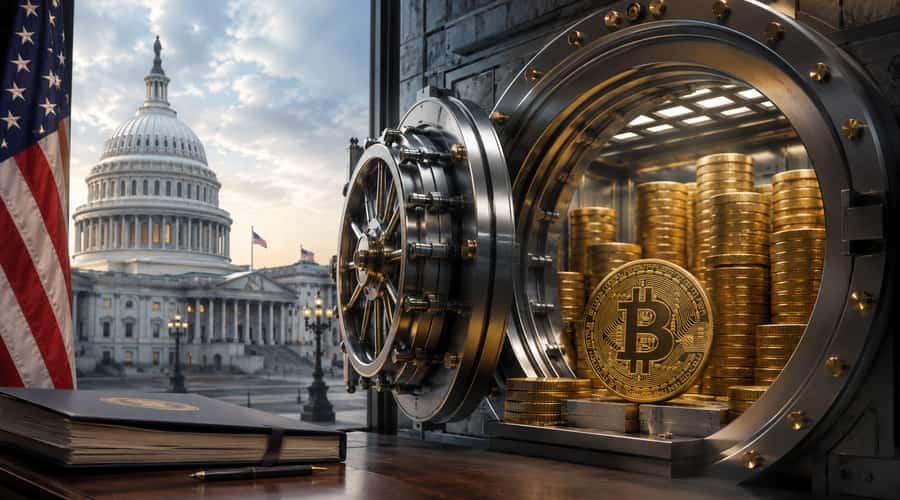
A bipartisan House bill introduced on May 21 would put the Strategic Bitcoin Reserve into federal law and require seized Bitcoin held in the reserve to stay there for at least 20 years. The bigger question is whether Congress is ready to treat Bitcoin like a permanent national reserve asset, rather than an asset the government happens to seize and sell.
The United States already controls one of the largest sovereign Bitcoin stockpiles in the world, but it has never had a durable policy for managing it. Representatives Nick Begich of Alaska and Jared Golden of Maine want to change that with the American Reserve Modernization Act of 2026, a bipartisan bill that would establish a Strategic Bitcoin Reserve inside the Treasury Department and create a separate Digital Asset Stockpile for federally held non-Bitcoin assets.
The bill matters because it moves the reserve debate out of the White House and into Congress. President Trump signed an executive order in March 2025 to create a Strategic Bitcoin Reserve and a U.S. Digital Asset Stockpile, but an executive order can be changed by the next administration. A statute is harder to unwind. That is the point of ARMA: to turn a policy preference into federal infrastructure.
According to Begich's office, the legislation would require federal agencies to account for digital assets they hold or control, consolidate oversight under Treasury, publish quarterly proof-of-reserve reports, use independent third-party audits, and submit the reserve to congressional oversight. It also says Bitcoin held in the Strategic Bitcoin Reserve must be maintained for at least 20 years, with any eventual sale directed only toward reducing the national debt.
That is a narrower and more precise claim than saying Washington is about to buy 1 million Bitcoin tomorrow. Begich has said he wants the United States to hold about 5 percent of the total Bitcoin supply, or roughly 1 million coins, a scale he compares to the country's gold reserves. ARMA points toward that ambition by directing a study of budget-neutral acquisition strategies that would not raise taxes, increase deficit spending, or add to the national debt. It does not make an immediate open-market purchase inevitable.
Why The Reserve Debate Is Back
The politics around crypto have shifted quickly. The bill has Democratic support from Golden and more than a dozen Republican original co-sponsors, including Pat Harrigan, Buddy Carter, Barry Moore, Burgess Owens, Mike Carey, and Mike Lawler. That does not guarantee passage, but it gives the proposal a different starting point from earlier Republican-led Bitcoin reserve efforts.
The broader legislative environment is also more favorable than it was a year ago. The Senate Banking Committee advanced the CLARITY Act in a 15-9 bipartisan vote on May 14, sending a major digital asset market structure bill closer to a full Senate vote. Senator Cynthia Lummis has suggested a mid-June vote is possible, although she has also described that timeline as optimistic. In practical terms, crypto policy is moving from campaign language into committee work.
There is still a long path from introduction to law. ARMA would need committee review, possible amendments, House passage, Senate approval, and a presidential signature. It could also run into objections from lawmakers who see Bitcoin as too volatile for reserve treatment, or who worry that a federal accumulation plan would expose taxpayers to market risk even if the acquisition methods are described as budget neutral.
The Market Signal
The U.S. government's existing Bitcoin position is already large. Estimates vary because federal holdings are spread across seized and forfeited assets, but recent tracking has put the figure around 328,000 BTC, worth roughly $25 billion at Bitcoin's May 2026 trading levels near $77,000. Those holdings include assets tied to major enforcement actions, including Silk Road-related seizures and the Bitfinex hack recovery.
For crypto companies, the most immediate impact may come from the bill's custody and transparency rules rather than the 1 million Bitcoin headline. Quarterly proof-of-reserve reporting and outside audits would create a public benchmark for how a national government should manage digital assets. Custody providers, wallet developers, auditors, and compliance firms would all pay attention, because federal standards often become market expectations.
The self-custody language is just as important for the industry. ARMA affirms that Americans have the lawful right to own, transfer, and self-custody digital assets, and says the federal government may not impair that right. For wallet companies and individual holders, that kind of statutory protection would reduce a major policy uncertainty.
The market reaction has been measured. Bitcoin was trading near $77,700 on May 21, while the Crypto Fear and Greed Index remained in fear territory, a sign that traders are treating the bill as a long-term policy signal rather than an immediate catalyst. A reserve law would not change Bitcoin's supply overnight, but it would change the way the world's largest economy talks about the asset.
The next milestones are committee referral, hearing dates, and whether ARMA can keep its bipartisan framing as the details are tested. If it advances, the United States will be taking its most concrete legislative step yet toward treating Bitcoin as a formal reserve asset. If it stalls, the debate will still have moved forward, because Congress is now arguing over how to manage seized Bitcoin, not whether the government owns enough of it to matter.
Also read: Zillow loses Chicago listings in data access war • South Carolina just built a crypto sandbox with teeth • SEC innovation exemption could legalize tokenized stocks