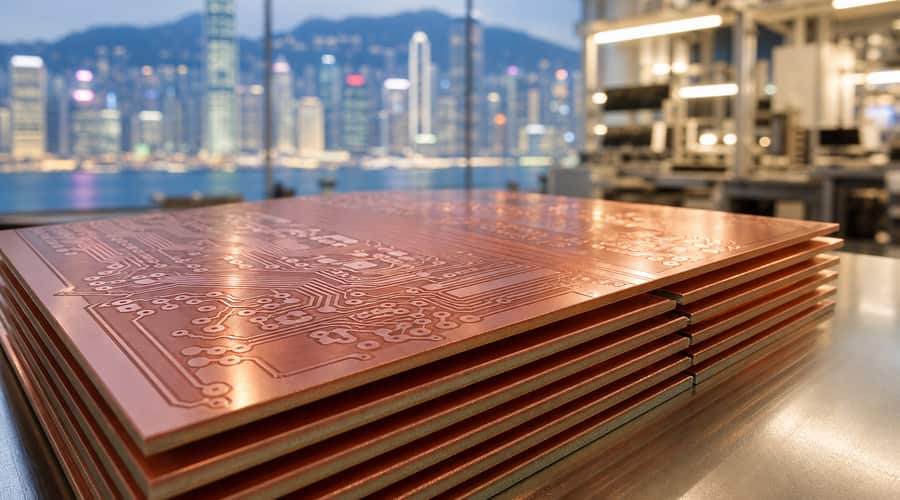
Kingboard Laminates has become a clearer way to read the AI infrastructure trade: the shortage is moving from chips into the materials that make the servers possible.
Investors spent the first phase of the AI boom watching Nvidia and the cloud giants. The more interesting signal now sits further down the chain, in copper foil, glass fiber, and the laminate boards used inside high-performance servers. Hong Kong-listed Kingboard Laminates, ticker 1888, has been pulled into that story because it makes the sort of upstream materials that do not usually make market headlines until they become hard to buy.
The original draft overstated the stock move and mixed incompatible price figures, so the cleaner point is narrower and stronger. Kingboard has rerated sharply as investors have started to price a materials bottleneck behind AI server production. A move from roughly HK$4.90 to HK$24 would be far more than 148%, while a price near HK$49 would imply a still larger gain. Those figures cannot all support the same headline. What can be supported is the larger market argument: AI spending is no longer only showing up in GPUs and high-bandwidth memory. It is showing up in the base materials that carry power and signals across dense server boards.
Kingboard's position is useful because the company sits close to several of those constraints. The broader Kingboard group manufactures laminates, copper foil, glass fabric, glass yarn, printed circuit boards, and related chemicals, with production spread across China and Thailand. That mix matters for AI servers because advanced boards need more demanding copper and laminate specifications than ordinary electronics. When buyers start competing for those inputs, a company with exposure across the materials stack can gain pricing power before the rest of the market notices.
The copper foil shortage is the clearest part of the story. PC Gamer reported in March 2026 that Mitsui Kinzoku had notified customers of a 12% dollar price increase on its MicroThin copper foil products, effective April 2026, citing higher copper material and labor costs. The same report noted that Mitsubishi Gas Chemical was also raising prices, in some cases by as much as 30%, and that high-end circuit foil supply had been pulled toward AI applications. These are dry supply chain details, but they explain why a laminate maker can suddenly become a market story.
AI servers are physical objects before they are revenue forecasts. They need substrates, copper, glass cloth, resins, and boards that can handle higher speeds and tighter thermal demands. Nvidia may own the most visible profit pool, but its systems still depend on suppliers whose factories were not built for unlimited AI server deployment. Once those suppliers begin raising prices, the shortage is no longer theoretical. It is sitting in purchase orders.
That is where the earlier article had the right instinct but too much unsupported precision. Claims about Nvidia directly securing HVLP4 copper foil capacity, coordinating inventory with Google, AWS, and Meta, and specific Goldman Sachs shortfall forecasts should not be stated without a verifiable source that can be checked by readers. The stronger edit is to stay with what is visible: copper foil producers have announced price increases, AI demand is absorbing high-end circuit material, and Kingboard belongs to the small group of listed companies investors can use to express that theme.
The investment case is still not simple. Materials stocks can move quickly when shortages appear, then give back gains when new capacity arrives or customers redesign around constraints. Kingboard's appeal is tied to a real bottleneck, but that does not make every price a bargain. If the shares have already moved several hundred percent from early-2024 levels, the market is no longer asleep. A good supply chain thesis can still become an overcrowded trade.
There is also a difference between exposure and proof. A company can make the right materials and still miss the best economics if customers lock in pricing, competitors add capacity, or demand shifts to a different specification. That is why the next set of disclosures matters more than the market slogan. Investors should be watching Kingboard's laminate margins, copper foil pricing, capacity additions, and customer mix rather than treating every upstream supplier as a hidden Nvidia.
The real lesson from Kingboard is that AI capital spending keeps moving into less obvious places. First the market found GPU makers. Then it found memory suppliers. Now it is looking at copper foil, glass fiber, and laminates. That progression is not hype by itself; it is how a large hardware cycle travels through a supply chain. The best evidence is not a grand forecast. It is a supplier raising prices because customers still need the material.
Kingboard's rise should be read that way: as a signal that the AI buildout has reached the layer of the stack most investors used to ignore. The question is no longer whether GPUs are in demand. It is whether the materials underneath them can keep up.
Also read: Japan's taxi app Go surged 21% on its Tokyo debut, and its blueprint beats Uber's playbook • Morgan Stanley opens its trillion-dollar stock plan plumbing to AI agents and Wall Street is watching • Nvidia sells $20 billion in bonds as AI demand outpaces its own cash generation