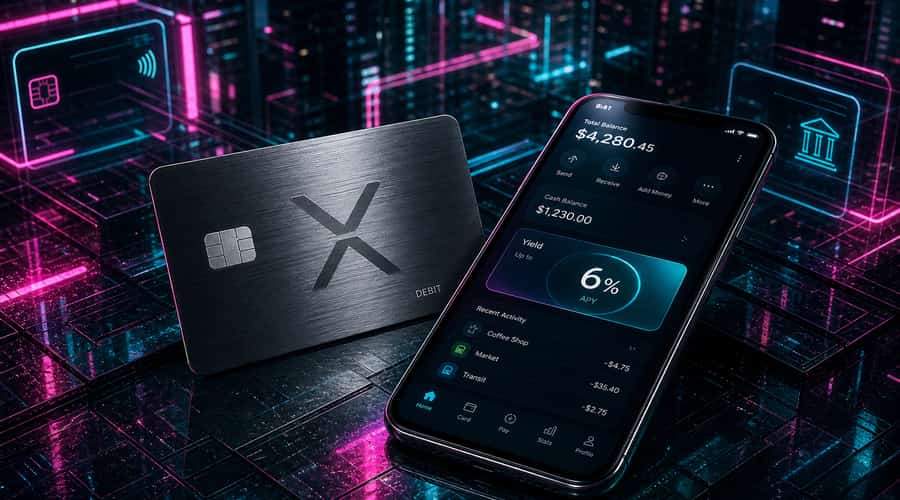
X launched its embedded payments platform to broad US users on July 27, 2026, promising 6% APY and a metal Visa debit card , but without a bank charter and locked out of New York and Massachusetts, the ambition has a visible ceiling.
The product is real, and it arrived fast. X Money went live for Premium and Premium+ subscribers across the US yesterday, giving tens of millions of users access to a dollar wallet, a brushed metal Visa debit card stamped with their X handle, instant peer-to-peer transfers between X accounts, and a headline annual yield of 6%. The deposits sit at Cross River Bank, a New Jersey-based FDIC member institution, with a cash sweep program that spreads balances across partner banks and advertises up to $10 million in aggregate FDIC coverage. For context, the best high-yield savings accounts from established online banks , Ally, SoFi, and similar , are currently offering between 4% and 4.21% APY, according to NerdWallet's July 2026 rankings. X's 6% blows past that. For now.
The fine print matters. The 6% rate requires direct deposit, and financial analyst Ken Tumin noted on X that the rate is almost certainly promotional , "expect the rate to fall in line with competitors" over time, he wrote. That's how fintech launches work: lead with the headline number, build the user base, let the rate drift toward market once switching costs kick in. Chime did it. SoFi did it. The question isn't whether X Money is doing the same thing , it clearly is , but whether the platform is big enough to make users stay when the rate normalizes.
X doesn't have a bank charter. It holds money transmitter licenses in 41 US states and Washington D.C., which is enough to move money but not to hold it. That's why Cross River Bank is in the picture. The arrangement is structurally identical to how Chime and dozens of other fintechs operate: partner with a chartered bank, keep deposits there, market the yield on top. It works until it doesn't. The collapse of Synapse Financial in 2024 , a middleware company that connected fintechs to their banking partners , left tens of thousands of customers locked out of their funds for months when the arrangement broke down. Cross River itself has its own history: the FDIC cited it for unsafe lending practices in 2018 and issued another enforcement action in 2023 for unfair or deceptive practices, according to Senator Elizabeth Warren, who sent a formal letter of concern to Musk in April. None of that means X Money will fail. It means the infrastructure under the 6% yield is less simple than the marketing suggests.
New York and Massachusetts aren't on the map yet. New York lawmakers have reportedly pushed state regulators to deny X a license, and both states require separate approval before X can operate there. That's two of the largest and wealthiest consumer markets in the country locked out of the flagship launch. X says it's pending regulatory sign-off in both. That's a reasonable explanation and a real constraint at the same time.
The everything-app math
Musk told employees in February that the goal was for users to be able to "live your life on the X app." He's pointed at WeChat, the Chinese super-app from Tencent, as the template since he took over Twitter in 2022. WeChat's payments product, WeChat Pay, works because it's embedded in a platform where users already do messaging, shopping, news, and social activity , payments are the connective tissue, not the point. X Money is betting on the same logic: if you're already on X for content, the friction of switching to a separate banking app starts to feel unnecessary.
The feature set supports that pitch. Beyond the 6% yield, X Money includes bill pay, free wire transfers, ATM reimbursements, zero foreign transaction fees, 3% cashback on purchases, and creator payout routing so X's monetization layer and its financial layer start to merge. For a creator who earns revenue through X and wants to spend it through X, the loop is almost closed. That's genuinely useful and genuinely different from what any legacy bank offers inside a social platform.
Frankly, the regulatory gap is the honest story here. A 6% APY and a metal card are marketing. The real question for X Money's long-term ambitions is whether it eventually applies for a bank charter , something Musk's team has reportedly discussed but not pursued , or whether the fintech-bank-partnership model scales to the level Musk is describing. Getting to WeChat Pay means handling hundreds of millions of transactions daily with the reliability users expect from their primary financial institution. Cross River Bank, whatever its virtues, was not built to be the backend for an everything app used by 300 million people. The architecture will have to change if the vision is real. For now, X Money is a well-featured fintech product with a competitive introductory rate and a more complicated story underneath it. That's not nothing. It's also not a bank.
Also read: The Pentagon cleared Starlink from America's router blacklist while every other foreign-made device gets shut out • OpenAI brings real-time interruptible voice AI to enterprise workspaces and launches Presence for customer-facing agents • Verizon signs a dark fiber deal with Google worth over $1 billion as AI infrastructure demand reshapes telecom