vLLM ROCm support in Lemonade is still experimental, but it points at a more practical future for AMD-based local inference. For startups, that makes hardware choice a strategy question, not just a developer preference.
Lemonade has added vLLM ROCm as an experimental backend, giving AMD GPU users another route into high-throughput local model serving without having to live entirely inside the Nvidia CUDA ecosystem. The move is small in the way early infrastructure changes often look small: a backend flag, a quick-start command, a new portable build. But for teams trying to control inference cost, hardware supply, and deployment privacy, it is a sign that the AMD side of local AI is getting more serious.
In a post on r/LocalLLaMA, AMD engineer Jeremy Fowers said vLLM can now be installed in Lemonade with a backend command and used to run a vLLM model directly, while noting that the essentials are implemented and there are still rough edges. The thread drew 141 points and 44 comments within three hours, which is a useful signal because LocalLLaMA is not a casual audience. These are the users who notice when a local server saves them a week of dependency work, and they are usually quick to say when it does not.
vLLM matters because it is not just another way to run a single chat model on a desktop. It was built around high-throughput serving, with features that matter when there are multiple users, multiple requests, and pressure to keep GPUs busy. Its reputation has been strongest in cloud and data center inference, where batching, memory management, and model support can change the economics of a deployment.
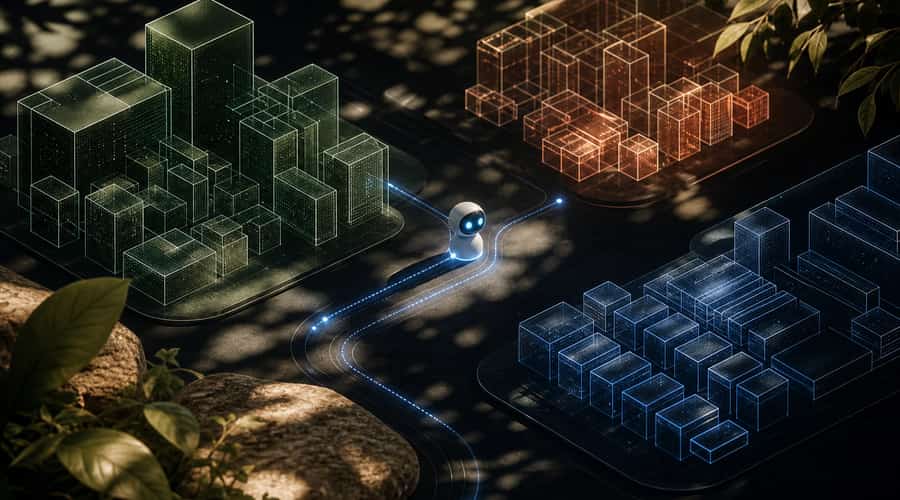
That gives Lemonade a different role. Lemonade already presents itself as a local AI server that can route workloads across CPUs, GPUs, and NPUs while exposing familiar APIs to applications. Adding vLLM ROCm makes it less like a single-engine wrapper and more like a bridge between open-source serving software and whatever hardware a team can actually buy. For a startup, that is the point. The winning setup is not always the most elegant one, it is the one that ships, fits the budget, and does not collapse when usage grows.
The hardware picture is still complicated, but it is improving. The portable vLLM ROCm repository lists builds for Strix Halo, Strix Point, RDNA4 GPUs such as the RX 9070 XT, RX 9070, RX 9060 XT, and RX 9060, and RDNA3 GPUs including the RX 7900 XTX, RX 7900 XT, RX 7900 GRE, RX 7800 XT, RX 7700 XT, and RX 7600 series. AMD's own ROCm 7.12 preview documentation for vLLM also points to Instinct accelerators such as MI300X and MI300A, newer MI325X, MI350X, and MI355X parts, Radeon Pro AI hardware, Radeon RX 9000-series cards, and Ryzen AI Max systems.
That list matters because AMD's AI story has often suffered from a gap between theoretical support and practical deployment. Developers might see a supported GPU on a matrix, then lose time to driver versions, Python versions, kernel requirements, missing wheels, and model-specific errors. Lemonade's portable vLLM ROCm builds try to reduce that pain by bundling a relocatable Python runtime, vLLM, PyTorch, and ROCm user-space libraries, so the user is not assembling the stack from scratch.
The Startup Angle
For startups, the immediate question is not whether ROCm has matched CUDA everywhere. It has not. CUDA still has the deepest ecosystem, the cleanest default path, and the strongest assumption baked into tutorials, benchmarks, and enterprise tooling. The better question is whether ROCm is good enough for serious local and small-team deployments where the goal is experimentation, privacy, internal tooling, or cost control rather than massive production scale.
On that narrower question, the answer is moving toward yes, with conditions. If a team is using newer AMD hardware, staying close to supported model families, and willing to tolerate an experimental backend, Lemonade plus vLLM ROCm could be a practical way to test higher-throughput inference without renting Nvidia capacity for every workload. That does not make it a plug-and-play replacement for a polished cloud stack. It makes it a credible option for teams that want leverage before they commit to a larger infrastructure bill.
There is also a fragmentation risk. Local AI is filling up with backends: llama.cpp, vLLM, SGLang, ONNX Runtime, Vulkan paths, ROCm paths, NPU-specific engines, and vendor-tuned builds. Choice is useful until every model requires a compatibility investigation. Lemonade is betting that routing and packaging can hide enough of that complexity from developers, while still letting advanced users choose the engine that fits the job.
That is the right ambition, but the market will judge it on reliability. Experimental backends get attention. Stable backends get adopted. The next test is whether vLLM ROCm in Lemonade can move beyond early users and become something small teams trust for internal copilots, coding assistants, RAG services, and private inference endpoints.
The larger implication is clear. Nvidia dependency is no longer just a procurement issue, it is a product and margin issue. If AMD-backed local inference keeps getting easier, startups will have more room to design around available hardware instead of building every AI plan around CUDA by default. Watch the rough edges, because how quickly they disappear will say a lot about how real the non-Nvidia local AI market is becoming.
Also read: Timothy Gowers says AI is forcing mathematics to rethink research • Florida Makes Big Data Centers Pay Their Own Power Bills • A federal judge says DOGE broke the law with ChatGPT grant cuts