Mach Industries has raised $300 million at a $1.8 billion valuation, giving the young defense manufacturer fresh capital just as investors are treating autonomous weapons, drone defense, and rocket motor supply as a serious venture category.
Mach Industries is no longer just another defense startup with a sharp pitch and a crowded cap table. The Huntington Beach company has raised a $300 million Series C led by Infinite Capital and Ribbit Capital, nearly quadrupling its valuation from $470 million last June to $1.8 billion. For a three-year-old hardware company building unmanned systems, that is the part worth paying attention to.
According to TechCrunch, founder and CEO Ethan Thornton originally went out to raise $200 million, then pushed the round to $300 million after investor demand came in stronger than expected. Existing backers Bedrock Capital, Sequoia Capital, and Khosla Ventures also participated. That matters because defense manufacturing is not a cheap business to scale. It requires facilities, supply chain control, testing, engineering talent, and patience with government procurement cycles. Venture investors are betting Mach can move faster than the old defense primes without getting buried by the same industrial constraints.
The company's product lineup explains why the round landed now. Mach has five autonomous vehicles in development: Viper, a jet-powered vertical take-off and landing system; Glide, a high-altitude glider capable of launching weapons; Stratos, an airborne surveillance platform; Dart, a low-cost counter-drone interceptor; and Pike, a long-range munition built for larger-scale deployment. It has also won a Department of Defense contract through the Defense Innovation Unit to develop a sixth vehicle, described as a runway-independent strike aircraft for the Navy.
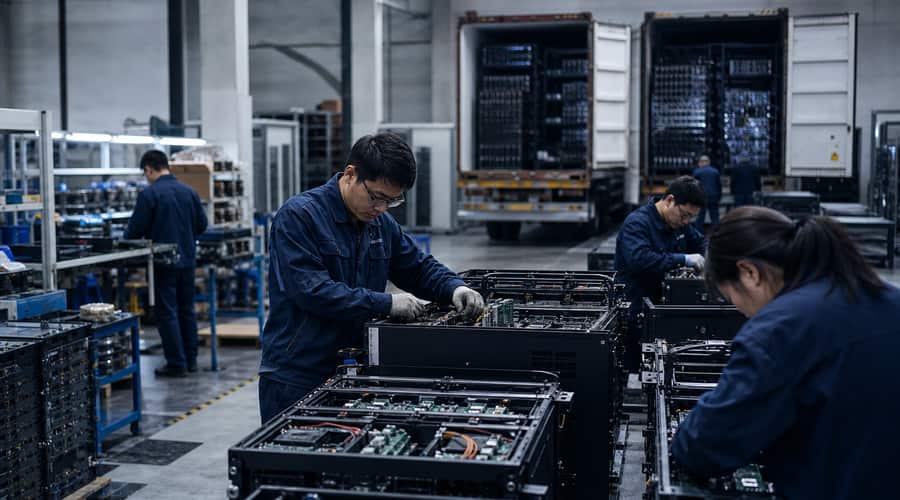
That is a different profile from a software company trying to sell tools into the Pentagon. Mach is building physical systems meant to fly, strike, surveil, and be manufactured at pace. The company has grown from a small team to about 350 employees, operates a 115,000-square-foot manufacturing facility in Huntington Beach, and says it expects to add four production facilities by the end of 2026. The real question is whether it can turn fast product development into repeatable production.
Mach's clearest move in that direction came in May, when it acquired Exquadrum, a solid rocket motor startup based in Victorville, California, in a $50 million cash-and-equity deal. The unit has been rebranded as Mach Energetics, bringing 85 employees, intellectual property, business lines, and a 70,000-square-foot facility into Mach's operations. The point was not only expansion. It was control.
Solid rocket motors are a genuine bottleneck across the American defense industrial base. Demand from drones, missiles, and other unmanned systems has risen sharply, while domestic capacity remains concentrated among a small number of major suppliers. Lead times can stretch for years. By buying Exquadrum, Mach is trying to own a critical input rather than wait in the same queue as everyone else. That is a practical advantage if the company wants to produce weapons systems at the speed its valuation now implies.
Defense tech has become a capital category
Mach's $1.8 billion valuation looks large in isolation, but it is modest compared with the biggest names in the current defense tech wave. Anduril raised $5 billion in May at a $61 billion valuation, roughly doubling in less than a year. Shield AI raised $1.5 billion in Series G funding and added $500 million in preferred equity financing in March, giving it a $12.7 billion post-money valuation. Saronic Technologies, focused on autonomous maritime systems, reached a $4 billion valuation in 2025.
That comparison is useful because it shows where Mach sits. It is not yet in Anduril's league for scale, revenue, or political visibility. Its opportunity is narrower and more industrial: attritable unmanned systems, counter-drone defense, strike platforms, and propulsion. In that corner of the market, vertical integration can matter more than brand recognition. If you control the motor, the airframe, the autonomy layer, and the factory, you have more room to improve cost, availability, and iteration speed.
The capital market has changed around that thesis. A few years ago, many generalist venture firms treated defense as uncomfortable or simply too slow. Government contracting looked unfamiliar, hardware margins looked uncertain, and the politics were hard to ignore. Russia's invasion of Ukraine, drone warfare, and renewed concern about U.S. industrial capacity changed the conversation. Defense tech is now drawing not only specialist funds but mainstream investors that once preferred software, fintech, and consumer platforms.
Ribbit Capital's role in Mach's round is a good example. The firm is best known for fintech, not munitions. Its participation suggests investors are looking past category labels and toward companies that combine software, autonomy, and durable government demand. Infinite Capital's role as co-lead shows the specialist side of the market is still important, but the investor base is broadening.
The next test is execution
The hard part starts after the funding announcement. Mach now has the money, the valuation, and the investor attention. What it still needs is proof that its systems can move from development programs into meaningful production and procurement. A Department of Defense contract for a runway-independent aircraft is a strong signal, but a single program does not make a scaled defense manufacturer.
There is also a burn-rate issue baked into the story. A 350-person workforce, multiple vehicle programs, manufacturing facilities, and an energetics division all cost real money before they produce predictable revenue. That is normal for defense hardware, but it leaves less room for vague milestones than software investors are used to tolerating. If procurement timelines stretch, Mach will need enough commercial and government work to keep momentum intact.
The more interesting takeaway is that venture capital is no longer only funding tools around the defense industry. It is funding companies that want to rebuild pieces of the industry itself. Mach's bet is that a startup can manufacture faster, integrate more tightly, and respond to battlefield needs more directly than legacy contractors. The Series C gives it room to prove that. The next twelve to eighteen months will show whether Mach is an emerging prime contractor or simply one of the best-funded experiments in the sector.
Also read: BiteBuddy AI Handles Restaurant Phone Calls and Drops Orders Directly Into the POS • Venture capital flows into AI infrastructure as sector hits record funding highs • Coffee Piano Lets Musicians Explore Harmony Through Visual Chord Maps and Reharmonization