Meta's new compact vision encoder family runs under 100 million parameters while matching specialist models across image understanding, dense prediction, and vision-language tasks, potentially transforming how AI runs on phones and wearables.
The bottleneck for on-device AI has never been purely about hardware. The real problem is model architecture. Most state-of-the-art vision encoders are simply too large to deploy on smartphones, AR headsets, or IoT devices, and when you compress them to fit, the capabilities that made them useful tend to evaporate. Meta's AI research division is proposing a way around this tradeoff with a family of compact vision encoders called the Efficient Universal Perception Encoder, or EUPE, that keeps parameter counts under 100 million while performing competitively with much larger specialist models.
This matters because the edge computing market is accelerating fast. Global edge AI chip revenue is projected to surpass $20 billion by 2028, driven by demand for real-time inference on consumer devices. But the software side has lagged behind the silicon. Today, if a device needs to handle image classification, scene segmentation, and visual question answering simultaneously, the standard approach is to deploy multiple encoders, each optimized for one task. That is computationally expensive and drains battery life. EUPE attempts to collapse those separate functions into a single, lightweight model.
Vision encoders work by converting raw pixels into compact feature representations that downstream tasks can use. Think of them as the visual processing engine inside a larger AI pipeline. The problem is that most modern encoders are trained with narrow objectives, and those objectives shape what the model can and cannot do well.
OpenAI's CLIP and Google's SigLIP 2, for instance, are trained on image-text pairs. They excel at image understanding and vision-language tasks, but their ability to handle dense prediction, work that requires pixel-level spatial precision like depth estimation or semantic segmentation, is often inadequate. On the flip side, self-supervised models like Meta's own DINOv2 and its successor DINOv3 learn outstanding geometric and structural features, making them strong at dense prediction, but they lack robust vision-language capabilities. Meta's Segment Anything Model, SAM, delivers impressive zero-shot segmentation but similarly falls short on language-grounded tasks.
For an AR headset that needs to understand a scene, segment objects, and respond to voice commands about what it sees, deploying all three of these encoders simultaneously is impractical. Running even one large encoder continuously on a mobile device can drain a battery within hours.
Where Previous Approaches Stumbled
Researchers have attempted to solve this through agglomerative multi-teacher distillation, a method where a single student model learns to mimic several domain-expert teachers at once. Projects like AM-RADIO and RADIOv2.5 demonstrated that this works reasonably well for large models exceeding 300 million parameters. Another approach, DUNE, tried merging 2D and 3D perception teachers through heterogeneous co-distillation. But as MarkTechPost recently reported, when you apply these same techniques to efficient backbones, performance degrades significantly. The small models simply lack the representational capacity to absorb and unify diverse feature representations from multiple specialists in a single training step. The result is mediocrity across the board.
Scale Up First, Then Shrink Down
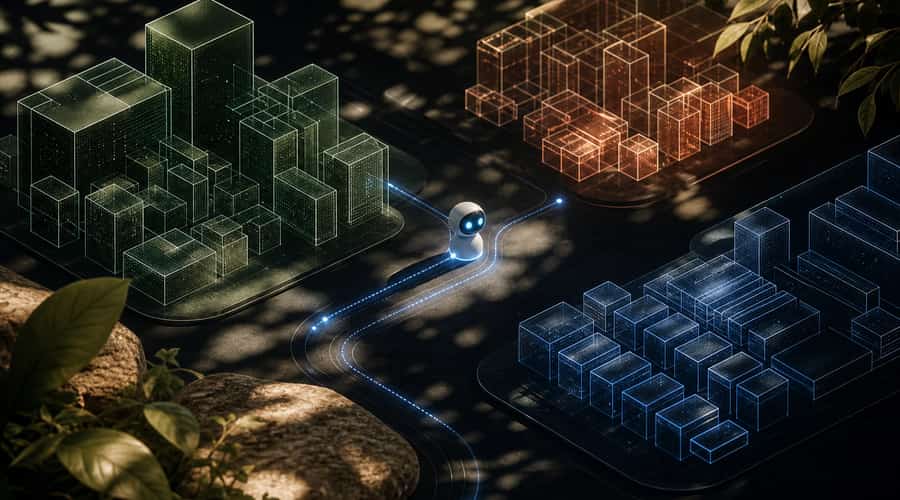
EUPE's core innovation is what the researchers call a two-stage process: first scaling up, then scaling down. Rather than distilling knowledge directly from multiple specialist teachers into a small student, EUPE introduces an intermediate step, a large proxy teacher with sufficient capacity to absorb and unify diverse representations from all the specialists. Only then does the team distill this unified proxy into the final compact model.
This intermediate proxy acts as a bridge. It gives the training process enough representational headroom to reconcile conflicting signals from different teacher models before compressing everything into the efficient final form. Early results show EUPE models performing competitively with domain specialists across image understanding, dense prediction, and vision-language tasks, all from a single encoder under 100 million parameters.
The practical implications extend well beyond benchmarks. Apple, Google, and Qualcomm are all racing to build on-device AI capabilities into their next-generation silicon. Having a vision encoder that can handle multiple perception tasks in a small footprint would reduce the compute budget for camera-based features, free up memory for other applications, and lower power consumption across augmented reality, robotics, and autonomous systems. Startups building in mobile-first AI or edge computing should watch this space closely, as the availability of genuinely compact, generalist vision models could shift what is possible to run entirely on-device without cloud dependency.