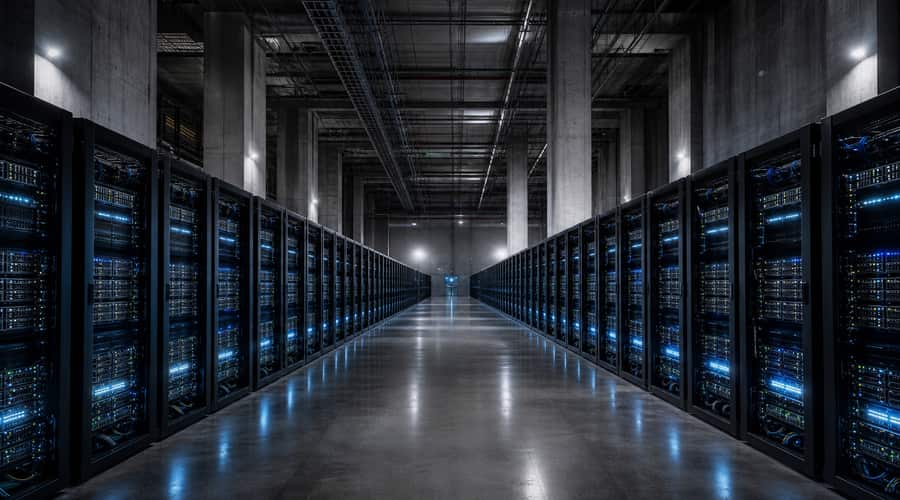
Meta's Hyperion buildout in Louisiana is no longer just a data center story. It is now big enough to reshape regulated utility planning, power generation and the costs that sit underneath the AI boom.
The most important thing about Meta's Louisiana AI project is no longer the size of the campus. It is the size of the power system now being built around it. Entergy Louisiana has lifted its four-year capital plan by $14 billion, and the reason is increasingly clear, Hyperion, Meta's sprawling AI data center in Richland Parish, now needs electricity on a scale that forces a utility to think like an industrial developer. Reports this month confirm Meta is funding ten gas-fired power plants in total for the campus, including seven newly announced units on top of three already approved, with the full package now tied to more than 7 gigawatts of capacity. That is not ordinary data center demand. That is grid-rewriting demand.
The scale matters because it changes who ends up carrying the financial and physical burden of AI. Meta says it will pay the full cost of the infrastructure tied to Hyperion, and Entergy has stressed that its other customers should not be on the hook. But even if the direct costs are isolated, the knock-on effects are broader. A project like this pulls regulated utilities into debt-heavy capital spending, transmission upgrades, fuel planning and public-service approvals. It also pushes gas infrastructure deeper into the center of AI expansion, at the very moment when the industry likes to talk about software abstraction and virtualized intelligence. The reality is more concrete. AI needs electrons. Lots of them. And somebody has to build the pipes that deliver them.
For years, data center coverage has mostly focused on land, chips and cloud contracts. Hyperion shows why that is no longer enough. The real bottleneck is power, and not just in the abstract sense. It is power plants, substations, transmission lines and the regulatory machinery that approves them. Entergy's revised capital plan is the clearest evidence that AI infrastructure is now large enough to affect a utility's balance sheet and long-term investment schedule. When a single corporate customer causes a utility to expand spending by $14 billion, the AI sector is no longer buying electricity as an operating expense. It is effectively reshaping the utility's business model.
That has consequences for everyone else in the region. Even if Meta is covering the direct cost of service, utilities do not operate in a vacuum. Every new plant, every upgrade and every transmission project flows through approval processes, bond markets and public expectations about reliability. Once a utility starts planning around an AI megacampus, the line between private infrastructure and public infrastructure gets blurry very fast. The question is not only whether Meta can get the power it needs. It is how much of the surrounding system must be reconfigured to make that possible.
This is where the Louisiana story becomes a preview of a larger national problem. AI companies talk about building the future, but the future still has to pass through regulated monopolies, fossil fuel plants and local infrastructure budgets. That means the boom is starting to show up in places that most consumers never connect to AI at all, utility debt, grid interconnection queues, gas turbine orders and public service commission hearings. The more AI compute scales, the more these hidden costs move from background noise to the main event.
The Hidden Cost Of Scale
Meta's Hyperion project began as a $10 billion plan and has already grown far beyond that. Public filings and reporting now put total development costs at roughly $27 billion, with the campus expanding in footprint and power requirements as the AI buildout evolves. The new agreement with Entergy adds another layer of complexity because the utility is not just delivering power, it is coordinating an industrial ecosystem around a single customer. Seven additional gas plants, three earlier approved plants, transmission upgrades and up to 2.5 gigawatts of renewable and battery capacity now sit inside the same project logic. That is a lot of infrastructure to support one AI campus, even by hyperscale standards.
It also tells you something about how AI companies think about time. Meta is not making a short-term bet here. It is building a long-term power base, one that can support multiple phases of compute growth. That is why the company is willing to finance infrastructure at this scale. The reward is control. Owning the power plan means controlling the pace of expansion, the reliability profile and the economics of the site. For a company trying to stay ahead in the AI race, that control can be worth billions. For the utility and the region, it means accepting a project whose consequences will last for decades.
That is not necessarily bad. Louisiana wants investment, jobs and relevance in the AI economy, and Entergy argues that the agreements are structured to deliver customer savings over time. But the arrangement also underlines a harder truth. AI is becoming a capital-intensive industrial sector, not just a digital product category. Once the power bill gets large enough, the company building the models starts looking a lot like a utility customer, a power buyer and a quasi-utility planner all at once.
What This Means For AI
The biggest mistake would be to treat Hyperion as an isolated mega-project. It is a signpost. As AI systems become larger and more compute-hungry, their power footprints will keep expanding, and the burden will increasingly be negotiated through state-regulated utilities rather than private cloud contracts alone. That means AI economics are bleeding into the infrastructure economy in a way that most users will never notice directly, but will absolutely pay for indirectly through taxes, rates, debt and regional energy policy.
Meta's Louisiana buildout shows how quickly that can happen. One company scales its AI ambitions, a utility raises its capital plan, gas plants get built, and the grid becomes part of the product. That is the real story here. The next phase of AI will not only be decided by better models or cheaper chips. It will also be decided by who can secure enough power, quickly enough, without blowing up the systems around them. Meta is already acting like that race is underway. Louisiana is where the bill starts to show up.
Also read: Runway wants to sell the machine-readable version of reality • Parag Agrawal's Parallel Web Systems is building the internet agents actually need • Google is turning Photos into a wardrobe and a shopping funnel