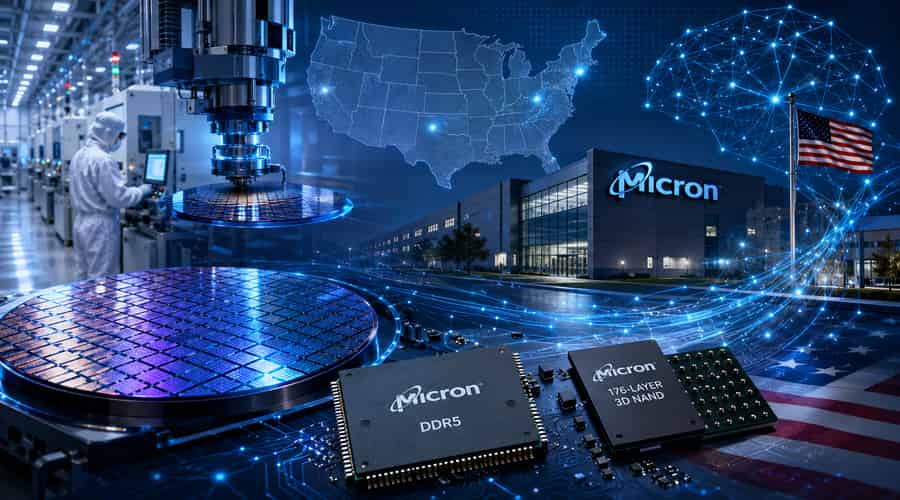
Micron has started advanced DRAM manufacturing in Virginia, but the bigger story is timing. AI demand is moving faster than new memory capacity can arrive.
Micron is turning its Manassas, Virginia fab into a more important piece of the U.S. chip supply chain just as AI infrastructure is putting unusual pressure on memory markets. The company said on May 22 that it has begun manufacturing 1-alpha DRAM at the site, calling it the most advanced memory technology yet produced in the United States.
That sounds technical, but the market signal is simple. Memory is no longer a quiet component sitting behind the headline processors. It is becoming one of the constraints that decides how quickly cloud providers, model builders, automakers, defense suppliers and industrial companies can build the systems they now want.
Micron CEO Sanjay Mehrotra framed the Virginia milestone as part of the company’s roughly $200 billion U.S. investment plan across manufacturing and research. Micron said in its May 22 release that the Manassas expansion is backed by more than $2 billion of investment and is expected to quadruple the company’s DDR4 wafer supply at the site, with qualified 1-alpha DRAM production expected by the end of calendar 2026.
The important point is not that Manassas will suddenly solve the AI memory shortage. It will not. The Virginia facility is focused on long-lifecycle products used in automotive, defense and aerospace, industrial, networking and medical device markets. Those are not the same as the highest-end HBM stacks attached to the latest AI accelerators.
But the announcement still matters because AI is pulling the entire memory industry tighter. Micron, Samsung and SK Hynix are the three major global DRAM suppliers, and when AI data centers absorb more advanced memory capacity, the pressure does not stay neatly contained in one product category. It moves through pricing, procurement and capital allocation across the portfolio.
That is why a domestic DRAM milestone aimed partly at critical industries can still matter to AI planners. If memory becomes strategically scarce, reliable local supply is not just a political talking point. It becomes a planning tool. Automakers want predictable component access. Defense contractors want trusted supply. Cloud providers want multi-year commitments. Everyone is trying to avoid being caught at the back of the line.
Micron has already been clear that customer demand is running ahead of available supply. The company’s fiscal second-quarter 2026 results, released on March 18, showed revenue of $23.86 billion, up from $8.05 billion a year earlier, and Micron guided for $33.5 billion in fiscal third-quarter revenue. The numbers explain why investors are watching every capacity update closely. This is no longer just a cyclical recovery story. It is a test of how quickly the memory industry can add supply without overshooting later.
Domestic fabs move on a slower clock
The hard part is that fabs do not move at the speed of AI model demand. Training clusters, inference workloads and enterprise AI rollouts can change purchasing forecasts in a quarter. Semiconductor construction, qualification and yield improvement take years. Micron expects initial wafer output from its first Idaho fab in mid-calendar 2027, while its larger New York complex remains a longer-range buildout.
That timing gap is where the tension sits. U.S. incentives, including CHIPS Act support, can make domestic projects more attractive, but they do not erase the physics of manufacturing. A new memory fab needs specialized equipment, clean-room capacity, trained labor, supplier coordination and customer qualification. Money helps. It does not compress every step.
Manassas is different because Micron is modernizing an existing facility rather than starting from bare ground. That gives the Virginia project more near-term relevance, especially for markets that need secure supply of mature and long-lifecycle memory. Micron says its Manassas facility is the only fully owned 300mm fab in the U.S., and the company has said only about 2% of the world’s memory chips are manufactured domestically, all at that site.
For hyperscalers, the more direct question remains high-bandwidth memory. HBM is central to AI accelerator performance because it feeds processors with data fast enough to keep expensive compute from sitting idle. If HBM supply is tight, a company can have money, power contracts and data center space and still struggle to deploy systems on schedule.
That makes Micron’s broader U.S. roadmap worth watching beyond Virginia. The company has said its U.S. expansion includes leading-edge DRAM fabs in Idaho and New York and advanced HBM packaging capabilities. Those pieces are more directly tied to the next phase of AI infrastructure, but they will arrive over time, not all at once.
The practical takeaway is that Micron’s latest move strengthens the domestic memory base, but it also highlights how stretched the market has become. AI is making memory a boardroom issue, a procurement issue and a national supply chain issue at the same time. The next thing to watch is not only whether Micron can build on schedule, but whether demand forecasts keep rising faster than the industry’s most ambitious expansion plans.
Also read: AI recreations of dead pilots force NTSB to rethink public data • The S&P 500 rally is reopening the exit conversation • Blue Origin is turning Florida into a launch capacity bet