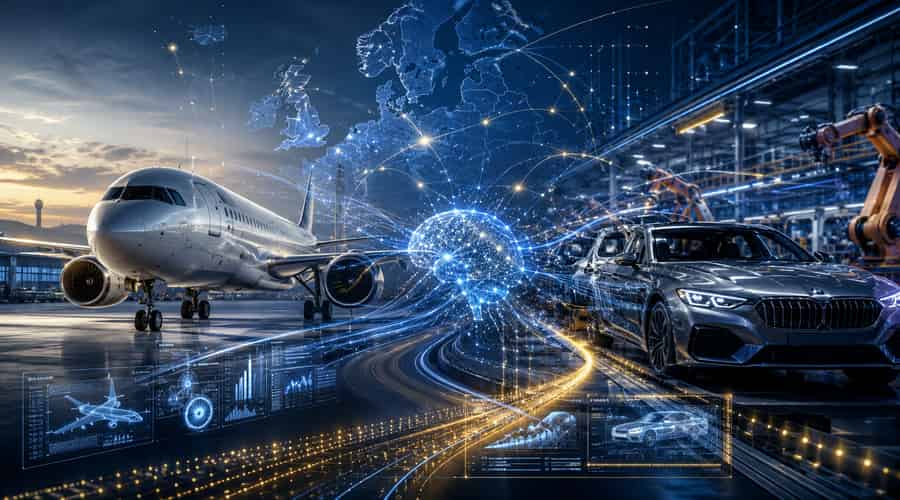
Mistral AI is moving from a French startup story to an industrial AI supplier story, but the stronger evidence is its recent Emmi AI acquisition rather than unverified Airbus and BMW contracts.
Mistral's industrial push is real. The cleaner way to frame it is not as a pair of confirmed procurement wins at Airbus and BMW, because public evidence for those specific deals is thin. The story is that Mistral is buying its way deeper into the kind of engineering and manufacturing work European companies badly want to automate, while industrial groups such as BMW and Airbus show why that market is becoming more valuable.
According to Reuters, Mistral said on May 19 that it had acquired Austrian physics AI startup Emmi AI for an undisclosed sum, a deal aimed at strengthening its offer to industrial clients across Europe. Emmi AI specializes in models for complex physics problems such as airflow, heat transfer and material stress. That is not a generic chatbot use case. It goes much closer to the work that determines how aircraft, cars, chips and industrial systems are designed, tested and improved.
That distinction matters. Generative AI has already moved through the easy layer of enterprise adoption, from internal assistants to document search and software coding tools. The harder prize is operational AI that can live inside engineering workflows, use sensitive data, and produce output trusted by teams that deal with safety, manufacturing constraints and regulated processes. If Mistral wants to become more than Europe's answer to OpenAI, it has to prove it can serve that layer.
BMW's own AI strategy shows why the market is opening. The automaker says it is using AI across development, procurement, production and customer service, and its Leipzig plant is preparing a humanoid robot pilot for summer 2026 in high-voltage battery assembly and component production. That project is with Hexagon Robotics, not Mistral, but it still points to the broader shift: manufacturers are no longer treating AI as a side experiment. They are looking for systems that can operate in production environments and connect to the physical work of making things.
Airbus fits the same industrial logic. Aerospace companies face constant pressure to cut costs, compress development cycles and protect engineering data. That makes simulation, design assistance and production optimization obvious areas for AI investment. It also makes vendor choice more sensitive. In aircraft manufacturing, the value of AI is not just whether a model can generate a plausible answer. It is whether the system can be governed, integrated, audited and trusted around proprietary engineering work.
Europe's procurement habits are shifting
The broader signal is more important than any single logo. Europe has spent years talking about AI sovereignty, but industrial procurement is where that argument becomes practical. When manufacturers, banks and public-sector buyers select AI vendors, they are not only buying model performance. They are buying data control, legal comfort, deployment flexibility and a supplier relationship they can explain to boards and regulators.
That gives Mistral a real opening. The company is European, independent and increasingly positioned around sensitive enterprise work. HSBC signed a multi-year agreement with Mistral in late 2025 to use generative AI across the bank. BNP Paribas has also worked with Mistral models, while Stellantis expanded its collaboration with the company in areas including vehicle and enterprise applications. None of that removes U.S. hyperscalers from the market, but it does show that large buyers want more than one AI stack.
There is also a political layer that should not be overstated but cannot be ignored. European policymakers want local AI capacity, and industrial groups want leverage against dependence on American and Chinese technology providers. Those two interests are starting to meet in purchasing decisions. Mistral does not win because it is European alone. It wins if its European identity comes with strong enough models, useful enterprise tooling and deployment options that fit regulated buyers.
What it means for Mistral's value
For Mistral, the commercial logic is clear. Industrial and enterprise contracts can be slower to land than consumer growth, but they are often more durable once the technology is embedded. A model that helps with engineering simulation, manufacturing planning or internal process automation is harder to swap out than a consumer app subscription. That is exactly the kind of revenue investors like to see.
The valuation context makes the point sharper. Mistral said in September 2025 that it raised 1.7 billion euros at an 11.7 billion euro valuation, with ASML leading the round through a 1.3 billion euro investment. ASML also agreed to work with Mistral on AI across its semiconductor equipment portfolio, research, development and operations. That is one of the strongest examples of Mistral moving into serious industrial territory, because ASML sits at the center of the global chip supply chain.
The risk is that industrial AI is slow, messy and full of integration work. Buying Emmi AI gives Mistral stronger technical depth, but it still has to turn that depth into repeatable products and revenue. Manufacturers will test aggressively before placing AI near sensitive workflows, and procurement teams will want proof that the systems perform reliably under real constraints.
Still, the direction is clear. Mistral is trying to become part of Europe's industrial operating system, not just another model lab with a polished interface. The next thing to watch is whether the company can convert its ASML partnership, banking wins and Emmi AI acquisition into visible, recurring industrial revenue. That will tell us whether Europe's AI sovereignty story is becoming a business, or remaining a slogan.
Also read: MiniMax's revenue surge shows China's AI labs are learning to sell • Orbital Industries raises 50 million as AI-for-science funding heats up • Geordie AI's 30 million raise shows the agent stack is getting a control layer