Investors just tried to put more than seven times as much money into SK Hynix's Nasdaq debut as the company is actually selling.
You don't see demand like that very often, not even in a market obsessed with anything touching artificial intelligence. Bloomberg reported on July 8 that SK Hynix's US share offering was more than seven times oversubscribed ahead of its Thursday pricing, with interest coming from global long-only funds, technology-focused funds, sovereign wealth funds and Asia-focused investors.
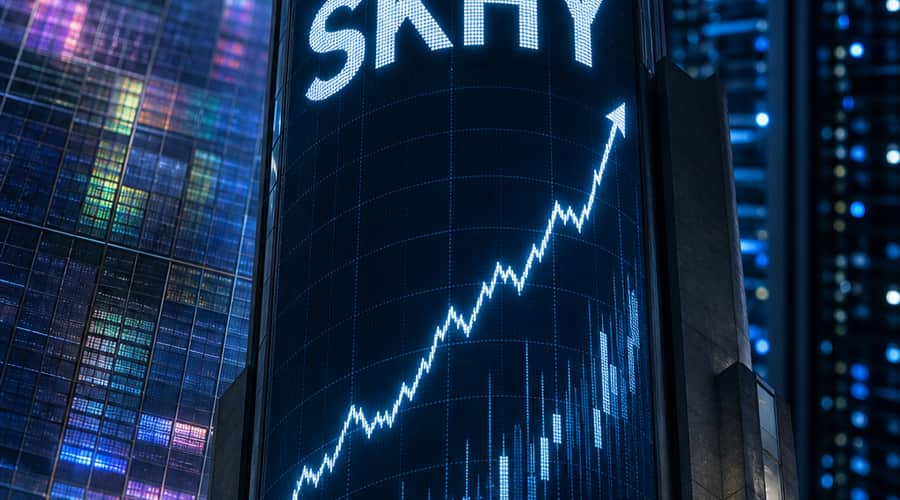
The South Korean chipmaker priced its American depositary receipts at 255,500 won apiece on Thursday, taking the offering to roughly $28.2 billion. That makes it the largest IPO by a foreign issuer on a US exchange in history, eclipsing Alibaba's $25 billion listing in 2014, and the second-biggest US listing of any kind this year behind only SpaceX's $85.7 billion Nasdaq debut in June. Trading in the ADRs, under the ticker SKHY, is set to begin Friday, July 10.
Here's what's actually driving it. SK Hynix is the world's top supplier of high-bandwidth memory, the specialized chips that sit next to Nvidia's GPUs and feed them data fast enough to keep an AI cluster running. Nvidia CEO Jensen Huang visited SK Hynix's booth at Computex 2026 and wrote "Please Make More" on an HBM4E wafer, a small moment that says a lot about how tight supply has gotten. According to Bloomberg, three investors alone, Baillie Gifford Overseas, Coatue Management and Situational Awareness Partners, had separately indicated interest in buying up to a combined $7 billion of the ADRs before the deal even priced.
SK Hynix isn't riding this cycle alone. DRAM and NAND prices have climbed through 2026 as Samsung and Micron compete for the same fabrication capacity, and SK Hynix's own quarterly results this year have repeatedly beaten estimates on HBM sales tied to Nvidia's roadmap. That backdrop is why underwriters felt comfortable pricing this deal near the top of the range instead of trimming it to fit softer conditions.
None of this comes with a calm chart attached. SK Hynix's Seoul-listed shares have swung by double digits in single sessions over recent weeks, the kind of move that reflects how leveraged the stock has become to AI capex headlines. A cyclical memory chipmaker trading on Nvidia's order book, and on how convinced Wall Street is that hyperscalers keep spending, is a volatile combination. The Nasdaq debut layers first-day trading uncertainty right on top of it.
That's the tension worth sitting with. Sevenfold oversubscription tells you institutional money still wants direct exposure to the physical infrastructure behind AI, the chips and the memory and the factories that make them, even as a separate argument rages over whether hyperscaler capital spending is sustainable at its current pace. Much of the financial press has spent 2026 chronicling that skepticism, questioning whether Microsoft, Meta, Amazon and Google can keep spending tens of billions a quarter on data centers without a matching jump in revenue. SK Hynix's book build suggests that whatever caution exists in that debate hasn't reached the investors who actually allocate capital to the memory supply chain.
It also puts real pressure on how the deal trades once it opens. Heavy oversubscription usually gives underwriters room to price at the top of the range, part of why the final take landed above the roughly $24 billion figure floated earlier in the week. It raises the odds of a strong first-day pop, similar to what happened when SpaceX jumped 19% on its debut. But it cuts the other way too. A stock that opens rich on hype has further to fall if HBM demand cools or if Nvidia's own order book shifts.
Frankly, the number that matters here isn't the 7x. It's the $7 billion that three funds committed before pricing even happened. That's not retail money chasing a hot ticker. That's Baillie Gifford. That's Coatue. That's Situational Awareness Partners - firms that size positions around long-term theses, deciding the HBM supply crunch has years left in it. Whether that bet pays off depends on something SK Hynix doesn't control: whether the AI buildout that Nvidia, Microsoft and the rest keep funding actually shows up in earnings, or whether 2026 turns out to be the year the spending finally outran the returns.
Also read: Man Group Is Betting Big on AI Tokens While Wall Street Debates the Bill • CXMT's $4.3 Billion IPO Puts Beijing's Chip Ambitions to a Real Test • Zhipu raises $4 billion in Hong Kong days after its stock surged nearly 1,500 percent