Elon Musk's Terafab plan is no longer just a big idea on stage. It is now moving through local approvals, supplier talks and the bottleneck every advanced chip project eventually meets: ASML.
The most important part of Musk's chip ambition may not be the Texas land, the tax break or even the headline investment number. It is whether his companies can get close enough to the machinery layer that decides how many advanced AI chips the world can actually make.
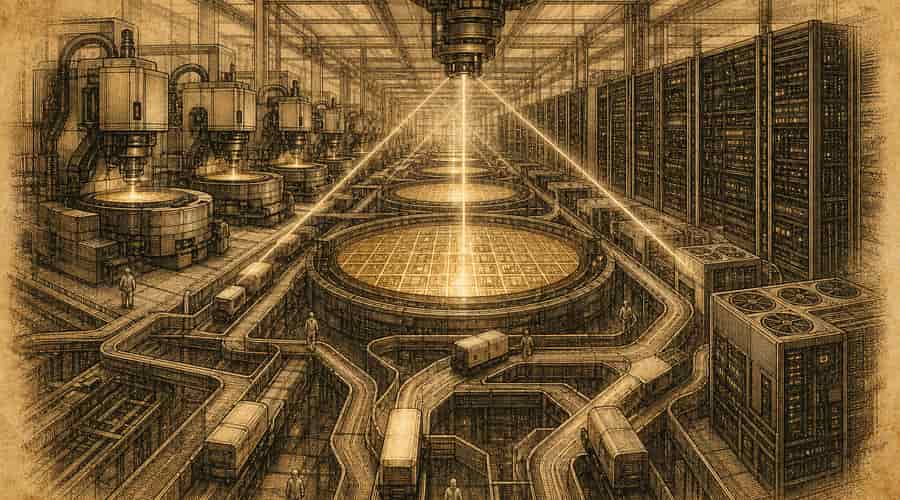
That is why ASML matters so much here. The Dutch company is the only commercial supplier of extreme ultraviolet lithography systems, the machines used to produce the most advanced semiconductors. Reuters has described those systems as indispensable to the AI boom, and ASML's own 2025 results showed recognized revenue on 48 EUV systems. For a project like Terafab, money is only one part of the problem. Access, timing and engineering capacity may matter more.
The latest development is not a launch video or another broad claim about future compute. On June 5, KBTX reported that Grimes County, Texas, had released documents for SpaceX's proposed Terafab agreement after county commissioners approved a tax abatement package earlier in the week. The documents showed a 100% abatement on buildings and equipment for 10 years, beginning in 2027 and running through 2036, but also noted that the agreements had not yet been signed by SpaceX officials.
The fine print is important. The written agreements require SpaceX to invest at least $5 billion by 2030 and create 1,800 jobs by 2035, even though the company has publicly discussed a much larger $55 billion commitment. They also allow SpaceX to terminate the agreement with 30 days' notice. That does not make the project meaningless, but it does make the gap between public ambition and binding obligation worth watching.
A public vote moves Terafab forward, but it does not turn it into a working semiconductor plant. Semiconductor factories are not like software launches. They depend on equipment slots, trained workers, yield learning, water and power planning, and a long list of suppliers that already serve TSMC, Samsung, Intel, SK hynix and Micron.
Terafab has been described in county filings as a vertically integrated semiconductor manufacturing and advanced computing fabrication facility at the Gibbons Creek Reservoir site. Earlier filings described an initial investment that could reach $55 billion, with later phases potentially taking the overall project as high as $119 billion. Those figures are enormous, but they still do not change the basic semiconductor arithmetic.
If Terafab wants to manufacture leading-edge AI processors at scale, it needs access to the tools that print the finest circuit patterns on silicon. That means ASML's EUV systems, and eventually the newer High NA generation if the project wants to compete at the most advanced nodes. These machines cost hundreds of millions of dollars each, require deep customer support, and are usually planned years in advance with the world's biggest chipmakers.
This is where Musk's direct engagement with ASML becomes more than a courtesy call. Reports in May said ASML chief executive Christophe Fouquet had spoken directly with Musk and described him as serious about Terafab. That does not mean ASML has committed equipment, changed delivery schedules or put Musk ahead of existing customers. It does mean the conversation has moved into the part of the supply chain where ambition meets scarcity.
For AI companies, that scarcity is becoming a strategic issue. Nvidia still dominates accelerator supply, TSMC remains central to advanced manufacturing, and memory suppliers are racing to add high-bandwidth memory capacity. But ASML sits even further upstream. Without lithography capacity, every plan downstream becomes a negotiation over who gets wafers, when they get them, and at what cost.
The Bigger AI Hardware Lesson
Musk's companies have a particular reason to care. Tesla wants chips for autonomous driving and robotics. xAI needs compute for model training and inference. SpaceX has its own advanced hardware needs and could become the entity that carries the heavy industrial side of the project. If those businesses keep expanding their chip demand, relying entirely on outside foundries leaves them exposed to the same capacity fight facing every serious AI operator.
Building a fab is the extreme answer to that problem. It promises control, but only after years of spending and execution risk. TSMC's C.C. Wei has repeatedly warned that new plants take years to build and more time to ramp. Nvidia's Jensen Huang has also cautioned that manufacturing semiconductors is an extremely hard engineering problem, not just a capital problem. Those warnings are worth taking seriously because the chip industry punishes shortcuts quickly.
There is also a political angle. A massive SpaceX-linked fab in rural Texas would sit inside the broader U.S. effort to bring more semiconductor capacity onshore. Local officials see jobs and tax revenue. Residents see infrastructure pressure, water concerns and a powerful company receiving large incentives. Nationally, the project would add another private actor to a supply chain already shaped by export controls, government subsidies and geopolitical pressure around Taiwan, China and the Netherlands.
The practical takeaway is simple. Terafab should be judged less by its biggest projected number and more by evidence that the supply chain is actually lining up. Signed county agreements would be one step. Confirmed tool orders would be a much bigger one. Clear partnerships with equipment makers, foundry veterans and packaging specialists would matter more than another statement about future compute targets.
If Musk can move from local approvals to credible semiconductor execution, Terafab could become one of the most consequential AI infrastructure bets in the United States. If he cannot, it will still tell us something important: the next AI race is not only about models, talent or data centers. It is about who can reach the machines that make the chips before everyone else does.
Also read: The helium squeeze is becoming an AI chip supply risk • Elizabeth Warren puts Nvidia’s China chip sales in Congress’s sights • Meta's smart glasses now carry a bigger biometric risk