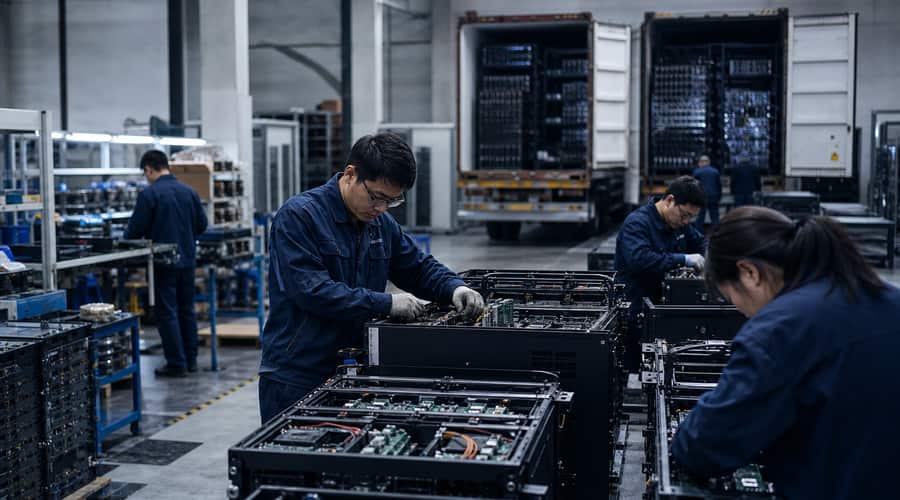
NVIDIA is expanding its infrastructure strategy through a deepening partnership with Marvell Technology, targeting custom silicon solutions that could reshape AI data center economics by 2026.
NVIDIA needs partners to keep building the physical backbone of artificial intelligence, and Marvell Technology is becoming one of the most important of those partners. The two companies have been quietly tightening their collaboration around custom chip design and high-speed data interconnects, a move that signals where NVIDIA sees the next wave of AI infrastructure spending heading. This is not about NVIDIA designing yet another GPU. It is about building the connective tissue between compute nodes, memory systems, and networking layers that determines whether a multi-billion-dollar AI data center actually performs at scale.
Marvell brings something NVIDIA cannot easily replicate on its own: deep expertise in application-specific integrated circuits, or ASICs, and the high-speed interconnect protocols that link thousands of chips together into a coherent system. As AI models grow from billions to trillions of parameters, the bottleneck is no longer just raw compute power. It is bandwidth, latency, and the ability to move enormous volumes of data between processors without creating logjams. That is exactly where Marvell's portfolio fits.
The largest hyperscale cloud providers, including Microsoft, Google, Amazon, and Meta, have all started designing their own custom AI accelerators. Google's TPU lineage is well documented. Amazon has its Trainium and Inferentia chips. Microsoft recently unveiled its Maia 100 accelerator. These companies want to reduce their dependence on NVIDIA's expensive, supply-constrained GPUs for at least part of their workloads. What they still need, however, is the networking and interface silicon that connects those custom chips into functional clusters. That is the gap Marvell targets, and it is why NVIDIA views the partnership as complementary rather than competitive.
According to reporting from Techgenyz, the collaboration is expected to yield new infrastructure products aligned with NVIDIA's platform roadmap through 2026 and beyond. The timing is deliberate. NVIDIA's next-generation architecture, codenamed Rubin, is slated to succeed the current Blackwell generation, and the surrounding ecosystem needs to be ready on day one. Delays in networking or interconnect components can strand expensive compute resources, a problem hyperscalers are desperate to avoid after the supply chain chaos of 2023 and early 2024.
For startups and enterprise AI teams, the practical impact is straightforward. More integrated infrastructure means better price-to-performance ratios for training and inference. It also means fewer compatibility headaches when deploying large models across distributed systems. If NVIDIA and Marvell can deliver on the promise of tighter coupling between compute and interconnect silicon, the cost of running frontier models could drop meaningfully, opening the door to smaller organizations that currently find GPU economics prohibitive.
The Competitive Landscape
Marvell is not the only company chasing this opportunity. Broadcom has long dominated the custom ASIC and networking chip space, and it counts Google among its most significant customers for TPU-related silicon. AMD is investing heavily in its own interconnect and networking portfolio following its acquisition of Pensando. Intel, despite well-documented struggles, continues to push its Gaudi accelerators and associated infrastructure. But Marvell has carved out a particularly strong position at the intersection of data center networking, storage controllers, and custom compute, making it a natural fit for NVIDIA's ecosystem strategy.
The financial stakes are significant. NVIDIA's data center revenue exceeded $47 billion in its fiscal 2025, driven almost entirely by AI-related demand. Marvell's data center business, while smaller, has been growing rapidly and now represents its largest end market. Wall Street analysts tracking the semiconductor sector have noted that Marvell's custom silicon pipeline could generate several billion dollars in annual revenue within the next few years if major design wins continue to materialize on schedule.
What to watch next is whether this partnership produces tangible product announcements at NVIDIA's annual GTC conference or whether the companies keep details under wraps until closer to the Rubin launch window. Either way, the direction is clear. The next phase of the AI buildout will be won not by whoever has the fastest single chip, but by whoever can build the most coherent, efficient system around it. NVIDIA knows this, and Marvell is proving to be a critical piece of that system-level vision.