Nvidia’s RTX Spark is a direct push to make AI PCs useful for developers, not just another label on premium hardware.
Nvidia is no longer content to own the data center rack. With RTX Spark, it is trying to move the AI argument back onto the desk, into the laptop bag, and inside Windows itself.
The company unveiled RTX Spark on June 1 during its Taipei announcements around Computex 2026, positioning it as a new class of processor for slim Windows laptops and compact desktop PCs built around local AI agents, creative work, gaming, and developer workloads. That matters because the AI PC category has been full of promise but short on proof. Most people still use cloud services for serious AI work, while laptop makers have spent the past two years adding neural processors that often feel more like a spec-sheet requirement than a reason to buy a new machine.
RTX Spark is Nvidia’s attempt to raise the stakes. According to Nvidia’s June 1 announcement, the chip combines a Grace Arm CPU, a Blackwell RTX GPU, CUDA, TensorRT, DLSS, OptiX, Reflex, G-SYNC, and support for up to 128GB of unified memory. Ars Technica reported that the configuration includes a 20-core Grace CPU co-developed with MediaTek and up to 6,144 Blackwell GPU cores. That is not a casual office PC pitch. It is a developer and prosumer machine dressed up as the next phase of personal computing.
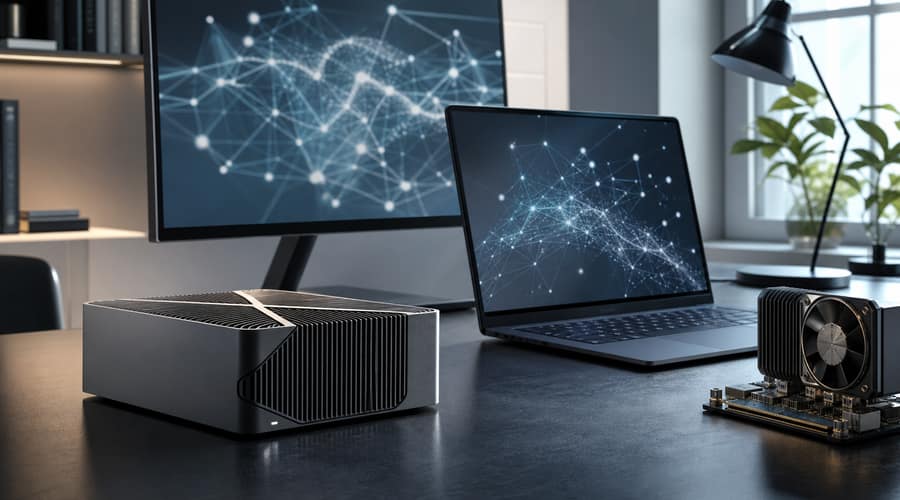
The newer development is Microsoft’s Surface RTX Spark Dev Box, reported on June 3 as a compact desktop aimed at developers who want sustained local AI performance in a small system. Microsoft says the box offers up to one petaflop of AI compute, 128GB of unified memory, and a 100-watt thermal envelope. That gives the story a sharper point. This is not only Nvidia announcing a chip. It is Microsoft giving the platform a first-party Windows device, which turns RTX Spark from a silicon story into a strategy story.
The problem with the AI PC has never been marketing. The industry has had plenty of that. The problem has been that the value has often been hard to feel. A faster background blur, a better search box, or a few offline assistant features do not change how developers, creators, or businesses make buying decisions.
RTX Spark is aimed at a more demanding user. If a developer can run larger models locally, test agents without paying for every cloud call, or keep sensitive data on the machine during early development, then the hardware has a cleaner argument. Local inference is not just about speed. It is about cost control, privacy, latency, and the ability to keep working when cloud access is inconvenient or expensive.
That is why the 128GB unified memory figure matters. Memory has become one of the practical limits of local AI. A machine that can hold larger models and move data between CPU and GPU more efficiently gives developers room to experiment. It will not replace cloud training clusters, and it does not need to. The more useful question is whether it can reduce the number of tasks that have to leave the device in the first place.
This also plays directly into Nvidia’s wider position. The company already dominates AI accelerators in the cloud, but cloud dominance alone leaves room for others to shape the client side of computing. Qualcomm has been pushing Windows on Arm, AMD and Intel are building AI features into PC chips, and Microsoft wants Windows to look relevant in a world where work increasingly starts with a prompt. RTX Spark gives Nvidia a way to carry its software stack, especially CUDA, into a category that has historically belonged to x86 PC incumbents.
Local AI is still a bet
There is a practical challenge here. Developers will not rebuild workflows just because a chip is impressive. They need tools, drivers, libraries, model support, and a Windows experience that does not make Arm compatibility feel like a tax. Microsoft and Nvidia appear to understand that. Microsoft has pointed to Windows ML and TensorRT support, while gaming-focused coverage has highlighted work around anti-cheat systems, Prism emulation, and Xbox PC app compatibility.
That last part may sound like a side issue, but it is not. If RTX Spark laptops are supposed to be everyday premium PCs as well as AI machines, then the basics have to work. Games, creative tools, developer environments, and common Windows applications cannot feel like a compromise. The AI story will not save a machine that struggles with ordinary PC expectations.
Price is another open question. Microsoft has not given pricing for its Surface RTX Spark Dev Box, and early coverage suggests these systems will sit at the high end of the market. That makes sense for a first wave. Developers, AI researchers, creators, and enterprise teams are the users most likely to pay for local compute before the mass market catches up.
For startups, this is the interesting part. If more capable local AI machines become common, product design changes. Apps can lean on on-device models for private drafts, code assistants, media generation, customer data analysis, and offline workflows. Cloud AI will still carry the heaviest loads, but the edge becomes more capable. That gives software teams a new architecture to think about.
The risk is that this becomes another hardware cycle where the label arrives before the behavior. The opportunity is that RTX Spark gives the AI PC a clearer job: bring serious inference closer to the person doing the work. Watch the developer tools, not the slogans. If the software stack is strong and the systems arrive at a price businesses can justify, Nvidia may have made the Windows PC fight much more interesting.
Also read: Putin is pulling Russia’s AI race closer to the Kremlin • Alphabet is turning the AI race into a capital markets test • Cerebras is turning Nvidia exclusion into an AI chip strategy