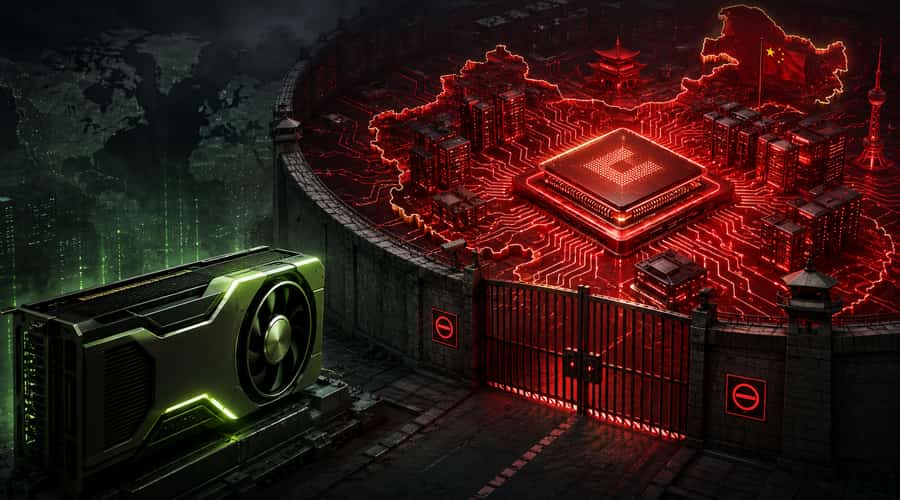
Nvidia's China problem is no longer theoretical. Huawei's Ascend business is now large enough to make the country's domestic AI chip shift look permanent, not temporary.
Jensen Huang has spent the past year warning that if Nvidia is kept out of China, Huawei will not wait politely at the door. Now that warning has become the market. The Nvidia chief told CNBC that the company has largely conceded China's AI chip market to Huawei, a blunt admission from the company that still defines AI infrastructure almost everywhere else.
The timing matters because Huawei is no longer just the patriotic alternative Chinese companies test when Nvidia hardware is hard to get. According to a Reuters report citing the Financial Times, Huawei expects AI chip revenue to reach about $12 billion this year, up from $7.5 billion in 2025, based on orders it has already received. Most of that demand is tied to the Ascend 950PR processor, which entered mass production in March, with a 950DT upgrade planned for the fourth quarter.
That number changes the conversation. A $12 billion AI chip business is not a lab project, and it is not a symbolic procurement program. It is enough volume to pull software teams, cloud buyers, model builders, suppliers and government planners into the same orbit. Once that happens, Nvidia is not just losing sales. It is losing habit.
For years, the assumption was that U.S. export controls would slow China's AI progress by limiting access to the most capable accelerators. That logic still has force at the frontier. Nvidia's Blackwell and Rubin systems remain ahead of what Huawei can offer, especially when the full stack of chips, networking, memory, software and developer tools is counted together.
But markets do not always wait for the best product. They often move toward the product that is available, supported and politically durable. In China, that increasingly means Ascend. ByteDance, Alibaba and Tencent have all been reported among the large domestic buyers shifting more procurement toward Huawei, partly because Nvidia supply is uncertain and partly because Beijing wants the local stack to mature.
The H200 story shows how quickly uncertainty can become strategy. Nvidia received approval for sales to some Chinese customers, and Huang said earlier this year that orders existed. But the chips have not turned into a smooth reopening of the market. Washington has conditions. Beijing has its own industrial priorities. Chinese buyers have to decide whether a foreign chip that can be blocked again is worth rebuilding plans around.
That is where Huawei gains. It does not need to beat Nvidia globally to win inside China. It needs to be good enough, available enough and aligned enough with the domestic direction of travel. For many Chinese AI companies, those three conditions may now matter more than raw benchmark leadership.
Export controls have created a second stack
The most important shift is not simply that Huawei is selling more chips. It is that China's AI infrastructure is being forced to organize itself around a separate technical stack. Nvidia has CUDA, the software moat that made its GPUs the default choice for AI developers. Huawei has CANN and the Ascend ecosystem, which still trails Nvidia in maturity but now has something it previously lacked: a captive market with serious spending behind it.
This is how substitutes become competitors. First they are inconvenient. Then customers adapt. Then software gets optimized, engineers get trained, vendors build tools and procurement departments stop treating the workaround as temporary. The moment that flywheel starts turning, reversing it becomes much harder than approving a chip shipment.
There are still real limits. Huawei depends on China's domestic semiconductor supply chain, including advanced manufacturing capacity that remains constrained compared with TSMC. Yields, memory bandwidth, packaging and production speed all matter in AI hardware, and these are not problems solved by demand alone. If Chinese model builders need the very highest-end training clusters, Nvidia remains the benchmark they measure against.
But the market is telling a different story from the spec sheet. Ascend does not have to be the world's best chip to become the default chip in the world's second-largest AI market. It has to support enough workloads at enough scale while Nvidia remains exposed to policy risk. That is the opening Huawei is walking through.
For Nvidia investors, the immediate concern is not that the company is suddenly weak. It is not. Global AI infrastructure demand remains enormous, and Nvidia's lead outside China is still formidable. The issue is the revenue ceiling. China was once the market Nvidia could not afford to miss, and Huang has previously described the opportunity there as tens of billions of dollars. If that market closes structurally, future growth has to come from a narrower geography of customers.
For the wider AI industry, the implication is more strategic. U.S. policy may have slowed China's access to the best American chips, but it also accelerated the commercial case for a Chinese alternative. The result is a more divided AI hardware market, with one stack led by Nvidia and another increasingly shaped by Huawei. The next thing to watch is not whether Ascend matches Blackwell. It is whether Chinese developers stop needing to ask that question at all.
Also read: Nvidia is watching Huawei turn China into a real AI chip market • Hidden audio commands expose a new weak point in voice AI • California moves first on the AI jobs problem