
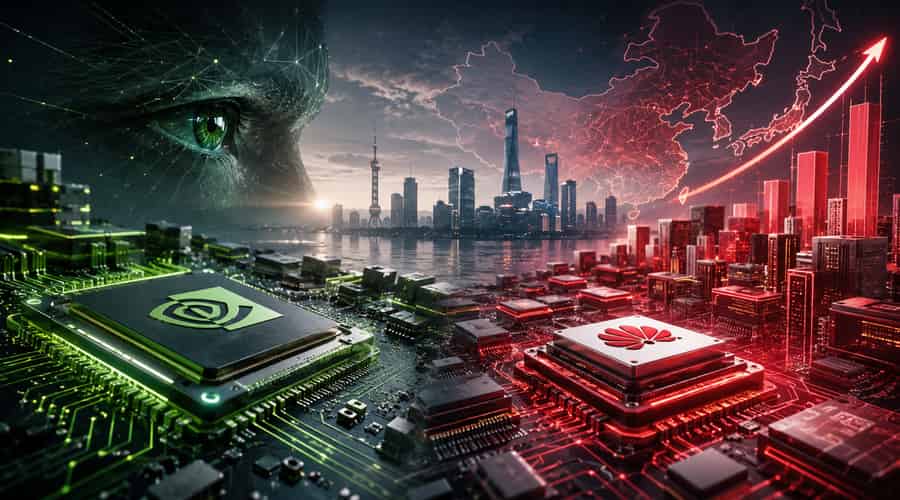
Jensen Huang's latest China comments show that Nvidia's problem is no longer just export controls. Huawei's reported $12 billion Ascend order book means Chinese AI buyers are building around domestic silicon at real scale.
Nvidia has spent years warning Washington that if American chips are kept out of China, China will not wait politely for permission to build AI. Now Jensen Huang is saying the quiet part in public: Nvidia has effectively ceded the Chinese AI accelerator market to Huawei, and the replacement is no longer theoretical.
The important number is not just Nvidia's lost revenue. It is Huawei's reported $12 billion in expected AI chip revenue for 2026, up from about $7.5 billion last year, based on orders already in hand. According to Reuters citing the Financial Times, those orders are coming from the same class of Chinese technology buyers that once treated Nvidia hardware as the obvious default for training and inference capacity.
That changes the way investors and founders should read this story. Huawei's Ascend line is not simply a sanctions workaround anymore. It is becoming an infrastructure choice for companies that need compute, cannot plan around steady access to Nvidia's best systems, and now have a domestic supplier backed by policy, procurement pressure and a growing software stack.
For a long time, the cleanest version of the China chip story was simple. Nvidia had the best accelerators, Chinese companies wanted them, and export rules made that relationship difficult. The market was constrained, but not necessarily lost.
That view is getting harder to defend. Huang has told CNBC in recent months that Huawei is a serious competitor and that if the United States does not participate in China, Huawei has the country covered. More recently, industry coverage of his comments has framed Nvidia's China share in AI accelerators as having fallen to essentially zero, a brutal reversal from the period when it dominated the market.
There is still demand for Nvidia in China. That is not the issue. The issue is whether Chinese customers can build their next generation of AI systems around a supplier they cannot reliably receive from. Data centers are not phone upgrades. Once a company commits engineering teams, model tuning, networking, procurement and software tooling to one hardware base, reversing that decision becomes expensive.
That is why Huawei's order volume matters. A few symbolic pilot projects would not change the market. A multibillion-dollar order book does. It tells Chinese startups and cloud providers that Ascend capacity is not merely available, but increasingly normal. In AI infrastructure, normal is powerful because developers build for what is present, not what they wish regulators would allow.
The software stack is the real battlefield
Nvidia's strongest advantage has never been only the chip. CUDA, libraries, developer familiarity and the huge installed base around Nvidia systems made its hardware easier to adopt and harder to leave. That ecosystem effect is why American export controls always carried a strategic risk. Blocking the hardware creates space for a rival stack to mature.
Huawei is trying to fill that space with Ascend processors, CANN software, data center systems and broader enterprise relationships. The company does not need to beat Nvidia's highest-end Blackwell or Rubin systems chip for chip in every benchmark to win domestic share. It needs to give Chinese buyers enough performance, enough supply certainty and enough local support to keep projects moving.
That is particularly important for Chinese AI startups. A company that secured Ascend allocation early may now have a planning advantage over rivals still hoping for imported H200 supply or future exemptions. The advantage may not be raw performance. It may be cost visibility, delivery certainty and the ability to optimize models around hardware that Beijing wants the market to adopt.
Western investors often underestimate that kind of advantage because they look first at theoretical performance gaps. But infrastructure markets do not always reward the perfect product. They reward the product that customers can get, deploy and scale. Huawei's rise is a reminder that commercial traction can close a technical gap faster than outsiders expect, especially when a national market is pushing in one direction.
For Nvidia, the long-term concern is not that China disappears from one quarter's revenue line. Nvidia has enough demand from American cloud companies, sovereign AI projects and global enterprises to remain the center of the AI buildout. The concern is that a huge developer market learns to live without it.
If China's AI companies train engineers, write code and build data centers around Ascend, Nvidia may find that reentry is not as simple as winning a license or designing a compliant chip. The market will have moved on. Customers who were once waiting for Nvidia could become customers who no longer need to wait.
The next thing to watch is not only whether Washington loosens export rules or whether Beijing allows limited Nvidia shipments. It is whether Huawei can turn this order surge into repeat deployments, stronger software adoption and real performance at scale. If it can, the AI chip market becomes less global and more divided, with Nvidia leading one world and Huawei hardening its position in another.
Also read: Palantir's USDA contract puts federal worker monitoring on the AI map • Nvidia is learning how fast China can move without it • Google turns Gemini Omni into a new front door for AI video