Nvidia's Computex moment is not just about faster chips. It is about making the rest of the computer industry build around its version of the AI future.
Jensen Huang arrived in Taipei with the one thing every hardware company wants right now: leverage. Nvidia already owns the most valuable layer of the AI infrastructure boom, and its Computex push made clear that the company wants to stretch that advantage from data centers into workstations, edge systems and eventually the PCs sitting on corporate desks.
That matters because AI is moving from experiment to deployment. For the last three years, companies have been asking whether generative AI would be useful enough to justify the spending. Nvidia's own live updates from GTC Taipei said Huang told the audience that AI is now both a profit generator and a GDP generator, language that says a lot about where the company thinks the next wave of demand will come from.
This is not a small change in positioning. If AI becomes a normal operating layer for companies, the buying decision is no longer just about who has the fastest GPU inside a hyperscale data center. It becomes about servers, networking, edge machines, developer tools and PCs that can handle more local AI work without sending everything back to the cloud.
For AMD, Qualcomm and Intel, the uncomfortable part is that Nvidia no longer needs to win the PC market in the old way. It does not have to replace every processor in every laptop. It only has to convince developers, enterprises and hardware makers that an AI PC is more valuable when it is connected to Nvidia's software and silicon ecosystem.
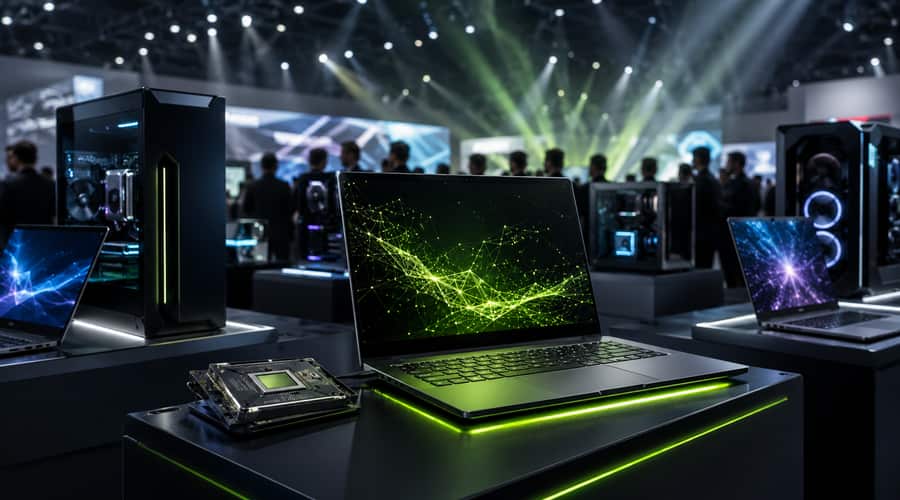
That is why the pre-Computex signals around Nvidia-powered Windows machines drew so much attention. According to Axios, Microsoft, Dell and Nvidia were expected to show the first Windows computers using Nvidia chips as the main processor across Computex and Microsoft's Build developer conference. The same report said Microsoft was preparing software to help AI agents do more work locally on Windows computers.
That last point is the real story. A local AI PC is not exciting because it can summarize a document without opening a browser tab. It becomes interesting when agents begin handling work across files, apps and company systems, and when businesses start looking for ways to cut cloud inference costs. If more AI tasks move onto the device, hardware makers get a new reason to refresh corporate fleets. Software companies get a new surface to build for. Chipmakers get a new battlefield.
Qualcomm has spent years trying to make Windows on Arm more credible, helped by strong battery life and improving performance. Nvidia entering that lane could validate the category, even while making Qualcomm's life harder. Intel and AMD face a different pressure. They have deep PC relationships and x86 compatibility on their side, but the AI PC conversation is increasingly being shaped by accelerators, developer tools and model performance, not just CPU generations.
Infrastructure is still the center of gravity
The easier mistake is to treat the PC angle as the whole Computex story. It is not. Nvidia's stronger hand remains AI infrastructure, where its roadmap now runs through Grace Blackwell, Vera Rubin, networking, software and a long list of manufacturing partners that most buyers never see but every deployment depends on.
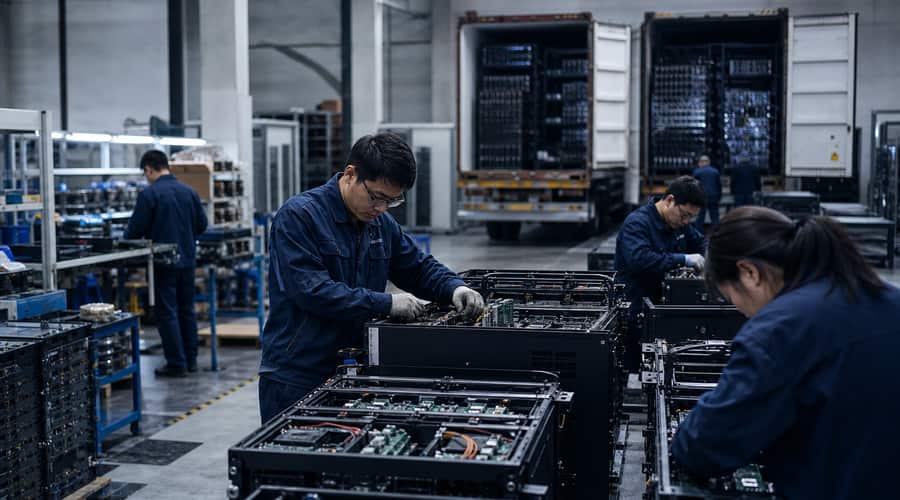
Huang's Taipei schedule underlined that point. Nvidia highlighted its relationships with Quanta, TSMC and the broader Taiwan supply chain, while also pointing to Vera Rubin systems that can involve almost 2 million parts and about 150 ecosystem partners in Taiwan. That is not a normal product launch. It is an industrial coordination problem, and Nvidia is trying to make itself the company that coordinates it.
For entrepreneurs, that is the useful lesson. Nvidia's power is not only in its chips. It is in the way the company has built a market where many other companies make money by aligning with its roadmap. Server makers, cooling suppliers, networking vendors, software developers and cloud operators all become part of the same commercial flywheel. Once that happens, competitors are not fighting one product. They are fighting a system.
Dell, Lenovo, Asus and other PC makers are watching this closely because AI spending is no longer only a hyperscaler story. Enterprises want smaller deployments, private AI systems, edge machines and workstations that fit into existing procurement habits. Hardware companies that can package Nvidia's stack into usable products will have a clearer path to budgets than companies selling abstract AI potential.
There is still risk here. AI infrastructure spending is expensive, power hungry and politically sensitive. PC buyers may also move slowly if the local AI use cases feel too narrow or if Windows on Arm still creates software friction. We have seen big PC refresh narratives fade before when the practical benefit was not obvious enough.
But Nvidia is not betting on one refresh cycle. It is betting that AI work will spread across every layer of computing, from the data center rack to the laptop and the robot. If that happens, Computex 2026 will be remembered less for any single chip announcement and more for the moment Nvidia made the rest of the hardware industry choose how closely it wants to follow.
Also read: SoftBank's AI bet is testing Toyota's hold on Japan's market crown • SK hynix shows why AI investors are moving into memory • Jiducloud becomes a unicorn as China’s AI money moves into 3D tools