Investors are treating Nvidia's expected Korea meetings as a signal that the next AI winners may be the companies building memory, robots and real-world infrastructure around its chips.
The rally in Samsung Electronics and LG Electronics is not just another burst of AI enthusiasm. It is a bet that South Korea's largest technology groups are moving from suppliers at the edge of Nvidia's world into the machinery at the center of it.
That distinction matters. Nvidia's rise has already lifted chip designers, foundries, server makers and power equipment suppliers. Now investors are looking further down the stack, toward the companies that can provide high-bandwidth memory, factory automation, robotics systems, cooling equipment and industrial hardware. Samsung and LG fit that story in different ways, and Monday's trading showed how quickly the market is willing to reprice them when Jensen Huang is expected in the room.
According to Reuters, shares in Samsung Electronics, LG Electronics and other South Korean technology firms rallied Monday as Nvidia CEO Jensen Huang was expected to visit South Korea later this week and meet senior executives, including LG Group Chairman Koo Kwang-mo. Reuters also reported that Samsung Electronics rose 9.5 percent, while LG Electronics jumped 28 percent.
For Samsung, the story is memory. For LG, it is physical AI. Together, they show how Nvidia's supply chain is widening from chips that train models into systems that let AI operate in factories, homes, vehicles and data centers.
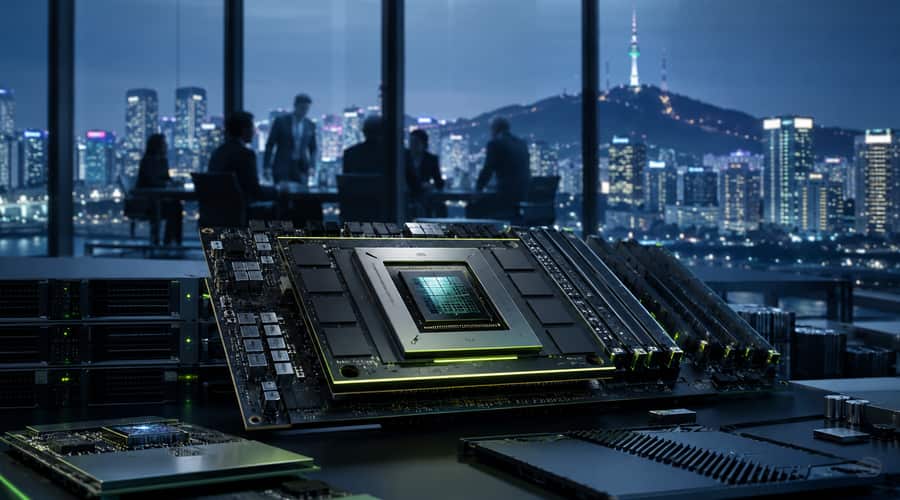
Samsung's strongest card is its latest high-bandwidth memory push. On May 29, the company said it had begun shipping 12-layer HBM4E samples to major global customers. Samsung described the product as using sixth-generation 10-nanometer-class DRAM and a 4-nanometer logic base die, with speeds of up to 16 gigabits per second per pin and bandwidth of up to 3.6 terabytes per second per stack.
Those figures sound technical, but the commercial meaning is simple. Nvidia's AI accelerators need memory that can feed enormous volumes of data into compute engines without slowing the system down. In that market, timing is everything. A supplier that qualifies early can end up designed into a platform for years. A supplier that misses the window may be left fighting for lower-volume business after the biggest contracts are already spoken for.
That is why Samsung's HBM4E shipment is being watched so closely. SK Hynix has held the stronger position in Nvidia's high-end HBM supply chain, especially after Samsung struggled to gain the same traction with earlier HBM3E supply. Samsung now wants investors and customers to believe the next round will look different.
Sample shipment is a meaningful step, but it is not the finish line. Nvidia and other large customers still have to test performance, thermals, signal integrity, power behavior and production consistency. The market will care less about who announces first and more about who can deliver qualified volume at acceptable yields. In AI memory, a fast sample can open the door. Reliable mass production keeps it open.
LG is selling a different AI story
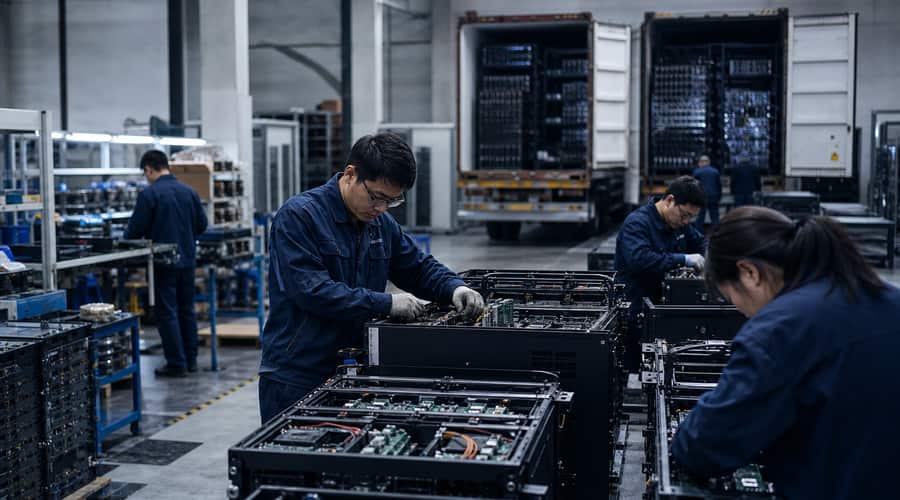
LG's rally has a different shape. It is not trying to become the next HBM leader. It is trying to show that physical AI can become a serious business across robots, mobility, appliances, data centers and commercial sites.
LG has already been preparing that message. In its first-quarter 2026 results, the company reported revenue of 23.73 trillion won and operating profit of 1.67 trillion won. Its home appliance unit delivered 6.94 trillion won of revenue and 570 billion won of operating profit, while the vehicle solutions business recorded its highest-ever quarterly revenue and operating profit, with operating margin above 6 percent for the first time. LG also pointed to future opportunities in AI data center cooling, home robots and robot components.
That is why a possible Nvidia meeting matters to LG. Nvidia's robotics and simulation platforms can give LG a stronger software and compute layer for machines that move through real environments. LG already has hardware distribution, appliance design, vehicle component exposure and commercial relationships. Nvidia has the AI stack. The market is betting that the two pieces may fit.
Physical AI is still a young category, and investors should treat it with care. Robots are harder to scale than software because they have to work safely, cheaply and repeatedly in messy real-world settings. Margins can be pressured by components, service costs and long qualification cycles. But LG does not need robots to become a mass-market miracle overnight. It needs credible partnerships, enterprise demand and margin evidence to convince investors that its hardware base can carry higher-value AI services over time.
The broader Korean market move shows what is really being priced. Nvidia is no longer viewed only as a buyer of chips. It is becoming the anchor customer, partner and standard setter for a much larger industrial ecosystem. That gives Korean conglomerates a chance to sell more than components. They can sell capacity, integration and deployment.
The next few sessions will be telling. If the meetings produce concrete language around supply, robotics cooperation or data center infrastructure, the rally may have more room. If the news stays vague, investors may start separating real contract potential from simple proximity to Nvidia. In this cycle, being near the AI buildout helps. Being built into it is what changes the valuation.
Also read: China tightens AI deal rules after blocking Meta's Manus purchase • ChatGPT is testing a small fix for long conversation threads • Cognitive debt is becoming AI's hidden business cost