Nvidia's latest Taiwan pledge is less a surprise than a confirmation. The company is still building its AI future around the island, even as Washington pushes harder to pull more chip work onto U.S. soil.
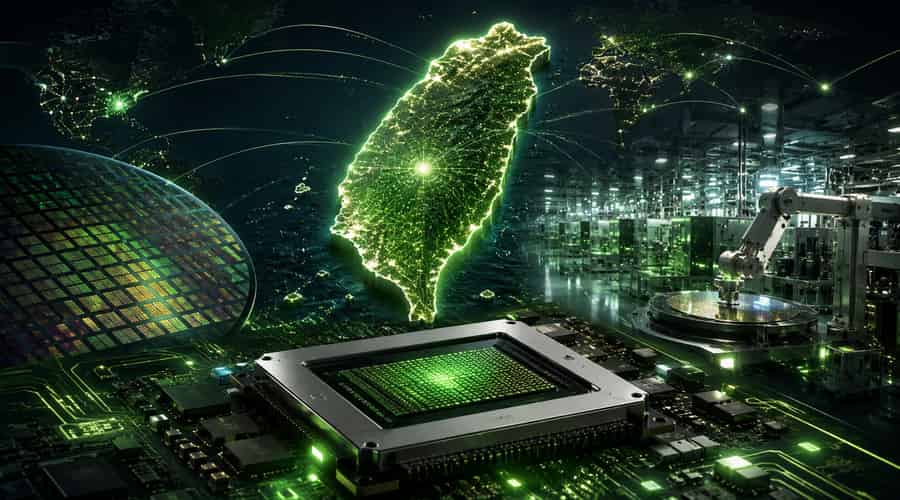
Nvidia's chief executive said on Wednesday that the company plans to invest around 150 billion a year in Taiwan, calling it the "epicentre" of the AI revolution and a manufacturing hub that will matter for a long time, Reuters reported. That is a loud signal at a moment when the Trump administration is still pressing for more domestic chip production and more visible proof that the CHIPS Act can rebuild strategic capacity inside the United States.
The scale matters because it tells you where Nvidia sees the least friction and the most leverage. Taiwan remains the place where the company can stay closest to TSMC, which still fabricates Nvidia's most advanced AI chips, and to the broader ecosystem of packaging, systems integration and supplier density that AI hardware depends on. Reuters noted that Nvidia is planning to deepen that relationship even further with a new Taipei campus, known as Constellation, which is expected to break ground this year and open in 2030.
Nvidia's pitch is practical, not sentimental. Four or five years ago, Huang said the company was spending about 10 billion to 15 billion a year in Taiwan, and that figure has now climbed to roughly 100 billion, with the next target at 150 billion. That trajectory says more about the actual economics of AI hardware than any policy speech does. Building equivalent capacity in the U.S. is possible, but it is slow, expensive and dependent on a supply chain that still has to be assembled piece by piece.
That is why TSMC remains indispensable. A Reuters report from late 2024 said TSMC was in talks with Nvidia to make Blackwell chips at its Arizona plant, but those chips would still need to be shipped back to Taiwan for packaging because the U.S. site lacked the necessary CoWoS capacity. In other words, even when production migrates, the chain still bends back toward Taiwan. For buyers waiting on H-series systems or Blackwell successors, the message is straightforward: the bottlenecks are not disappearing just because factories are being announced in Arizona or Texas.
The timing also tells its own story. Nvidia's spending commitment lands while the U.S. government is trying to make reshoring sound inevitable. It is not inevitable. It is a long industrial project, and Nvidia is behaving like a company that wants optionality more than slogans. The island offers speed, scale and proximity to the core of the AI manufacturing stack, and those advantages are still winning.
Policy pressure and lobbying
There is also a political read here. Nvidia has already shown that it knows how to operate across shifting export rules and government priorities, especially after months of lobbying around AI chip sales and U.S. policy toward China, as Reuters and other outlets have documented. A deeper commitment to Taiwan gives the company more room to argue that policy should focus on supply-chain resilience, not just on moving headlines. If advanced packaging, board assembly and key fabs are still centered in Taiwan, then a simplistic reshoring narrative misses the real constraint.
That does not mean Nvidia is rejecting U.S. manufacturing. It is doing the opposite, but on its own terms. The company can support domestic capacity while still acknowledging that the fastest path to meeting AI demand runs through Taiwan. For Washington, that creates an awkward reality: policy can subsidize the reshoring effort, but it cannot replace the dense industrial web that Taiwan already has.
For investors, the implication is equally clear. Nvidia appears willing to live with geopolitical risk in the Taiwan Strait because the alternative, rebuilding the same manufacturing depth elsewhere, would cost more and take longer than the market is willing to wait. That is a bet on continuity. It also assumes that the premium on supply security can be managed through diversification, not relocation.
For enterprise buyers, the takeaway is less dramatic but more useful. Availability for future AI systems will still depend on Taiwan-centric capacity expansion, and that means lead times, pricing power and allocation decisions will continue to be shaped by TSMC's roadmap rather than by political talking points in Washington. Nvidia's 150 billion figure is not just a spending claim. It is a forecast for where the center of gravity in AI hardware will remain well into the next decade.
Also read: MCP security flaws are turning AI infrastructure into a supply-chain risk • Illinois just raised the bar for AI regulation • Remote shows AI can lift revenue without lifting headcount