A 14-person company nobody outside developer circles has heard of now runs inside 85% of the Fortune 500, and it just raised $65 million to keep it that way.
Fourteen people built a company that now sits inside the majority of America's largest corporations, and you've probably never heard its name. Ollama, the open source tool that lets developers run AI models on their own laptops and servers with a single command, closed a $65 million Series B this month, led by Theory Ventures. Benchmark, 8VC, Y Combinator, Pace Capital, 49 Palms and GTMFund all joined in, pushing the company's total funding to $88 million.
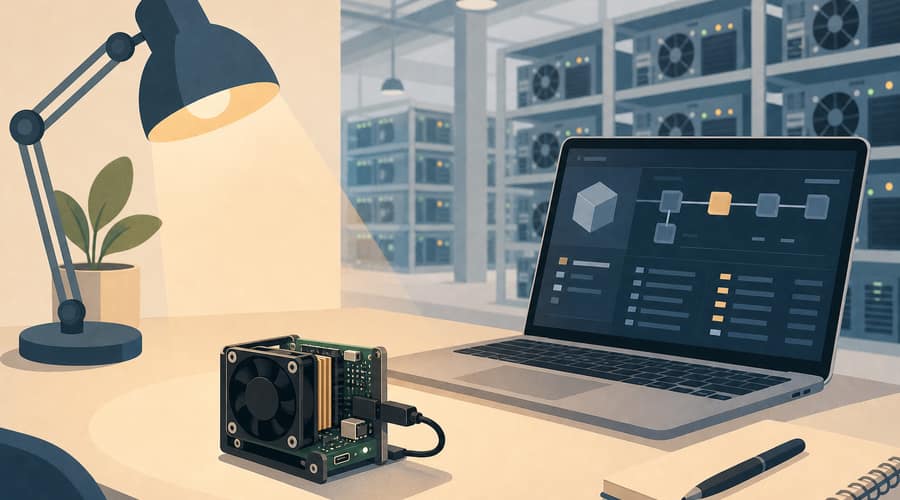
Jeffrey Morgan and Michael Chiang built Ollama on a simple premise. Instead of shipping a prompt to a cloud API and hoping nobody looks at it, you download the model's weights and run them yourself, on hardware you control. Type one command and Llama, Mistral, DeepSeek or dozens of other open weight models spin up locally. No API key required. No data leaving the building.
The numbers explain why investors showed up. Ollama says it now has 8.9 million monthly developers, more than 67,000 integrations built on top of it, and a user base that has doubled since January, according to founder and CEO Jeffrey Morgan. TechFundingNews reported the company is still running with just 14 employees. That's a startling ratio for a tool embedded in government, healthcare and finance, three industries that don't let vendors near sensitive data without a fight.
This isn't Ollama's first raise. Benchmark's Peter Fenton led a $15 million Series A before this round, a bet that looked modest at the time. This new round is more than four times that size, raised when Ollama was mostly known among developers testing models on their own laptops for free.
Here's the thing Theory Ventures is betting on. Meta's Llama family, Mistral's models out of Paris, and DeepSeek's releases out of China have all narrowed the distance to GPT and Claude on standard benchmarks over the past year. The models are becoming commodities. When that happens, the argument goes, whoever controls the layer that runs the model well - reliably, securely, cheaply - captures the value that used to sit with the model maker. Theory Ventures' Tomasz Tunguz called the local inference layer 'one of the most valuable positions in software.' His firm put money behind that view, not behind another model lab.
That framing is a direct wager against the API-first model that OpenAI and Anthropic have built their businesses on. Every prompt sent to ChatGPT or Claude leaves your infrastructure and lands on someone else's servers. For a hospital system or a bank, that's not a minor inconvenience. It's often the reason a project never leaves committee.
Why regulated industries picked this over a chatbot subscription
A bank's compliance team doesn't want account data touching a third-party API, no matter how good the model is. Running Ollama on internal hardware keeps everything inside the firewall, which is precisely why the company says it found traction in those same regulated sectors instead of just startups experimenting with chatbots. Frankly, that's a harder story to make exciting than a flashy consumer app, and it's exactly why Ollama spent two years building quietly instead of marketing loudly.
Ollama hasn't disclosed a valuation for this round, and it hasn't disclosed revenue either. What it has disclosed is a growth rate: nearly a million new installs a week, run by a team you could fit in a single conference room. If open models keep closing the gap with closed ones, the software running them locally becomes the layer everyone has to build on, whether or not they ever say Ollama's name out loud.
Also read: Hachette, Elsevier and Scott Turow Sue Google Over Gemini's Book Training • IBM Suffered Its Worst Trading Day Since 1987 As Clients Chased AI Hardware • Adam Mosseri Says AI Token Costs Could Soon Match Engineer Salaries