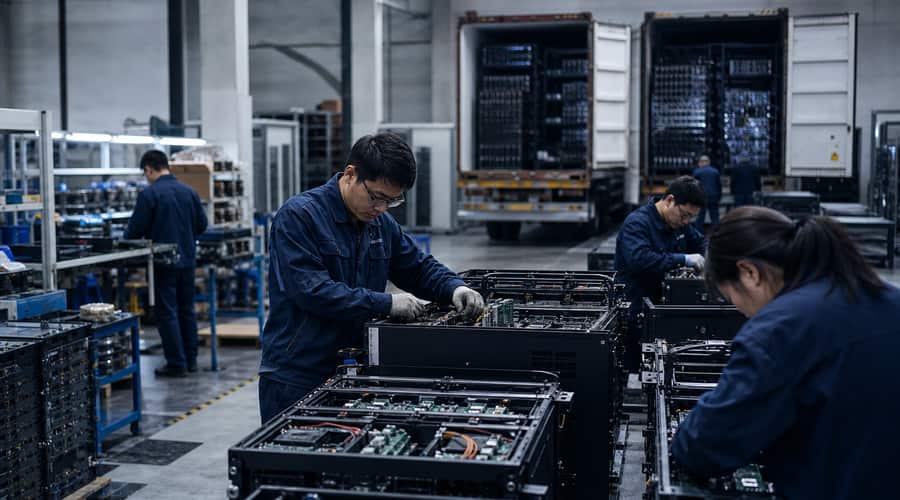
OpenAI president Greg Brockman has told Bloomberg the company expects to spend $50 billion on computing in 2026, a figure that places OpenAI's infrastructure commitment on the same order of magnitude as the largest hyperscaler capital expenditure programs in the world, and that forces a fundamental reframing of what OpenAI is: not a software company that uses cloud infrastructure, but one of the largest infrastructure buyers in the AI economy, whose competitive position depends on sustaining capital deployment at a scale that its revenue base does not yet fully support and that no venture-backed startup in its competitive category can approach.
The $50 billion figure requires decomposition before its implications become clear. OpenAI's computing spend covers several distinct categories. The largest is inference infrastructure: the GPU capacity required to serve ChatGPT's 600 million weekly active users across consumer, API, and enterprise channels at the response latencies that users expect. Inference at that scale, running GPT-4o and GPT-5 class models on queries that average several thousand tokens each, requires sustained GPU utilisation across a fleet that is measured in hundreds of thousands of chips. The second major category is training: running the experiments, ablations, and full training runs that produce each new model generation requires clusters of tens of thousands of GPUs operating continuously for weeks to months per major training run, plus the storage and networking infrastructure that moves training data to compute and model checkpoints to evaluation systems. The third category is research and safety infrastructure: the compute required for interpretability research, red-teaming, capability evaluations, and the experimental work that produces techniques applied to future model generations. Together, these categories explain how $50 billion in computing spend is possible even before adding the real estate, power procurement, cooling systems, and hardware refresh cycles that a data center portfolio of this scale requires.
The financing picture behind $50 billion in 2026 computing spend is the structural fact that gets obscured by the operational narrative. OpenAI's annualised revenue run rate was reported at approximately $10 billion at the end of 2024 and has been growing rapidly, with some estimates placing the 2025 full-year revenue near $14 to $16 billion. Even at the optimistic end of those estimates, spending $50 billion on computing in a single year requires either massive debt financing, continued equity fundraising, or drawing down on the capital raised in its 2025 funding rounds totaling approximately $40 billion. OpenAI is not self-funding at $50 billion annual compute spend. It is deploying capital raised from SoftBank, Microsoft, and other investors on the bet that the revenue growth trajectory will eventually close the gap between spending and earnings. That bet has been made before in technology: Amazon ran at near-zero profitability for years while building the infrastructure that eventually generated AWS's margins. The question for OpenAI is whether its path to profitability requires becoming an infrastructure provider at scale, similar to how AWS monetised Amazon's data center buildout, or whether the model API and ChatGPT subscription businesses can generate the margins required to service the infrastructure investment without an equivalent platform business underneath them.
The GPU supply and cloud pricing implications of OpenAI's compute commitment are the most direct transmission mechanism through which this spending affects the broader AI startup ecosystem. OpenAI is among Nvidia's largest customers, and its purchasing commitments at the scale implied by $50 billion in annual computing spend influence Nvidia's production allocation decisions, H100 and B200 availability in the spot market, and the pricing environment for GPU cloud compute across all providers. When a single buyer represents a meaningful fraction of the total available supply of the highest-demand GPU SKUs, that buyer's purchasing decisions create availability and pricing externalities for every other buyer in the same market. An AI startup that is trying to run training experiments on H100 capacity rented from Lambda Labs, CoreWeave, or AWS is operating in a market where the pricing and availability of that capacity is partly determined by what the largest buyers have committed to. The $50 billion OpenAI commitment, combined with comparable commitments from Google, Microsoft, Amazon, and Meta, means that GPU capacity allocation is effectively determined at the frontier lab and hyperscaler level, and the residual capacity available to the startup ecosystem is priced at whatever the large buyers have left after their procurement needs are met.
The moat versus capital trap question is the strategic one that investors evaluating OpenAI's trajectory and founders deciding whether to build on OpenAI's infrastructure are both asking. The moat argument is straightforward: the models that $50 billion in 2026 computing produces will be more capable than anything that $5 billion or $500 million in computing can produce, and if model capability at the frontier translates to product advantages that customers pay for, the spending creates a performance gap that competitors cannot close without matching the investment. The models that cost most to produce are the ones that can do things cheaper models cannot, and the use cases where that capability difference matters, complex reasoning, long-context synthesis, multimodal understanding at high quality, are precisely the use cases that enterprise customers are willing to pay premium prices to access. The capital trap argument is equally straightforward: if model performance improvements from additional compute are subject to diminishing returns at scale, if open-source models trained at much lower cost continue to close the capability gap with frontier models, and if inference cost continues to decline faster than frontier model capability improves, the $50 billion in annual computing spend generates diminishing competitive advantage relative to its cost. The honest answer is that both dynamics are real and their relative magnitude over the next three to five years is genuinely uncertain.
For founders building on OpenAI's API, the $50 billion compute commitment is simultaneously reassuring and concerning for reasons that operate at different time horizons. The near-term reassurance is capacity: a company spending $50 billion on computing in a single year is not going to run out of inference capacity for API customers. The reliability, latency, and availability of OpenAI's API infrastructure will be supported by a hardware base that is expanding rapidly. The medium-term concern is pricing power: a company with $50 billion in annual compute costs and the largest API user base in the world has both the motivation and the market position to price API access in a way that supports its infrastructure economics rather than in a way that maximises developer accessibility. OpenAI has cut API prices substantially over the past two years, tracking the trajectory of most cloud computing commodities as infrastructure efficiency improves, but a company whose cost base is growing at infrastructure scale will eventually face the tension between developer-friendly pricing and investor-expected unit economics. Founders who build their product economics around the assumption that OpenAI API pricing will continue declining indefinitely are making a bet that the $50 billion compute investment story does not obviously support.
Also read: Scott Turow and Major Publishers Allege Mark Zuckerberg Personally Authorized Meta's Mass Copying of Copyrighted Books and That Allegation Changes Everything About This Lawsuit • Pennsylvania Has Sued Character.AI Over a Chatbot That Posed as a Doctor and the Case Is Redefining What Consumer AI Companies Are Liable For • The Hard Drive Shortage Is Real and AI Is the Reason Storage Is Becoming the Infrastructure Constraint Nobody Was Watching