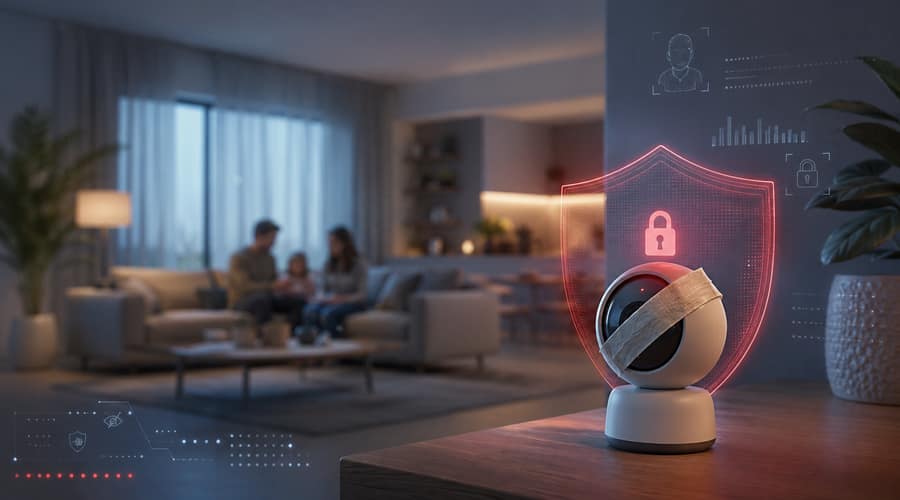
A viral claim says OpenAI is paying New Yorkers to record ordinary household routines with 360-degree cameras. The important story is not that the claim is confirmed, but that AI companies now need physical-world data badly enough for everyone to believe it might be.
The latest OpenAI privacy debate did not begin with a product launch. It began with a secondhand claim that moved from social media into Reddit threads and AI roundups, saying OpenAI was paying New York City residents to place 360-degree cameras around their homes and record daily chores such as vacuuming, washing dishes and cooking.
That claim remains unverified. OpenAI has not publicly announced such a program, and the visible online trail points back to posts describing a conversation with someone who allegedly said he was doing temporary work for the company. AI Pulse Daily's May 22 roundup listed the story as an allegation, while Reddit users immediately split between people who saw it as a natural next step for home robotics and people who thought the memory-card collection detail sounded implausible.
Even with that caveat, the reaction tells us something useful. The market no longer sees household video as science fiction. It sees it as training infrastructure.
AI models have already consumed enormous quantities of text, images, code and video from the open web. That kind of data is useful for writing an email, summarizing a legal document or producing a synthetic clip. It is much less useful for understanding how a person clears a table, reaches for a saucepan, folds laundry or avoids bumping into a chair in a cramped apartment.
This is where embodied AI changes the economics of data. A system that can help in the physical world needs to learn timing, space, object permanence and ordinary human habits. It needs to see the difference between a clean counter and a counter that is clean enough. It needs to understand that dishes are not just objects, but part of a routine involving water, soap, cabinets, drying racks and human preference.
Google DeepMind has been explicit about this direction. Its Open X-Embodiment work brought together real robot data from many institutions, and its AutoRT research used more than 50 robots across multiple buildings to collect 77,000 real robot episodes. Meta took a different route with Ego4D, a large first-person video dataset built around daily-life activity, with consent and de-identification procedures placed at the center of the project.
OpenAI is also moving toward the physical world. Axios reported in January that the company was on track to unveil its first device in the second half of 2026, after Sam Altman's push into hardware with Jony Ive. In March, Axios also reported that Sora's research team would focus on world simulation work for robotics and real-world physical tasks. Put those pieces together and a home-data rumor becomes easier to understand, even if the specific claim is still not proven.
The privacy problem is not theoretical
A camera in the home is different from a chatbot prompt. It may capture children, guests, contractors, medical devices, financial papers, intimate spaces and audio from people who never agreed to join an AI training program. Consent is simple when one adult checks a box. It becomes much more complicated when the data comes from a living room shared by a family, a babysitter and a neighbor who stopped by for five minutes.
New York adds another layer. The city has a biometric identifier law for certain commercial establishments that collect, use or retain biometric information, including rules around notice and restrictions on sale. That law is not a perfect fit for a paid in-home research program, but it shows the direction of travel. Once video is analyzed to identify faces, bodies, voices or behavioral patterns, a company is no longer just collecting footage. It is building personal data from the most private spaces people have.
Audio creates its own risk. New York is generally treated as a one-party consent state for audio recording, but a company collecting household recordings would still need to think carefully about who is participating in each conversation, whether guests understand what is happening and how recordings are stored, reviewed and deleted. A consent form signed by the homeowner may not solve every practical problem inside the home.
There is also the question of third-party access. The alleged account says workers collected memory cards. If true, that would raise basic security questions around chain of custody, encryption, contractor access and loss. If false, it still points to the same issue every AI company faces: real-world video is messy, heavy and sensitive, and moving it safely is not just a logistics problem.
OpenAI's public consumer data guidance says content from individual services may be used to improve and train models unless users opt out, while API and business data is handled differently unless customers choose to share it. That framework is built for digital products. A household camera program would need a much more specific rulebook, including clear participant rights, bystander protections, retention limits and a meaningful way to withdraw data after collection.
The practical takeaway is straightforward. AI companies want models that understand the world, and the world is not neatly available on the public internet. If the industry is going to move from screens into kitchens and bedrooms, it will need stronger consent architecture before the cameras arrive, not after the backlash starts.
For now, the OpenAI home-camera story should be treated as an unconfirmed claim, not an established fact. But the market signal is real. The next fight over AI data will not only be about books, websites or images. It will be about who gets to watch ordinary life closely enough to automate it.
Also read: SoftBank’s OpenAI bet is becoming the market’s AI IPO signal. • AI momentum is now carrying the global stock market higher • NTT Docomo's Tokyo land sale shows AI is repricing old telecom assets