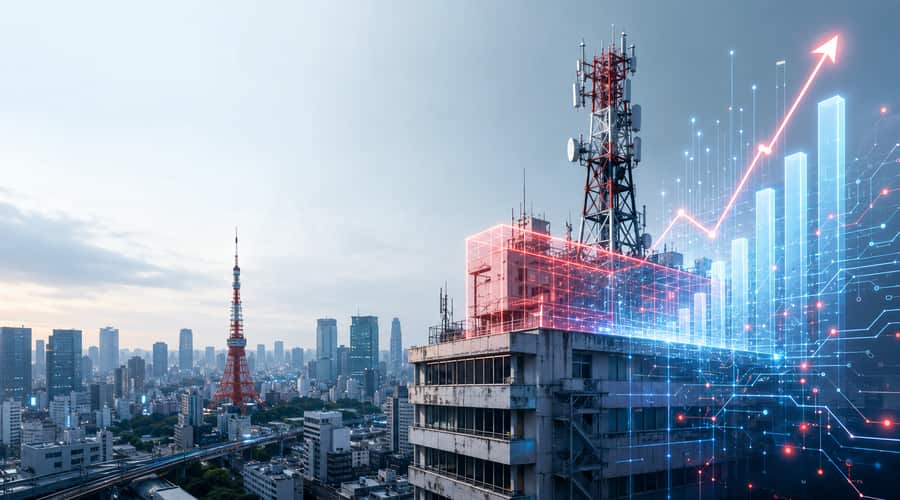
NTT Docomo's reported real estate review is not just a balance sheet story. It shows how telecom land is being reconsidered as Japan's AI infrastructure race puts new value on power, fiber and urban access.
NTT Docomo has become part of a bigger question now moving through Asian real estate: what should telecom companies do with physical assets that may be more valuable to infrastructure investors than to the operators that built them?
The Japanese mobile carrier has been weighing the sale of land around several office buildings in the Tokyo metropolitan area, with the total value expected to exceed $600 million, The Business Times reported in December, citing Bloomberg. That is different from a completed sale, and it matters. The story is not that Docomo has already cashed out a specific parcel. It is that land once treated as supporting infrastructure is now being tested against a very different market.
That shift is worth watching. Tokyo land has always been expensive, but sites with access to power, fiber routes, dense enterprise demand and established regulatory familiarity are becoming something else. In the AI era, they can look more like strategic inputs than passive assets sitting under office towers and network facilities.
For Docomo, the review fits a wider effort to make capital work harder after years of pressure in Japan's mobile market. The company remains the country's largest wireless carrier, but competition from KDDI, SoftBank and Rakuten Mobile has kept margins under pressure and forced operators to rethink what they need to own. Reported assets under review included land around the NTT Docomo Yoyogi Building in Shibuya, one of Tokyo's more recognizable telecom properties.
Artificial intelligence has made data centers a mainstream investment story, but the physical requirements are still easy to underestimate. Models need chips, chips need electricity, and the facilities that house them need locations that can connect reliably to both power grids and high-capacity networks. That makes certain pieces of urban or near-urban land far more valuable than their current use might suggest.
Japan is a natural place for this repricing to show up. Tokyo and Osaka are already major cloud and colocation markets, and operators have been adding capacity for hyperscale customers, enterprise cloud migration and AI workloads. ResearchAndMarkets' latest Japan colocation update points to AI and GPU demand, hyperscale expansion in Tokyo and hybrid cloud adoption as key drivers. This is not a distant forecast. It is already changing how investors think about land, power and connectivity.
The government is adding pressure from the other side. Japan has been trying to strengthen domestic AI capacity through projects such as GENIAC and support for post-5G infrastructure, while public agencies are exploring broader use of generative AI. These policies do not automatically create data centers, but they do increase demand for secure, local and resilient computing capacity. That demand needs somewhere to go.
The new value of telecom assets
Telecom companies own assets that many developers cannot easily recreate. They have central sites, long-standing rights of way, switching facilities, fiber connections, engineering knowledge and relationships with utilities and regulators. Some of those assets were built for older communications networks. Now investors are asking whether they can support cloud regions, edge computing, private AI systems or data center development.
This is where Docomo's reported review becomes more than a Japanese property story. Across Asia-Pacific, carriers and infrastructure owners are under pressure to release capital from assets that are valuable but not always essential to own outright. Tower sales have already shown the pattern. Operators sell physical infrastructure, lease back what they need, and use the proceeds for network upgrades, digital services or balance sheet flexibility.
Land is harder than towers because every site is different. A Tokyo parcel with strong fiber and power access cannot be compared cleanly with suburban land near a highway. A property tied to telecom operations may also carry technical and contractual limits that narrow the pool of buyers. But the basic logic is familiar. If a specialized investor values the asset more highly than the telecom owner does, a sale can make sense for both sides.
For data center REITs and infrastructure funds, the message is direct. The next opportunity may not be a clean greenfield campus on cheap land. It may be a complicated urban or edge site owned by a legacy operator, industrial group or utility. Those assets come with operational constraints, but they may also come with the connectivity profile that AI customers need.
There is still a practical limit. Japan's data center buildout will depend on power availability, cooling, permitting and community acceptance. AI facilities can turn grid access into the real bottleneck, and land without sufficient electricity is just land. That is why investors are looking beyond location alone and asking whether a site can actually become usable digital capacity.
Docomo's situation shows where the market is moving. Telecom companies spent decades building networks around people, offices and traffic flows. AI is now making some of those same locations valuable for machines that need to compute close to users, companies and reliable infrastructure. The winners will not simply be the firms that own land. They will be the ones that understand which land can become digital capacity, and how quickly it can be put to work.
Also read: Huawei says its chip plan can narrow the gap with TSMC • Pope Leo brings Silicon Valley into the AI ethics fight • Sakura Internet plans more AI data center spending in Japan