Panthalassa, a Washington state startup, is building self-propelled floating platforms that generate electricity from ocean waves and use it to power AI data centers at sea, with Ocean-3 units under construction and an August deployment target, as the land-based data center market hits a wall of permitting delays, grid constraints, and community opposition that makes offshore alternatives worth taking seriously for the first time.
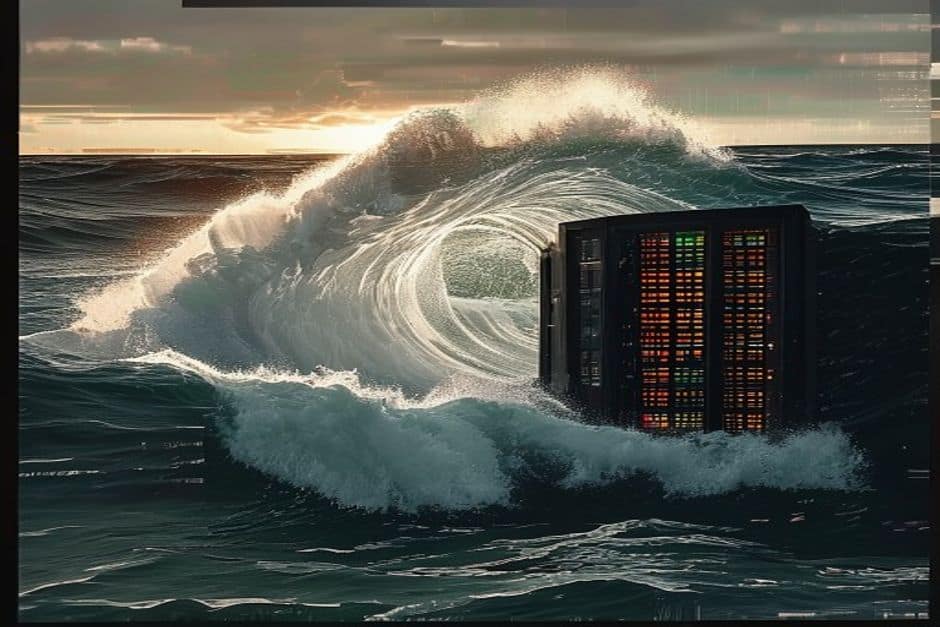
The core product is conceptually simple. Each Ocean-3 platform rises and falls with ocean waves, forcing water through an internal turbine to generate electricity. That electricity powers onboard servers. The processed results are returned by satellite. There is no cable to shore, no grid connection, no land permit required, and no fight with a county commissioner who does not want a data center in his district. Panthalassa's founder describes it as a floating hydroelectric dam, and the comparison is more precise than it sounds: the ocean provides continuous mechanical energy input at a scale that has no terrestrial equivalent, and the surrounding seawater handles cooling without any of the freshwater consumption or HVAC infrastructure that makes land-based data centers politically and environmentally contested. The unit economics of the system depend entirely on whether the engineering holds at sea and at scale, and on whether the satellite connectivity latency is acceptable for the AI workloads being served. Both are genuinely open questions with August's Ocean-3 deployment as the first meaningful data point.
The infrastructure crunch that makes Panthalassa's pitch land is real and accelerating. AI data center planned capacity in the United States now exceeds 50 gigawatts of demand. Pew Research found that Americans are significantly more likely to view data centers as environmentally harmful than beneficial, and that sentiment is translating into planning opposition in communities from rural Virginia to suburban Arizona. Half of planned US data center projects may be delayed or cancelled in 2026 according to some industry estimates, not because of capital constraints but because of power availability, grid interconnection queues, and local permitting timelines that run years rather than months. The companies most aggressively expanding AI capacity, Amazon, Microsoft, Google, Meta, and the sovereign wealth funds they are contracting with, are increasingly finding that the bottleneck is not money or hardware. It is electrons and permits. That is the problem Panthalassa is designed to solve by simply going offshore.
The competitive landscape for offshore and alternative power data center solutions is becoming a real category rather than a collection of individual bets. Aikido Technologies is building data center modules integrated directly into floating offshore wind turbine foundations, colocating compute and renewable generation in a single structure. Microsoft's Project Natick, which ran a submarine data center off the coast of Scotland, demonstrated that undersea operations are technically feasible and that hardware failure rates can actually be lower in a sealed underwater environment than in a conventional facility. Those experiments did not scale into commercial products, largely because the satellite and subsea connectivity costs made them uncompetitive against land-based alternatives at the time. The connectivity cost calculus is shifting as low-earth-orbit satellite networks reach higher throughput and lower latency, and as the land-based alternative becomes increasingly constrained by permitting and grid access rather than pure economics.
The economic comparison against hyperscale land-based campuses is where the sceptical case needs to be made precisely. A hyperscale data center campus built on land, connected to a utility grid, and operating at full capacity runs at a power usage effectiveness ratio of approximately 1.1 to 1.3, meaning it uses 10% to 30% more total energy than the compute it powers, with the difference going to cooling, lighting, and facility operations. Panthalassa claims its wave-to-compute pipeline eliminates fuel cost and dramatically reduces cooling overhead, which would compress operational expenditure significantly if the generation reliability holds across different sea states and seasonal wave patterns. What it does not eliminate is maintenance cost, and maritime maintenance is not cheap. Accessing hardware on a platform forty miles offshore for a failed server replacement is a boat trip, not a walk across a raised floor. Insurance for hardware at sea against storm damage, wave impact, and corrosion runs at different rates than for a data center in Phoenix. The economic case requires modelling maintenance frequency, insurance premiums, satellite bandwidth costs, and generation reliability across actual ocean conditions, not just controlled demonstrations. Panthalassa has not yet published that modelling publicly, and investors and potential customers should ask for it before committing to capacity on the Ocean-3 platform.
The sovereign compute dimension is the angle that large-scale investors in this space would be most interested in exploring. Countries that lack the land, grid infrastructure, or climate conditions for conventional large-scale data centers have a particular interest in offshore alternatives that can be deployed in their exclusive economic zones. Pacific island nations, Nordic countries with strong wave energy resources, and maritime-oriented economies that want to develop AI infrastructure capacity without depending on land-based energy grids from neighbouring states represent a potential customer category that has no equivalent in the conventional data center market. A sovereign government leasing offshore compute capacity from a platform operating in its territorial waters has a different relationship with its digital infrastructure than one renting cloud capacity from a US hyperscaler in a Virginia suburb. That framing, of ocean compute as sovereign infrastructure rather than just cheap power, is the argument that makes this category interesting to geopolitical capital as well as to cost-optimising hyperscalers.
Panthalassa's August deployment of Ocean-3 is the test that everything else depends on. If the platform generates power reliably, keeps hardware operational in real ocean conditions, returns results over satellite at acceptable latency, and survives its first winter season in open water, it becomes the demonstration asset that validates the category for larger capital commitments. If it fails on any of those dimensions, it joins Project Natick and several earlier wave energy ventures as a technically interesting but commercially premature concept. The AI infrastructure crunch is real enough and the land-based constraints severe enough that the category deserves serious evaluation on its engineering merits rather than being dismissed as a frontier curiosity. August will tell us which of those descriptions applies to Panthalassa specifically. The broader question of whether compute moves to sea in meaningful quantities over the next decade will take longer to answer, and the answer will depend on whether the economics prove out at scale rather than just at the prototype stage.
Also read: AI Models Are Giving Biosecurity Experts Operationally Useful Bioweapons Guidance and the Refusal Systems Are Not Stopping It • OpenAI's DeployCo Is Not a Fund. It Is a Captured Distribution Machine for the Enterprise Market. • Podslop Is Arriving Faster Than the Audio Industry Can Build Defences Against It