New peer-reviewed research from Arizona State University suggests Phoenix-area data centers are not just drawing power, they are also raising temperatures in nearby neighborhoods by as much as 4 degrees Fahrenheit.
That finding matters because it gives the AI buildout in metro Phoenix a more tangible local cost. The debate is no longer only about electricity demand, water use, and zoning fights. It is now also about heat that residents may actually feel on the street outside their homes.
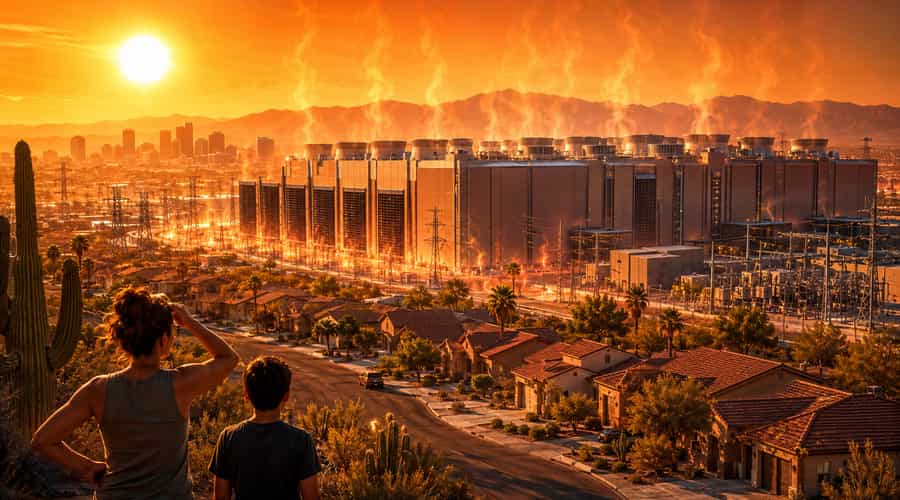
Arizona State University researcher David Sailor and his co-authors found that temperatures downwind of Phoenix-area data centers averaged 1.3 to 1.6 degrees Fahrenheit warmer than upwind areas and reached as much as 4 degrees higher, according to ASU News. The university said the research, published in the Journal of Engineering for Sustainable Buildings and Cities, is the first study to directly measure real-time air temperatures upwind and downwind of data centers to capture their effect on surrounding communities.
That is a meaningful shift in the conversation. Data centers have usually been discussed as hidden infrastructure, big buildings with noisy roofs and a heavy appetite for power. This study pushes them into a more visible role in the urban heat island problem, which is especially sensitive in Phoenix, a city that already treats heat as a public policy issue rather than a seasonal inconvenience.
The Phoenix metro has become one of the fastest-growing data center markets in the country because it offers land, relatively lower costs, and access to power. That is exactly why the region has become attractive to hyperscalers and AI compute operators looking to expand quickly. But the same conditions that make the market appealing also make every new facility part of a broader environmental tradeoff.
Sailor previously told KJZZ that his team measured temperatures around data centers in Phoenix by driving instrumented cars along regular streets and comparing upwind and downwind readings. ASU's latest write-up adds more detail: researchers used multiple vehicles with high-accuracy temperature sensors around four facilities, ranging from a 36-megawatt single-building site in Mesa to a 169-megawatt co-location campus in Chandler. The heat impact was detectable up to about a third of a mile from the perimeter of the sites.
That concentration is what makes the issue so hard to ignore. A data center is built to prevent servers from overheating, which means it must expel a lot of waste heat. ASU said air-cooled condenser arrays can discharge air that is 14 to 25 degrees Fahrenheit warmer than the surrounding air, creating thermal plumes that move into nearby areas. In a desert city where ambient temperatures are already punishing, that extra load can spill into neighborhoods that had no role in choosing the site.
For city planners, that creates a different kind of siting problem. Industrial development is one thing, but facilities that materially change local microclimates are another. A neighborhood that is already struggling with summer heat, high cooling bills, and tree cover gaps can absorb only so much more.
Policy is catching up
The study lands at a time when Phoenix-area officials are already trying to balance growth with basic resource limits. ASU's February discussion on data center expansion noted that utilities are under heavy pressure from unprecedented power demand, while local leaders are also working through water questions, zoning rules, and the broader economic case for the industry. That mix makes the thermal findings more than an academic curiosity. It gives regulators another variable to weigh.
Water remains part of the same picture, even if the new study is about heat rather than consumption. ASU experts at the February event said not all data centers use water for cooling, and those that do have become more efficient. Still, the region cannot separate these debates cleanly. If one part of the system is stressing the grid and another is adding localized heat, the burden on residents compounds fast.
The timing matters for the industry too. AI training and inference continue to drive construction, and companies want to move quickly while demand remains hot. But the more facilities cluster in places like Phoenix, the harder it becomes to present data centers as neutral pieces of industrial real estate. They are becoming part of the lived environment, for better or worse.
That is why this study is likely to resonate beyond Arizona. If data centers can measurably warm nearby neighborhoods in one of the hottest major cities in the U.S., then the local consequences of AI infrastructure are no longer theoretical. They are measurable, predictable enough to matter, and likely to show up more often in planning hearings, utility debates, and public relations campaigns as the buildout accelerates.
For operators, that means the burden is shifting. It is no longer enough to talk about cloud capacity and economic development. They now have to explain how their facilities fit into the heat, water, and power realities of the cities that host them.
Also read: Google I/O 2025 puts Gemini and Search on the spot as AI stakes rise • Alibaba's Qwen 3.7 Push Shows Open AI Is Still Moving Fast • Boston Dynamics turns Atlas into a stronger industrial contender