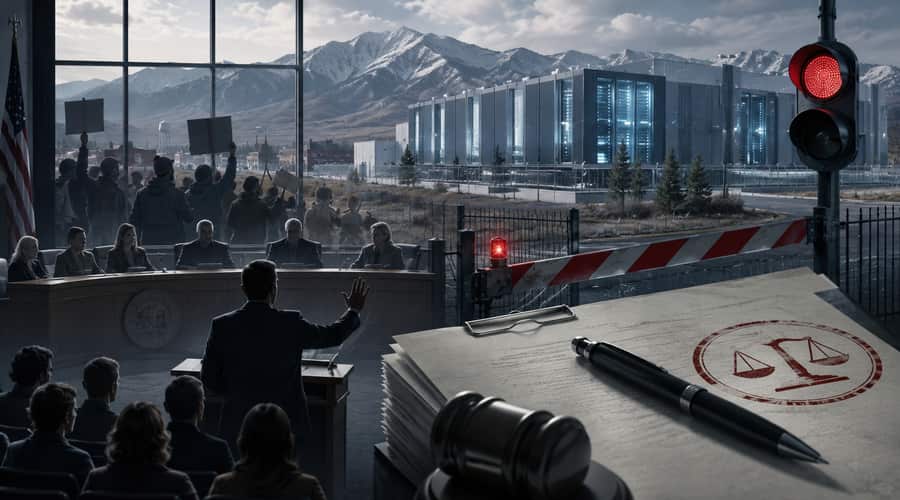
Pocatello's rejection of a proposed AI data center is more than a local zoning fight. It is a warning that community resistance can now stop hyperscale projects before they ever break ground.
The city's hearing examiner denied a conditional use permit for the project after public opposition swelled and concerns over power, water, wastewater, and air quality were left unresolved, according to KTVB and KIFI. The decision came after a crowded public hearing and gives Lex Developments LLC 14 days to appeal under city code, while any future application would need more detailed impact studies. For now, the proposal has been stopped.
That matters because Pocatello is not a coastal tech hub with a long history of fighting industrial development. It is exactly the kind of smaller market hyperscalers have been chasing, a place where land is cheaper, local leaders are often more open to economic development pitches, and the promise of new tax revenue can sound persuasive. This ruling shows that those assumptions no longer hold automatically. A site with cheap land and available infrastructure is not enough if residents decide the costs will land on them first.
According to reporting from local stations and city materials, the proposed facility would have gone on the former Hoku Materials site at 1800 River Parkway, where the applicant planned an AI data center complex that could have consumed at least 100 megawatts of power. Idaho Power told the city that level of capacity is comparable to the amount of power Pocatello uses in a year. The hearing examiner found the application did not adequately show that the project would not harm the public interest, health, safety, or welfare of the city. That is the kind of finding developers can sometimes answer with more studies, but it also gives opponents a clear victory because it puts the burden back on the applicant rather than the city.
The public process matters here. More than 300 residents gathered for the hearing, and reports from the meeting described more than 100 testimonies, with the overwhelming majority opposed to the permit. Residents pushed back on the familiar list of complaints, including strain on the power grid, water use, wastewater capacity, noise, and the worry that a giant industrial building would sit on local infrastructure without giving much back to the surrounding community. The hearing examiner's denial effectively turned those concerns into a legal barrier, not just a political headache.
That is the real shift. In earlier cycles, local opposition often forced developers to delay, rework plans, or negotiate for better terms. Now it is increasingly leading to formal denials and bans. In Pocatello, the issue was not just whether the project could be built. It was whether the city believed the application had done enough to prove it should be built at all.
Why this is spreading
Pocatello is part of a broader backlash that Reuters and other outlets have documented across the country, where states and municipalities are moving to curb or pause data center growth as AI infrastructure expands. Reuters reported in April that a dozen states were weighing curbs on data centers, while local moves have multiplied in cities and counties as residents push back against the environmental and utility impacts of these projects. Maine lawmakers approved a large data center moratorium before Governor Janet Mills vetoed it, and other states have introduced bills that would pause permits, limit incentives, or require more study before approvals move forward.
The pattern is easy to see. Developers pitch jobs, tax revenue, and a place in the AI economy. Residents see something else: high-voltage demand, water consumption, noise from cooling systems and backup generators, and the possibility that their utility bills rise while a single facility absorbs huge amounts of electricity. Those worries are not theoretical. They are the political fuel behind the new wave of moratoriums and bans, and they are now showing up at the municipal level rather than only in statehouses and federal hearings.
For AI infrastructure startups, this is a more complicated world than the one that existed even a year ago. Site selection can no longer be reduced to finding a suitable parcel, a willing county, and a utility partner. It now requires a political risk map. Local land-use boards, hearing examiners, and city councils can move faster than state legislatures, and they can do it in ways that create hard stops instead of soft delays. Once that happens, the project does not merely slow down. It can be denied outright.
That is why Pocatello should be read as a signal, not an outlier. If a smaller Idaho city can turn public resistance into a formal rejection, other municipalities can follow the same path. For hyperscalers and the contractors that build for them, the new rule is simple: power is necessary, but permission is everything.
Also read: SpaceX's IPO filing could reset private tech pricing • Crypto Twitter goes quiet as retail traders vanish • Violent thefts and kidnappings rise as crypto wealth makes holders visible targets