
Precision Micro completes a £1.8 million expansion of its Birmingham facility, positioning itself as a critical supplier for the global shift toward hydrogen fuel cells, carbon capture, and green energy technologies.
Global chemical etching supplier Precision Micro has announced the delivery of a new etching and stripping machine at its Fort Dunlop site in Birmingham, UK, finalizing its second new etch room. The milestone marks the culmination of a significant capital project that gives the company one of the most advanced photochemical etching capabilities in Europe, purpose-built to serve the rapidly expanding clean energy sector.
Part of a £1.8 million investment reported last year, the business believes it is now uniquely placed to meet the increasing global demand for next-generation energy technologies such as hydrogen production and storage, carbon capture, green energy buffering, electric, and hydrogen electric vehicles. The timing is significant. Governments and corporations worldwide are accelerating their net zero commitments, and the demand for precision-engineered components that can scale with these ambitions has never been higher. Precision Micro recognized early that existing supply chains would struggle to keep pace with the volume and complexity required by these emerging sectors.
Karl Hollis, Precision Micro's Director of Engineering, said: "With carbon neutrality and net zero a crucial agenda item for many countries and businesses around the world, there is an ever-growing appetite for complex etched components used in the production, storage, recovery and transfer of green energy. This includes components such as printed circuit heat exchangers, busbar battery interconnects, bipolar plates for fuel cells and electrolysers used for hydrogen production."
These components are not simple fabrications. Bipolar plates, for instance, require intricate flow field patterns etched into metal substrates to distribute gases evenly across fuel cell membranes. Busbar interconnects must handle high current loads while maintaining precise tolerances. Getting these parts right at scale is essential for the efficiency and durability of hydrogen electrolysers and electric vehicle battery systems. The challenge, until now, has been finding a supplier capable of producing them in the volumes the market demands.
"The increased volumes needed to meet this demand, however, often require much larger and thicker sheets of metal to be used and after many conversations with customers in the green energy sector, it became clear there was a gap in the market for a supplier that had the capacity and equipment to manufacture these components," Hollis explained.
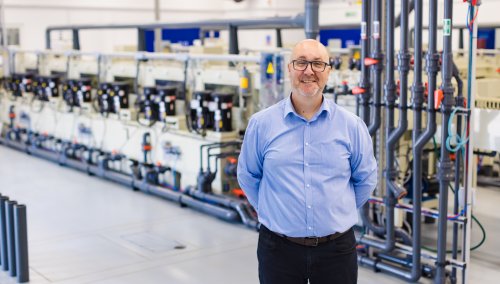
Believed to be an industry first, the new etch room facility is home to six new state-of-the-art etching and stripping machines, as well as an automatic exposure unit which enables larger sheet metals up to 1500mm x 600mm x 2.5mm in size to be etched in production volumes. In addition to increasing throughput and delivering cost savings to customers, the new equipment also minimizes human interaction and manual handling. That reduction in manual intervention matters not only for consistency and quality control but also for workplace safety, as it limits operator exposure to chemical processes.
To support this investment, Precision Micro has also made further improvements to its chemical regeneration processes by introducing automated systems that will increase the overall effectiveness of the new machines. The upgrade ensures that higher chemical consumption from processing larger sheets does not come at an environmental cost, a balance that matters deeply to the clean energy companies the facility aims to serve.
Hollis continued: "Larger sheets of metal require more chemistry and subsequently more waste management. ESG is at the forefront of this investment with Precision Micro already regenerating or recycling 98% of its waste sitewide. We are hugely excited about this unique offering and looking forward to helping emerging sectors create the technologies required to make net zero a reality."
The combination of expanded capacity, larger sheet processing, and strong environmental credentials positions Precision Micro at an interesting intersection in the supply chain. As hydrogen projects move from pilot phases to commercial deployment and electric vehicle production continues its upward trajectory, the need for reliable, high-volume precision etching will only intensify. Companies that have already invested in the infrastructure to meet that demand stand to benefit significantly. For Precision Micro, the bet on green energy manufacturing is no longer a forward-looking strategy. It is an operational reality.