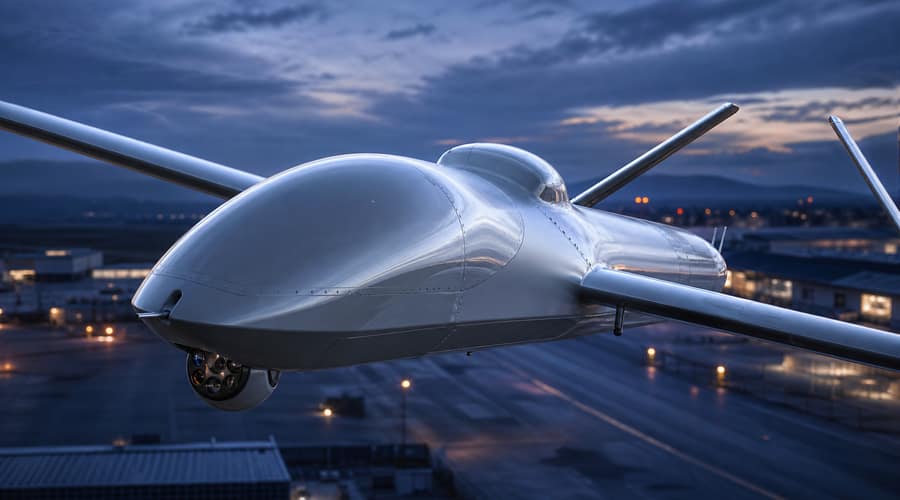
Quantum Systems has raised $1.2 billion at an $8 billion valuation, but the sharper story is who came in with the money: Airbus is now backing a company that wants to pull defense away from the old prime contractor model.
Munich-based Quantum Systems closed its $1.2 billion Series D on July 2, more than doubling its valuation to roughly $8 billion. The round was co-led by Blackstone, Noteus Partners, Airbus and Advent, with BOND, Fidelity, Wellington Management, A.P. Moller Holding, Elephant Lake Ventures, Balderton and HV Capital also participating, according to The Wall Street Journal.
Airbus is the name you should notice. Co-CEO and co-founder Florian Seibel told CNBC that Quantum Systems is building a "next generation neo prime" with the potential to "disrupt defense as we know it today." Airbus builds the sort of large defense hardware that Seibel wants to leapfrog, and it still chose to buy into the company trying to change the model. That is not charity. It is a hedge against being left outside the next procurement cycle.
Alongside the investment, Airbus Defence and Space agreed to deepen its partnership with Quantum. The companies said they would combine architecture, software and AI capabilities across the sensor-to-shooter chain, which is defense language for compressing the time between detecting a target and acting on it. In Ukraine, that gap is not a theoretical problem. It is where drones, software and artillery have already changed how armies fight.
Quantum Systems did not start as a weapons company. Florian Seibel, Armin Busse and Tobias Kloss founded it in 2015, initially selling drones for agricultural mapping and infrastructure inspection. Peter Thiel backed it early. The harder turn came after Russia's 2022 invasion of Ukraine, when a civilian drone company suddenly had the kind of battlefield relevance most startups only claim in investor decks.
The company says its systems flew more than 19,000 missions in Ukraine last year. Keep that number in mind, because it explains why this round is not only a valuation story. A defense startup can talk about autonomy, AI and new procurement all day. A drone that has flown thousands of missions in an active war gives customers something else: evidence.
The financials help too. Quantum Systems generated roughly 300 million euros in revenue last year, according to German press agency dpa, and says it is already profitable. The Financial Times reported that the company expects more than 700 million euros in revenue in 2026, about 200 million euros of EBITDA, and 1 billion euros of revenue by 2027. Those are aggressive numbers, but they are not the usual pre-revenue defense tech pitch. Frankly, that is why investors are paying attention.
The raise lands in the middle of a defense technology funding rush that would have sounded fanciful before the war in Ukraine. Fortune, citing Dealroom, reported that defense startups have pulled in $17.4 billion so far in 2026, already more than the $11.2 billion raised in all of 2025. Anduril raised $5 billion in May. Saronic Technologies raised $1.8 billion in March. Shield AI closed $2 billion that same month. The checks are getting bigger because governments are buying differently, or at least saying they want to.
Quantum's round also changes what the company is allowed to become. The Financial Times reported that Seibel used the financing to clean up the shareholder base after some investors objected to lethal weapons. He also said Quantum could consider merging with Stark, the kamikaze drone startup he co-founded in 2024. If that happens, Quantum would move from surveillance and reconnaissance deeper into strike systems, putting it more directly against companies such as Helsing and, eventually, the old defense primes themselves.
The new money will go toward expanding manufacturing capacity, strengthening supply chains and funding more AI and software work, including MOSAIC UXS, Quantum's software layer for connecting drones and unmanned systems across air, land and sea. That is the part Airbus wants near. The aircraft maker does not have to believe every startup slogan about disrupting defense. It only has to believe that autonomy and software are becoming too important to sit outside.
Whether Quantum Systems really displaces the primes is a question for the next few years, not this week. What is clear now is simpler: Airbus has decided that owning a piece of its potential disruptor is safer than watching it grow from the other side of the fence.
Also read: Convertible Note vs SAFE: The Dilution Math Founders Skip Before They Sign • How to Read a Startup Term Sheet Before You Sign It • Bhavin Turakhia is spending $30 million of his own money to rebuild Office from scratch