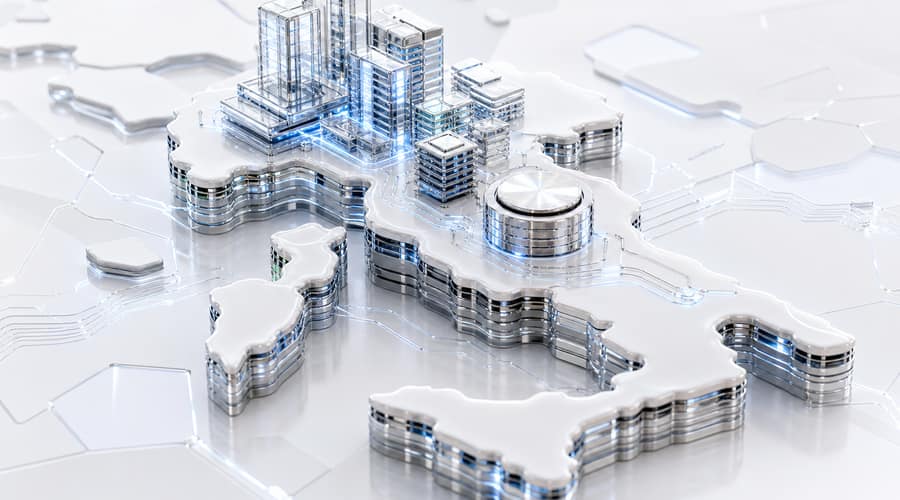
K2 Strategic has taken a €5.3 billion plan for a 300 MW data center campus south of Milan to Italy's business ministry. If it gets built, Robert Kuok's grandson won't just be expanding a family empire, he'll be testing whether Italy can turn AI infrastructure interest into steel, power and tenants.
The useful thing about this story is the scale. Meng Wei Kuok, the 41-year-old CEO and Managing Director of K2 Strategic, met Adolfo Urso, Italy's Minister of Business and Made in Italy, at Palazzo Piacentini on June 26, 2026 with a proposal for a hyperscale campus south of Milan. K2 put the possible investment at up to €5.3 billion, with about 300 MW of capacity, as many as 8,000 construction jobs and roughly 200 permanent roles once the site is running.
That isn't a small European toe in the water. For a company whose existing footprint is still mostly Asian, it is the sort of project that changes how customers read you. Hyperscalers and cloud operators don't only want cheap land and a big power figure. They want a counterparty that can deliver in more than one market, across more than one regulatory system, without learning the trade on their balance sheet.
Meng Wei is Robert Kuok's grandson. The older Kuok built one of Southeast Asia's best-known business groups through sugar, palm oil, shipping and hotels, including Shangri-La. The grandson is pushing the family name into a different kind of physical infrastructure: data centers, power contracts, cooling equipment, fiber links and long leases with cloud customers. K2 Strategic says it now operates about 120 MW of data center capacity, with projects in Johor, Malaysia and Bekasi, Indonesia. Its stated target is 1,200 MW by 2030, backed by about $10 billion in total capital.
Italy is the first move outside Asia. That's the point.
Milan used to be an unlikely answer if you asked where Europe's next AI infrastructure rush would land. Frankfurt, London, Amsterdam and Paris were the familiar names. But the Italian market has moved quickly. According to Bird & Bird's analysis of the sector, Italy attracted more than €25 billion in data center commitments for the 2026 to 2028 period, compared with €7.1 billion in the previous three-year cycle. Microsoft has pledged €4.3 billion for an Italian cloud region. AWS has committed €1.2 billion over five years. HSCALE has secured 250 MW of power across two Milan campuses, with more than €2 billion committed by 2028.
You don't get that kind of queue by accident. Italy has been trying to make permits less painful for large data center projects, and Milan has the advantage of fiber routes, submarine cable connections and a business base that can actually use the capacity. Policymakers also want the investment badly enough to show up for it. Urso's meeting with K2 matters because big infrastructure projects are not won only on engineering diagrams. They need ministries, utilities, local authorities and patient capital moving in the same direction.
The family bet on AI infrastructure
Don't treat this as a rich-family side project. K2's Johor campus, launched in October 2024 at Sedenak Tech Park, was built for the hyperscaler tier, where the discussion is hundreds of megawatts rather than a few server halls. Its Indonesian campuses with Sinar Mas Land follow the same logic. The Italian proposal is larger again. At 300 MW, it would sit among the more serious hyperscale campuses in Southern Europe if K2 turns the ministry presentation into a financed, permitted and leased project.
There is still a large gap between a public plan and a working campus. Anyone who has watched European infrastructure projects knows that the hard questions arrive after the announcement. Where exactly is the land? Who supplies the power? What is the timetable for grid connection? Which anchor tenant signs first? A €5.3 billion budget is only real when those pieces start locking together.
K2 also has to prove it can move in a market where it doesn't have the home advantage. Southeast Asia gave Meng Wei familiar regional relationships, local partners and governments eager to pull in foreign tech capital. Italy brings different labor markets, different power constraints and competitors already working around Milan. HSCALE is there. Vantage is there. Others are circling because AI demand has made capacity near major European business centers much harder to secure.
Frankly, that is what makes the bet interesting. K2 is not arriving early to an empty field. It is arriving late enough that the opportunity is visible and crowded enough that execution will matter more than family capital. If the company can secure the site, power and tenants, the Kuok Group gets a European infrastructure foothold at the moment AI demand is forcing cloud operators to hunt for capacity wherever the grid can bear it.
If it can't, the June 26 meeting will remain what these meetings often are: a polished public opening before the real negotiation begins. The hard part starts with land, electricity and customers, not with the photograph at the ministry.
Also read: Trump's 100% tariff threat over digital services taxes reshapes the cost calculus for every US tech company operating in Europe • Apple's touchscreen MacBook arrives on M5 chips as AI memory costs reshape the whole product line • Binance loses access to the EU's 27-country market days before the MiCA deadline and now bets on France to get back in