
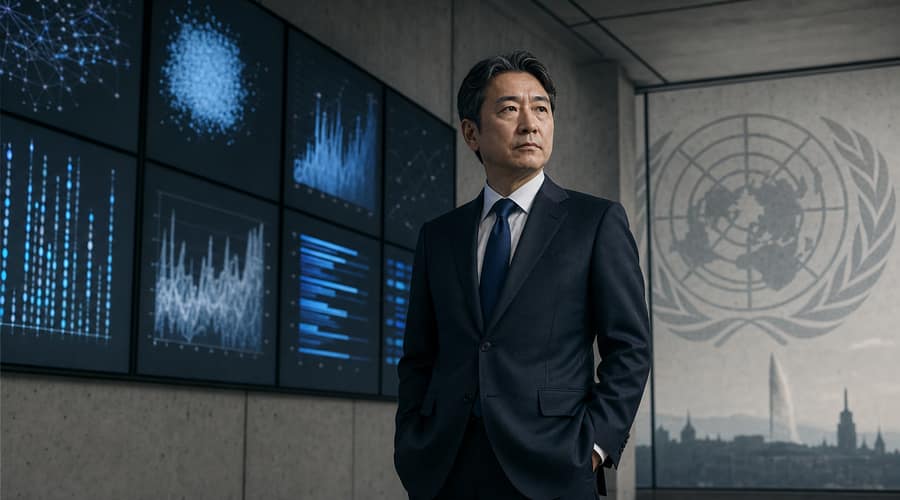
Ren Ito, the Tokyo entrepreneur behind Sakana AI, has joined a new UN-backed AI commission just as his company tests the limits of what global access rules can actually control.
The United Nations and the International Telecommunication Union have put Ren Ito on the founding roster of the AI for Good Global Commission. That would be notable on its own. It matters more because Ito's company spent June building around the same kind of AI access restriction this group now says it wants to discuss.
You don't usually see a Japanese AI executive share a commission roster with Jensen Huang and a sitting head of state. But that's the room Ito is walking into. Axios reported that the commission will hold its first meeting on July 8 in Geneva, with Salesforce CEO Marc Benioff and Rwandan President Paul Kagame as co-chairs. The same roster includes Amazon's Andy Jassy, Nvidia's Jensen Huang, Microsoft president Brad Smith, Anthropic co-founder Jack Clark, and Cohere co-founder Aidan Gomez. ITU Secretary-General Doreen Bogdan-Martin is also involved, alongside heads of state and AI policymakers from several countries.
Ito's presence isn't accidental. Sakana AI spent the past month close to the access fight the commission is meant to address. On June 12, the US Department of Commerce imposed export controls on Anthropic's Fable 5 and Mythos 5 models, forcing Anthropic to pull access more broadly because it couldn't verify user nationality in real time. Tom's Hardware reported that the controls were lifted around July 1 after Anthropic added a classifier meant to block one exploit-related prompting technique flagged by Amazon researchers.
That timing changes the Sakana story. Fugu is no longer just a workaround for a live ban. It's a warning about how quickly ambitious AI teams can route around a restriction once a frontier model becomes unavailable.
The numbers Sakana published are specific, a rarity in a field that runs on vague performance claims. In its June 19 technical report, Sakana described Fugu as an orchestrator system that dynamically uses a team of existing large language models rather than training one new frontier model from scratch. The paper said Fugu was tested across SWE-Bench Pro, Terminal Bench, LiveCodeBench, GPQA-Diamond, Humanity's Last Exam, and CharXiv Reasoning. Sakana's public benchmark table put Fugu Ultra at 73.7% on SWE-Bench Pro, ahead of Claude Opus 4.8 at 69.2%, GPT-5.5 at 58.6%, and Gemini 3.1 Pro at 54.2%.
Frankly, the cost story is messier than a benchmark table makes it look. Anthropic's published pricing for Mythos Preview and Fable 5 gives developers a clear token bill. Fugu's orchestration approach can involve multiple model calls behind one answer, and that means the final cost depends on how many agents the system uses for a real workload. Sakana hasn't given readers a simple number for that. If you're deciding whether to build with it, that missing figure matters more than a leaderboard win.
None of that erases the achievement. Sakana built its reputation on squeezing more out of existing models instead of trying to outspend the largest labs. The company has worked on evolutionary model merging, a gradient-free method for combining model weights without retraining, and it has used that approach for Japanese-language and vision models. Fugu follows the same instinct: use collective behavior, not only scale, to get better results.
That instinct has become a serious business. Sakana was founded in Tokyo in 2023 by Ito, David Ha, and Llion Jones. Ha is a former Google Brain researcher and serves as CEO. Jones was one of the authors of the 2017 Attention Is All You Need paper, the transformer work that still sits under much of today's generative AI market. Sakana raised a Series B round of about $135 million in November at a valuation around $2.65 billion, with Mitsubishi UFJ Financial Group, Lux Capital, and In-Q-Tel among the investors, according to company and investor reporting cited in public company profiles.
Ito's own route into this commission is useful context. Before Sakana, he worked at Mercari, where he ran European operations through the company's 2018 IPO, and later served as chief operating officer at Stability AI in London. Writing for Project Syndicate, he has argued that Washington's first priority should be preserving AI access for close allies, not letting export controls push trusted partners toward other technology stacks. You can disagree with that view, but it is at least a real position from someone whose company has now lived through the restriction he is talking about.
The commission's weakness is already visible. Axios framed the group as an attempt to bring AI builders and political leaders to one table, and that is exactly the problem as well as the point. The companies building frontier systems now sit beside the officials who are supposed to govern them. If you care about public accountability, that should make you pause.
Ito's seat cuts both ways. He represents a company outside the usual US megacap circle, which is useful. He also represents a company that just showed how fast technical workarounds can move when policy tries to close a door. The commission meets on July 8 in Geneva. Whether it becomes anything more than a long list of powerful names will depend on whether those names are willing to talk about control, cost, and access with the same specificity they use when selling the models.
Also read: Kioxia Sells Out Its Entire 2026 NAND Flash Supply Just as AI Chips Ship • A Nuclear Reactor in Utah Just Powered an Nvidia Chip for the First Time • Anthropic Opens Talks With Samsung to Build Its First Custom AI Chip