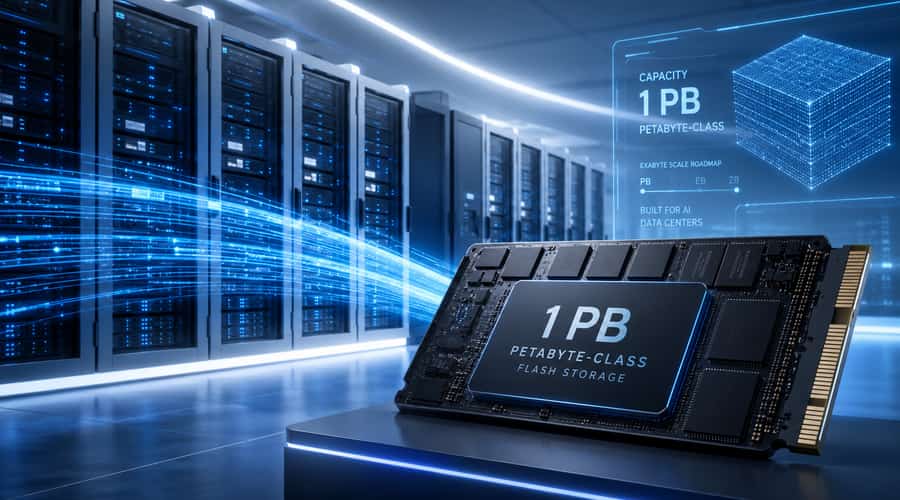
Samsung's reported 250TB to 1PB nearline SSD work is not a consumer storage story. It is a direct move at the infrastructure layer that AI builders are quickly turning into a strategic battleground.
Samsung appears to be preparing for a world where data centers no longer treat hard drives as the default answer for massive capacity. The company is reportedly developing nearline solid-state drives starting at 250TB and scaling as high as 1PB per drive, a range that would push flash storage into territory once reserved almost entirely for mechanical disks.
The detail matters because AI infrastructure is not only about GPUs, networking and power contracts. Training data, model checkpoints, inference logs, retrieval systems and enterprise data lakes all need to sit somewhere. If storage becomes too slow, too scattered or too power hungry, the rest of the system starts paying for it.
As Blocks & Files reported in its coverage of comments from Scality chief product officer Erwan Girard, Samsung and Solidigm are both developing next-generation nearline flash, with Samsung's smallest drive expected to start at 250TB and the largest reaching 1PB in EDSFF E3.L or E2 form factors. Scality has said it already has early drives in its lab for testing, which makes this more than a vague roadmap claim, even if Samsung has not turned it into a formal product launch.
Nearline storage sits between hot, performance-heavy storage and colder archival systems. It is where data needs to be available without always requiring the highest endurance or fastest possible write profile. That makes it a natural target for AI data lakes, object storage, media archives, large enterprise datasets and retrieval-augmented generation systems that need fast access to huge pools of information.
The reported tradeoff is endurance. Girard said the nearline flash being discussed has endurance around 0.1 drive writes per day, below the roughly 0.5 DWPD associated with current QLC drives. For many enterprise buyers, that will not be a deal breaker. If the workload is read-heavy and capacity-focused, density and power efficiency may matter more than write endurance.
This is where Samsung's reported numbers become interesting. The design could allow almost 50PB in a 4U shelf and close to half an exabyte in a rack. For hyperscalers, that changes the physical math of data centers. Fewer racks can mean less floor space, less cabling, lower cooling demand and fewer devices to manage.
Micron has already raised the competitive bar
Samsung is not moving in isolation. Micron announced in May that its 6600 ION 245TB data center SSD is now shipping, with the drive shown at Dell Technologies World from May 18 to May 21, 2026. Micron is presenting it as the world's highest-capacity commercially available SSD, aimed at AI data ingest, data lakes, hyperscale storage and cloud infrastructure.
That makes Samsung's reported 250TB starting point look less like a moonshot and more like the next step in a fast-forming market. Micron is shipping 245.76TB. Solidigm has already pushed high-capacity QLC SSDs into enterprise environments. Samsung now appears to be signaling that it wants to compete at the high end of storage density, not simply defend its existing NAND business.
The pressure on hard-drive suppliers is clear. Western Digital and Seagate still have deep positions in nearline storage, especially where cost per terabyte remains the main buying criterion. But if flash narrows the cost gap while offering better rack density and energy efficiency, the argument changes. A chief infrastructure officer does not only compare drive prices. They compare the full cost of power, space, cooling, maintenance and performance bottlenecks.
That does not mean hard drives disappear quickly. Large storage buyers are conservative because their systems run at enormous scale and failures are expensive. A 1PB SSD will also have to prove itself on price, reliability, serviceability and supply availability before it becomes a mainstream deployment choice. The market will not move on capacity alone.
Samsung's internal timing is hard to ignore
The reported product push lands while Samsung's semiconductor business is dealing with bonus and wage tensions tied to the AI memory boom. Recent Korean reports have described a tentative agreement covering Samsung's Device Solutions division, along with fresh pushback from employees outside the memory business. That matters because storage and memory are no longer quiet component categories sitting behind finished devices. They are now central to the AI infrastructure cycle.
For Samsung, a nearline SSD in the 250TB to 1PB range would send a simple message to customers and employees: the company wants to capture more of the AI stack. Not only HBM for accelerators. Not only conventional NAND. The company wants the storage layer that supports model development, deployment and enterprise data movement.
The questions now are practical. Samsung has not publicly confirmed product pricing, shipment timing or full specifications. Buyers will want to know how the drives behave under sustained workloads, what failure management looks like at petabyte scale and whether Samsung can supply them in volume while memory demand remains tight.
If Samsung can answer those questions, the market implication is substantial. AI data centers are becoming denser, more expensive and more dependent on specialized suppliers. Storage used to be the less glamorous part of that equation. The next round of infrastructure spending may prove that it was one of the most important all along.
Also read: Cox Media Group pays for the ad pitch that said phones were listening • Reddit's dip is testing whether growth can outrun valuation • AI cost savings are running into a token bill problem