South Korea's largest Samsung union has taken its profit-sharing battle to the streets, demanding workers receive a direct cut of the $35 billion in operating profit the chipmaker generated riding the global AI wave.
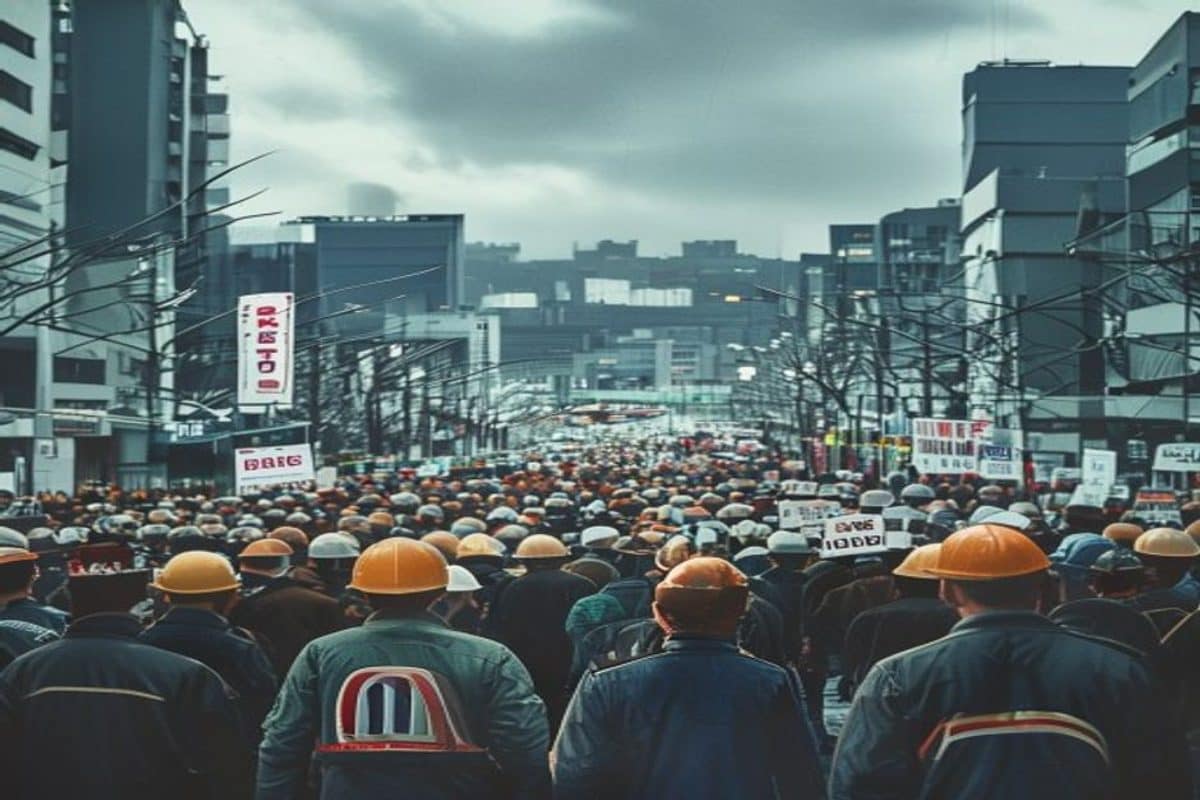
The demonstration that unfolded today across South Korea is unlike anything Samsung's leadership has faced in its modern history. More than 30,000 members of the National Samsung Electronics Union marched publicly, turning what had been a negotiating-room dispute into a full-scale street confrontation. Their demand is blunt: an average bonus of $400,000 per worker, funded by directing 25% of the company's net operating profit into a workforce incentive pool. For a company that reported operating profits exceeding $35 billion in fiscal 2025, the math is uncomfortable to dismiss.
Samsung's ascent over the past 18 months has been built almost entirely on high-bandwidth memory chips. HBM has become the circulatory system of the AI data center build-out, and Samsung sits at the center of that supply chain, shipping to Nvidia and the major cloud providers at volumes that would have seemed implausible three years ago. Shareholders have captured that upside through dividends and a surging stock price. Executives have collected compensation tied to that performance. The NSEU's core argument is straightforward: the people on the manufacturing floor who actually produce these chips have received neither.
A $400,000 bonus sounds like agitprop until you consider the structure of the demand. The union isn't asking Samsung to invent money. It's asking the company to redirect a quarter of profits it has already earned. Standard Korean tech industry bonuses run to a few months of salary, a rounding error against what Samsung posted last year. The NSEU is arguing that an extraordinary profit cycle created by an extraordinary technological moment warrants an extraordinary response, and they've shown up in the streets to make that case impossible to ignore.
The timing is deliberate. Samsung is in the middle of a critical competitive window against SK Hynix, which has moved aggressively on HBM3E supply. Any disruption to Samsung's production cadence now creates ripple effects that travel directly to Nvidia's server roadmap and the infrastructure timelines of hyperscalers who have staked enormous capital commitments on chip availability. The union knows it. That knowledge is precisely what put 30,000 people on the street today rather than waiting out another round of closed-door talks.
What This Means Beyond Samsung's Headquarters
The structural significance here goes well past one company's labor dispute. Samsung spent decades cultivating a workplace culture that kept unions at arm's length. The NSEU's growth and its willingness to escalate publicly marks a genuine shift in how labor relations function inside Asia's most advanced manufacturing operations. If this dispute ends in a substantial payout, it sets a template that unions at TSMC, SK Hynix, and eventually the nascent US chip fabs being built under CHIPS Act incentives will study closely.
If Samsung refuses and the standoff hardens into a prolonged strike, the global AI infrastructure build-out faces a supply shock at one of its most sensitive chokepoints. Neither outcome is painless for the industry. A generous settlement resets expectations for labor costs at a moment when chipmakers are already navigating expensive capital investment cycles. A breakdown on the picket line risks supply disruption at a moment when AI server demand is still accelerating and clients have very little tolerance for delay.
What to watch next is whether Samsung moves quickly to contain this through an early offer or lets the dispute mature into something more disruptive. The company's historical playbook leans toward resolution before production is meaningfully affected, but the scale of the demand and the public visibility of today's demonstrations suggest this negotiation has already left the room where that playbook was written. The AI economy has created enormous wealth fast, and the people closest to its physical production are now making clear they intend to be part of that conversation.
Also read: ChatGPT is teaching itself to draw letters and the type design industry is watching nervously • Tesla buried a $2 billion AI hardware purchase in a single sentence and the silence is deafening • Cardano and SingularityNET just gave AI agents their own wallets and the market noticed immediately