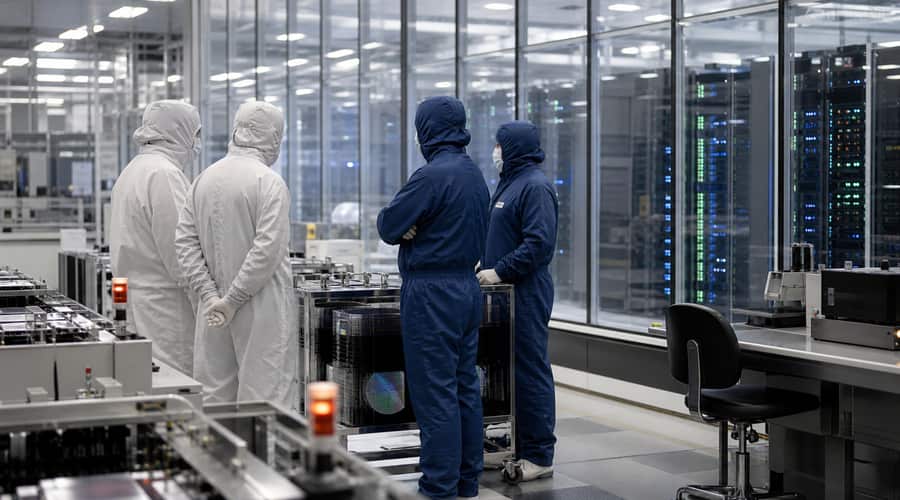
Samsung's strike threat is not just a labor story. It is a reminder that AI infrastructure depends on factories, workers, and stable supply chains as much as it depends on chips.
Samsung Electronics is facing one of its biggest labor tests in years, and the market is already treating it as a supply chain risk. The company's shares came under pressure after talks with its largest union failed, leaving an 18-day strike scheduled to begin on May 21 if no last-minute deal is reached.
That matters well beyond Seoul. Samsung is the world's largest memory chipmaker, and the dispute sits right on top of the AI boom that has tightened demand for high-bandwidth memory and other advanced chips. When workers at a company this central threaten to stop production, the shock does not stay inside one factory. It ripples through server makers, cloud providers, and startups already running close to the edge on compute availability.
The core disagreement is straightforward, even if the numbers are large. The union wants performance bonuses tied more directly to the semiconductor division's operating profit, including a demand for payouts equal to 15% of that profit and an end to limits on bonus awards. Samsung has offered a different structure, but the sides have not bridged the gap. Reuters reported that more than 45,000 workers are threatening to take part in the walkout, while Korean reports have put possible participation around 50,000.
The dispute has also moved from warning sign to operational issue. Korean media reported on May 15 that Samsung had begun slowing parts of chip production ahead of the planned strike, including reducing new wafer input and prioritizing higher-value products. That does not mean the worst-case scenario has arrived. It does mean customers and investors no longer have to imagine disruption as a theoretical risk.
For founders, the important point is not the wage formula. It is the reminder that compute scarcity is not only a question of chip design or raw wafer capacity. It is also a question of labor stability, political pressure, and how concentrated the supply base has become. A single disruption at a dominant memory supplier can quickly turn into delayed deliveries, rising prices, and worse terms for smaller buyers who have the least leverage.
The AI industry has spent the past two years talking about GPU shortages as if supply risk was mainly a hyperscaler problem. That is too narrow. Modern AI hardware depends on a long chain of memory, packaging, testing, substrate production, and assembly, and Samsung sits near the center of that stack. If output slows, the impact is felt not just in finished chips, but in the timing and cost of the systems built around them.
Analysts have warned that a prolonged shutdown could carry losses in the tens of billions of dollars, although the final damage would depend on how many workers participate and which production lines are affected. Even a shorter strike could unsettle customer confidence. That matters because startups trying to secure hardware, financing, and deployment schedules at the same time have very little room for surprises.
That is why this dispute should be read as an early warning. AI startups that assume the only risk is access to GPUs are already behind. The more realistic risk is a set of overlapping bottlenecks, where labor unrest, export controls, factory concentration, and one bad quarter at a critical supplier all hit the same runway.
How founders can hedge the risk
The first answer is boring, but necessary: diversify suppliers before the market forces you to. Founders building inference appliances, AI servers, or edge hardware need more than one path for memory, boards, packaging, and final assembly. That does not mean every component can be swapped instantly. It means designing procurement around optionality so a single factory does not become a single point of failure.
The second answer is commercial discipline. If a startup depends on a narrow set of components, it should treat capacity reservations, longer lead times, and inventory buffers as part of product strategy, not back-office logistics. Samsung's labor dispute shows how quickly a stable relationship can become fragile. A founder who waits until a strike, export restriction, or shutdown has already started has waited too long.
The third answer is to think beyond traditional hardware sourcing. Some teams are already exploring alternative chipmakers, regional manufacturing partners, and decentralized compute networks to reduce dependence on one channel. Those options are not perfect substitutes for top-tier memory or training hardware, but they can buy time, preserve runway, and keep customer commitments intact when the primary supply line wobbles.
The broader lesson is simple. AI infrastructure is entering a more physical phase of the cycle, where labor negotiations can matter as much as model benchmarks. The companies that survive the next supply shock will not be the ones that expected perfect continuity. They will be the ones that planned for disruption before it arrived.
Also read: How Subnautica 2's explosive launch teaches indie founders to match audience and architecture • SpaceX is testing a founder-first model as Musk tightens control ahead of IPO • Palantir's SaaS is dead claim is a warning shot for founders